Monday, March 31, 2008

The Woolworth Building

Minnesota architect Cass Gilbert (1859-1934) designed several important buildings for 20th century New York. The Alexander Hamilton U.S. Custom House (1902-1907) at 1 Bowling Green, his first big commission, is a lavish Beaux Arts- style masterpiece. The New York Life Building (1926-28) is a massive building that blends neo-Gothic with the geometries of more modern 1920s structures.

He designed the Allen Memorial Art Museum at Oberlin College, where I spent my undergraduate years, and also buildings for the campus of The University of Texas in Austin, including Battle Hall (1911), a Spanish-Mediterranean Revival building that houses the architecture library and is considered one of the best structures in Texas. I only bring this up because I spent many pleasurable hours inside Battle Hall researching my master's thesis on the American skyscraper. I remember how I would sometimes look up from my books and gaze at the windows and ceiling and thinking about wanting to live in such a place.

The Woolworth Building at 233 Broadway, the tallest building in the world when it was built in 1913, annoyed some modernist architects for its neo-Gothic ornamentation and bothered others for just being so tall. It was impressive for its design and engineering, with the steel frame skeleton supported by enormous caissons driven deep into the earth. The elevators were faster and more plentiful than in other buildings at the time, a profitable factor that Frank Woolworth appreciated for his "cathedral of commerce."

This morning I walked south through Soho on Mercer Street until Canal, walked a block east and then continued south on Broadway until I reached the Woolworth Building. I sat in City Hall Park across the way and looked at the building for some time. The neo-Gothicism lends the building the ecclesiastical aura, but there's little doubt of its secular intent as permanent outdoor advertising. What it doesn't look like at all, interestingly, is a Woolworth store.

The Woolworth Building hovers in my field of vision whenever I walk through downtown, and I've started to invest in it spiritual meaning and power. Maybe angels hang out up there, like the ones dressed in trench coats in Wim Wenders' Wings of Desire.

Image: The Woolworth Building, 233 Broadway.

See nearby places in Tribeca:
Establishing Shots: The Tribeca Film Festival
The Tribeca of Duane: Duane Street and Duane Park
Tribeca Living: A Building for Chocolate, and One for the Wool Trade
In Search of the Lower West Side: Before Tribeca
Walking Off Tribeca and Remembering Mostly Lunch
Walking Off Tribeca: The Lay of the Land
Walking Off Tribeca: Starting at Square One

Sunday, March 30, 2008

Scenes from a Film Symposium: Orphans 6


The first several slides would suggest that the participants in the Orphan Film Symposium, March 26-29, 2008 at NYU, were more interested in food and drink than films, but most of the images that follow reveal their true passion.

Today is my day for naps, pizza, and college basketball. As a sophisticated flâneuse, I sometimes need a time-out.

T.O., baby! Texas is out.

Walking Off the Big Apple will return to the streets tomorrow.

(see previous posts for more on the Orphan Film Symposium.) Photos in slideshow by Walking Off the Big Apple. March 2008.

Friday, March 28, 2008

Orphan Film Symposium: Moving Orphans, Itinerant Filmmakers, and Pancho Villa

Last night at the Orphan Film Symposium, we gathered for dinner inside the historic Judson Memorial Church on Washington Square South. Making the most of the "on location" feel for the symposium, most of the events take place in and around Washington Square Park.

Ever since it was announced that the symposium was moving to New York, some people worried that the southern grit flair established in South Carolina for so long would be lost in translation. I worried about this myself, but on balance, just after the opening couple of days, I don't think there's anything to worry about now. Wednesday night's tribute to the late Helen Hill, a native of Columbia, South Carolina, and with it, the presence of family and friends from South Carolina, made an effective and moving transition for the symposium's segue to New York. In addition, the friendly humor that developed among earlier participants is still alive and well here, and maybe even funnier. The food is still good, and all the films are remarkable.

Last night I attended Mexican filmmaker Gregorio Rocha's presentation and screening of the restored La Venganza de Pancho Villa (ca. 1930-34) by itinerant filmmakers, Felix and Edmundo Padilla. Rocha's discovery of the famous lost reels of Pancho Villa in the archives at the University of Texas at El Paso was a breaking news story announced at the second symposium in 2001. The Padillas, operating as itinerant filmmakers along the US-Mexican border, put together this thrilling tale, combining fictional recreations with actual footage of the real Villa and his army.

Growing up in Texas and living in Austin, I met several Texans from the border area who had their own stories of Villa's raids on their ancestors' haciendas. They couldn't decide if they loved Pancho Villa or loathed him (their grandparents hated him), and the film that Gregorio showed the audience was equally ambiguous.

I've spent most of the day running errands - buying flowers, beverages, cheese and crackers, all with the aim of hostessing the orphanistas, as we are known, with le know-how, the French translation for je-ne-sais-quoi.

Images: above, gathering for dinner at the Judson Memorial Church, and below, flowers at W. 3rd and Thompson St. I brought home the red carnations.

For more on Gregorio Rocha's Pancho Villa, please see the related post at the Orphan Film Symposium blog.

Thursday, March 27, 2008

Orphan Film Symposium: The 1961 Folk Singer Protest in Washington Square Park, and Emile de Antonio's America


At the beginning of each Orphan Film Symposium, I like to scan the schedule and make note of the films I can't miss. The registered participants see all the films together as well as talk over organized lunches and dinners. The screenings start in the morning and continue through the evening, so the collective experience is intense. Though I take care of minor behind-the-scenes tasks, I like to attend most of the screenings.

I put today's early afternoon session at the top of my list – films that documented protests held in Washington Square Park in the 1960s, and a couple of presentations on maverick documentary filmmaker Emile de Antonio.

Dan Drasin was a burgeoning 18-year-old filmmaker when he took his cameras and some black and white film to document a protest by folk singers in Washington Square Park in 1961. Reacting to the passage of an ordinance that prohibited singing in the park (folk singers attract unsavory elements, don't you now?), the active folk music community brought guitars to the park and sang songs of freedom. After the singers dispersed, policemen beat up some of the spectators. Drasin's 17-minute film captures that gritty determination of New Yorkers at the beginning of the 1960s, and many consider Sunday to be the first protest film of the 1960s.

Other films from the session included selections of footage shot in Washington Square Park from 1966 by Bob Parent, an artist known mostly as a still photographer, and an NYU surveillance film from 1968 of students protesting Dow Chemical's role in the Vietnam War. Ross Lipman (UCLA) presented a PowerPoint show on the restoration of Emile de Antonio's Point of Order (1963), focusing much on the usage of the word "spectacle."

Andrew Lampert of the Anthology Film Archives recently found a 1967 interview with de Antonio filmed in Leipzig, Germany. With Point of Order, his edited film of the 1954 Army-McCarthy televised hearings, De Antonio explains that he didn't set out to make a movie about his opposition to Sen. Joe McCarthy but to make a movie about the aspects of America that created the conditions for McCarthyism. De Antonio, by the way, promoted and distributed Drasin's Sunday protest film.

After sitting in the dark film theater and seeing the sights and hearing the sounds of Washington Square Park in the 1960s, walking back through the same park in the rain on my way home was a bittersweet experience. The fountain area is torn up now as part of an extensive multi-year renovation. The sincere voices and strumming that accompanied the well-preserved black-and-white moving images of protest seemed fresh, but the sounds of "This land is your land, This land is my land" grew faint as I looked around the park in it's current state of disruption. I am full of hope, however, that variations on these melodies will return one day back in full force.

Images: above, NYU surveillance film of Dow Chemical protesters; below: de Antonio.

Orphan Film Symposium, Explanation of "Orphan Widow," and Keynote Address

Orphans 6 (Orphan Film Symposium, 6th iteration) kicked off officially this morning in the Cantor Film Center. Richard Allen, the Chair of NYU Cinema Studies, introduced organizer and faculty member Dan Streible by saying all kinds of nice things about him, including holding up Streible's new book, Fight Pictures, and reading passages from Charles Musser's introduction. If you've been following along in previous posts, I am Streible's spouse, and I am sometimes known as the "orphan widow."

Because Streible spends an unreal amount of time preparing for Orphan events, I came up with this witticism to describe my status. I'm actually listed in the official program that way. I really haven't felt much like the widow at all for Orphans 6, however, probably because he's often at home and on the computer, and I'm also at the keyboards, blogging half the day. We spend quality time at home sitting on the couch with our laptops and watching TV at the same time.

Back to the symposium. The first bit of orphan film was from the University of South Carolina's Fox Movietone Newsreel collection and was footage from 1929 showing sights and sounds of New York's Radio Row (Wikipedia entry). The camera caught the action of the neighborhood from the top of a truck, showing the streetscapes and people in this once vibrant section of the Lower West Side.

Paolo Cherchi Usai's keynote address focused on the dilemmas facing state-run media archives, and as he spoke, he showed us a silent film from the National Film and Sound Archive in Australia. I'm not sure what year the film was made, but it was some sort of older instructional film to show the evolution of animals as upright walking creatures. The film opened with crawling, low-riding animals such as alligators and moved up to primates. The shocker came at the end, with a humiliating racist depiction of indigenous Australians. After the film concluded, Usai pointed out that the film was at at one point "de-acquisitioned," or "orphaned, but it's now back in the archive's collection. The larger issue, he explained, was the potential for all of cinema history, as film, to become orphaned in the digital age.

Image: early arrivals, Orphan Film Symposium, Thursday morning, March 27, 2008.

Openings and Overtures: The Orphan Film Symposium

Yesterday's weather of warming temperatures, clear skies, and abundant sunshine in New York provided clear sailing for the arrival of guests at the Orphan Film Symposium. The twilight that followed provided a stunning glow for the opening reception. Here you see the celebrated film accompanist, Dennis James, providing the sounds. The skyline, even more glamorous than usual, made a too perfect backdrop for a conference devoted to film.

I had a great time at the reception. I saw many friends I haven't seen since Orphans 5, and I introduce several people to one another. In point of fact, I think this is my most important role in the symposium. Making new friends, discovering new potential colleagues, and establishing the groundwork for future relationships is what it's all about. After the reception, the participants strolled across Washington Square Park toward NYU's Cantor Film Center to take their places for opening remarks and the special tribute night for the films of Helen Hill.

The evening screenings at the film center kicked off with imaginative Bill Morrison's special trailer for Orphans 6. Created in his signature style, one that calls attention to the frailties and beauties of the material of film, the trailer incorporated clips from upcoming screenings that showed people arriving at a new place - debarking from airplanes and so forth. While watching the extraordinary short animated films of Helen Hill that followed, I continued to be moved by how her vision was so innovative, loving, avant-garde and full of childlike wonder. No one else I know can be described as a cutting-edge and experiment saint, and so, she is sorely missed.

Image: March 26, 2008. Dennis James at the piano. New York, New York. by Walking Off the Big Apple.

More about orphan films at Wikipedia entry.

Wednesday, March 26, 2008

Preparing for the Orphan Film Symposium

As I've hinted in previous posts, I've set aside the regular agenda for Walking Off the Big Apple this week in order to make myself useful as the spouse of the organizer of a film symposium. This usefulness should last only through Sunday morning. Then I can return to my normal life as the peripatetic and useless bride, back out on the streets of Gotham in search of art and culture and in denial about any pressing needs at the grocery store.

The Orphan Film Symposium (official site), a biannual gathering of film scholars, film archivists, filmmakers, film restorers, and other filmic professionals, began in 1999 at the University of South Carolina. Designed to heighten awareness and improve preservation of previously neglected moving images such as home movies, industrial films, and educational films, the symposium grew in size and stature over the years. Dan Streible, the founder and animating impressario, now teaches at NYU, and the symposium will be held in NYC for the first time. Streible, a native of Louisville, Kentucky, was given the honorary distinction of "colonel" by the Commonwealth of Kentucky when he was 14 years old. The plaque hangs on our dining room wall. I took the framed decree down off the wall the other day to show someone, because the person seemed surprised by the whole thing.

I plan to write as many posts as possible about what transpires over the course of the next few days. The event begins tonight with a tribute to Helen Hill, a gifted filmmaker who was tragically killed in post-Katrina New Orleans. I will see several of the films tonight and during the next few days, but my main duty is to smile, run interference, and procure enough food and beverages for any sort of party. Over 300 people are registered for the symposium, with 18 countries represented. Fortunately, they're not all staying with us. My postings should provide an unusual perspective, given that I'm on the edges as a participant. I will have to break away from the proceedings at times so I can walk the dogs.

This morning I picked up the fine art prints of the posters for the symposium. I designed them. My artist friend in Tribeca did a great job printing them, and I think they look really good.

Tuesday, March 25, 2008

Attention, Soho Shoppers

There's a special on the block on Broadway between Prince and Spring.

This afternoon, after raking through the closet, I decided it was time for a little early spring clothes shopping. Walking into the bright sunshine and down Broadway, I'm always a little stunned by the shopping hordes. After spending a long time by myself indoors, the mass of people on New York streets makes me think that something out of the ordinary has taken place. "What's going on?", I sometimes ask myself. In fact, nothing out of the ordinary, just the circumstances of my life now plopped down in the midst of one of the world's shopping meccas.

I'm an anxious shopper. I usually pick one store along a favorite stretch of Broadway, find several items that I think I can live with, and then turn around and go home. Late March is tricky for the seasonal transition, so I selected a few cashmere sweaters in pastel colors and called it a day.

Many of the women out on the streets were still wearing jeans stuffed into their fur-lined boots. The overall effect, and it's been like this for years, is that the most fashionable New York women dress like Davy Crockett, king of the wild countree-ee-ee.

(See also the popular post from the Christmas season, Shopping in SoHo Without Euros, for my list of shopping favorites.)

Tomorrow, follow along as I shop for party snacks, beverages, and flowers, and the behind-the-scenes preparations for 300 out-of-town visitors. A regular Mrs. Dalloway (site map by E.K. Sparks, Clemson University, October 2002), I am.

Monday, March 24, 2008

Checklist for a Busy Week: Hair Stylist, Canal Street, a Film Symposium


The events of the upcoming week can conspire to do me in, but I'm assembling forces of angels to help me out. Beginning this Wednesday, my spouse (a.k.a. the colonel) will host 300 people at a nearby venue for a film symposium. This symposium, not a festival, is a biannual event, and I've gone through this very fun and enlightening experience/trial-by-fire five times in a previous life. This is the first of such events in New York.

Strangely, I am calm. I've made a list of tasks, accounted for surprises, and organized my life to account for crises. I carry my passport and a credit card with me at all times, so if any day gets too much, there's always New Zealand.

1. Haircut. Before friends arrive, I go see Jason Razorcuthands, my hair stylist in Soho. He gives me the extra flair I need as well as any updates on where to eat fried okra in the city. He also knows that the hair I wake up with in the morning will pretty much look like the hair I'm wearing all day, so he cuts it that way. He's a celebrity stylist and knows how to talk to me.

2. Passport picture. I had to get a new passport picture for something I can't talk about right now (not New Zealand), so I asked a good friend/artist/graphic designer/printmaker/Tribeca pioneer to take it for me. I passed through Soho streets to see her south of Canal.

3. Pashmina. Coming back home north from Tribeca and into the Square above Canal (Squabca, my new name for Soho, suddenly), I looked at a new scarf long enough for the merchant to lower the price.

4. Walking dogs. All days include a walk to the park with loving canines. One of my two best friends, I noticed, is turning into a hairy beast of the forest and needs to see her own stylist. Wouldn't you know, in my neighborhood, that her haircut would cost more than mine?

Sunday, March 23, 2008

Curious Slideshow from Easter Brunch


This Easter Sunday, we met friends for a casual brunch at a restaurant on Greenwich Avenue. We had a lot of catching up to do. As they're good friends, they didn't seem to mind too much that I started playing with the plastic animals that the restaurant festively floats in many of the drinks. I put my camera directly on the table, cut the flash and pointed in various directions. I thought these images weirdly cool enough to pass along. Watch for one of the friends checking his watch.

Saturday, March 22, 2008

Letter to the Editor from a Visitor in Need of Art Tourist Therapy

Readers, I have interrupted my Easter recess in order to address the pressing needs of an art-crazed reader who plans to visit New York in the coming week. As her predicament is shared by so many, I feel a little visit to WOTBA's armchair psychoanalyst's office, to follow, is in order and should help others.

Dear WOTBA,

I need your help. I'm a big WOTBA fan who is lucky enough to be coming to town next week for a most amazing, one-of-a-kind gathering of people in my field and several related ones. So what's the problem? As a long-time resident of a sleepy "mid-sized city" in a decidedly rural state who hasn't been to NYC in waaaaay too long I'm hungry for all it has to offer; but I also have many reasons to want to attend as much of said "one-of-a-kind-gathering" as I can--it's that unusual multi-day Event where you really don't want to miss a single thing. I'm fairly sure I can squeeze in a fair bit of fab food, chocolate, and walking around (at least round and about the location of the Event). But usually my most favorite thing about coming to NYC is art: MOMA on day 1, Whitney day 2, and so on.

So, my question: to a visual art lovin' out of towner who could only steal away for one or two art trips before or after said fabulous Event that she is otherwise committed to fully participating in, what would be your top picks of what's hangin' now, this week? If anything immediately comes to mind ("You MUST see..."), I want to know. Also, if it's useful, I'm a huge fan of color, paint, collage, 20th & 21st century America, video/screen art, people (figures, psyches, smart/feminist domestic stuff, etc.), design....I'll leave it at that for now. Obviously I can't WAIT for your review of the Biennial. Also curious if you've seen that 70s show at MOMA, their Color show, or the car bombing installation at the Guggenheim. Once I start looking around I see days worth of interesting stuff, and I really only have time for hours worth.

Sorry to run long to ask a simple question. I just know you're the PERFECT person to answer it, which in itself makes it pretty exciting to ask. :)) Mucho thanks in advance for any thoughts, links, etc.

Warmly,

DTCBAHP
[Dedicated to a Cause But Also Hungry for Paint]

PS Do you crave anything from a mid-sized city in a rural state well below yours that you can't get up there? I would be very happy to toss something in my suitcase for WOTBA or the Colonel!!


Dear DTCBAHP,

Thank you for your kind words. I have been watching the television psychoanalyst Paul Weston shell out advice every weekday night on the HBO series, In Treatment, and, therefore, I know how to help you make the breakthrough that you need. In addition, a few months ago, while walking in Central Park, I passed the actress Dianne Wiest out walking her dogs. I feel I can be your Gina.

To begin, though I am concerned with your use of the word "waaaaay," I find your punctuation excellent. You should consider a career as an English professor.

Let's move on. You seem to be saying...what I hear you saying...is that you are faced with too many choices for your art-viewing hobby while visiting New York next week. Let me assure you that this is a common problem that visitors face all the time. Many squander their opportunities by skipping the art altogether, and as a way to cope with their anxiety, decide to visit my neighborhood and get drunk.

I also hear you saying that you would like me to make recommendations for you. But as I've learned on TV, a therapist should not make decisions for you, like deciding to skip the Whitney Biennial. That's up to you. It's also not my place to tell you to go to see the worthwhile exhibits, Color Chart and Design and the Elastic Mind, at MoMA or the exciting Cai Guo-Qiang exhibit (which you disturbingly call "the car bombing installation," and we'll have to talk about that. Otherwise, I think you're fine) at the Guggenheim. Two venues is enough, and you should not feel guilty that you did not see every new painting, assemblage, or documentary in New York in the space of five days.

Best,
WOTBA

PS You could bring me some Moon Pies.

Image: WOTBA's therapy chair is often claimed by an overweight fox terrier.

Wednesday, March 19, 2008

The Rain on Bleecker Street


"I've stumbled on the side of twelve misty mountains
I've walked and I've crawled on six crooked highways
I've stepped in the middle of seven sad forests..."*

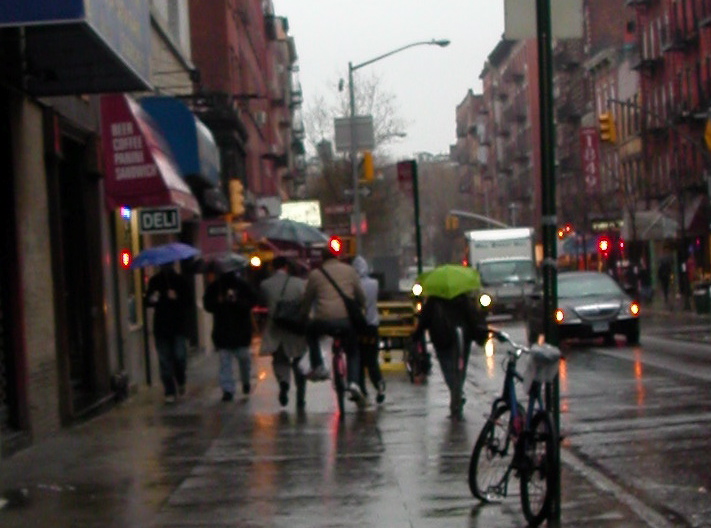
A writing assignment, the kind with a deadline, and a steady rain kept me indoors for most of the day. The elements conspired to make me focus on the task at hand, but I started suffering from cabin fever at dusk. Needing to get out, I wandered down Bleecker Street just to stretch my legs. I have come to depend on my desire to move through time and space.

A few people were out and about. I saw one woman with a green umbrella using a pay phone at the corner of Bleecker and Sullivan and another woman with a pink umbrella walking along and chatting with a guy in a hat. At one point several people converged under a canopy of their respective umbrellas. I can't tell too many details in weather like this. Everything becomes a little blurry.

* Bob Dylan wrote "A Hard Rain's Gonna Fall" in a basement apartment at 158 Bleecker St.

Blurry image from March 19, 2008. Bleecker Street. Walking Off the Big Apple. Greenwich Village. New York, New York.

Tuesday, March 18, 2008

Diversion: Hot Chocolate with Melting Peeps, and Easter Treats in the Big City

Everyone I've talked to agrees that Easter is too early this year. Not that we can help it. St. Patrick's Day and Easter in the same week is wrong. The presence of two parades of that magnitude in New York City in the same week is wrong.

With the winter chill still lingering, wool coat collars turned up against the wind, I'm not feeling appropriately pastel. I'm willing, nevertheless, to make the best of the situation at hand. In that spirit, I decided that nothing would be better this afternoon than a winter cup of hot chocolate with a couple of melting yellow Peeps.

It's prettier and tastier than I imagined, and the Peeps looked sweet during their final sleep of drowning chocolate death.


Edible Easter Creations in the City

In strolling about the city, I've taken note of some of the fine Easter creations of lower Manhattan's bakeries and chocolate artists. Among them (with links):

Jacques Torres (350 Hudson at King St. and285 Amsterdam Ave at 73rd St.) features chocolate-covered Peeps in milk or dark chocolate.

Duane Park Patisserie (179 Duane St.) makes pretty Easter baskets out of chocolate.

Vosges (132 Spring St.), always edgy in chocolate land, offers Easter Bunny hat boxes with caramels, 1 Red Fire Bunny, 1 Barcelona Bunny & ½ lb Bapchi's Caramel. Or go for the flying pig made out of a chocolate-bacon blend. Hmmm....

I recommend MarieBelle's Aztec Hot Chocolate for at-home science projects involving melting Peeps. 484 Broome St.

Image: melting Peeps in hot chocolate. Walking Off the Big Apple, at home in her kitchen, somewhere in the free Republic of Greenwich Village. March 18, 2008.

Establishing Shots: The Tribeca Film Festival & 2008 Festival Highlights


"Loneliness has followed me my whole life, everywhere. In bars, in cars, sidewalks, stores, everywhere. There's no escape. I'm God's lonely man."- Travis Bickle, Taxi Driver (1976)

After the attacks of September 11, life in lower Manhattan took a long time to recover. The neighborhood of Tribeca, just north of the WTC site, had already become an attractive destination for artists and families, but after the shocking events of that day potential new residents grew cautious. Area businesses suffered as streets were blocked to traffic, and only residents or those on official business could pass through checkpoints.

Actor Robert De Niro joined with producer Jane Rosenthal and her spouse, the philanthropist and writer Craig Hatkoff, to found the Tribeca Film Festival as a way to help filmmakers in New York and, specifically, to spur the economic recovery of lower Manhattan. Even before the September 11 attacks the three had invested money in the Tribeca neighborhood.

The Tribeca Film Festival, which will take place April 23 -May 4, 2008, continues to grow each year and generate millions of dollars in economic activity for the city.

The festival has just released the lineup for this year's festival, and I've started making a list of features that I would enjoy seeing.

Spotlight Section:

• Lou Reed’s Berlin, directed by Julian Schnabel. (USA) - New York Premiere, Documentary. I failed to get tickets for Reed's 2006 Berlin performance at St. Ann's Warehouse in Brooklyn, so I'm glad Julian was there.

• My Winnipeg, directed by Guy Maddin, written by George Toles and Maddin. (Canada) - Premiere, Narrative. The imaginative Canadian filmmaker turns his attention to his hometown.

• Man On Wire, directed by James Marsh. (UK) - New York Premiere, Documentary. French daredevil Philippe Petit's tightrope walk between the Twin Towers on August 7, 1974.

• The Universe of Keith Haring, directed by Christina Clausen. (Italy, France) - Premiere, Documentary.

Special Screenings:

• Empire II, directed by Amos Poe. (USA) - North American Premiere, Documentary. 3-hour film about the magic of NYC.

• Once Upon a Time in the West (C'era una volta il West), directed by Sergio Leone, written by Sergio Donati and Leone, English dialogue by Mickey Knox. (Italy, USA, 1968) - New York Premiere Restoration. My spouse saw this a few weeks ago at the Miami Film Festival and thought it truly beautiful.

Discovery (emerging filmmakers):

• Paraiso Travel, directed and written by Simon Brand. International Premiere, Narrative. Colombians illegally travel from Medellín to New York and find romantic drama.

• Waiting For Hockney, directed by Julie Checkoway. World Premiere, Documentary. Aspiring artist Billy Pappas spent 10 years painting his masterpiece in his parents' attic and needs to show it to David Hockney.

The Wild Man of the Navidad (link to Shoe Leather, my blog for Reframe), directed and written by Duane Graves and Justin Meeks. World Premiere, Narrative. An urban legend in Texas about a community frightened by a creature in the woods.

Tribeca Film Festival website

Image above by Walking Off the Big Apple

See related Tribeca posts:
The Woolworth Building
The Tribeca of Duane: Duane Street and Duane Park
Tribeca's Most Tripped-Out Vista
Tribeca Living: A Building for Chocolate, and One for the Wool Trade
In Search of the Lower West Side: Before Tribeca
Walking Off Tribeca and Remembering Mostly Lunch
Walking Off Tribeca: The Lay of the Land
Walking Off Tribeca: Starting at Square One

Monday, March 17, 2008

The Tribeca of Duane: Duane Street and Duane Park

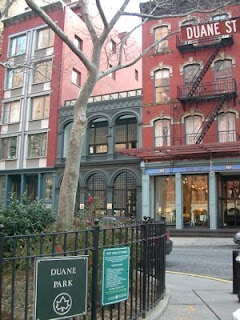
On my walks through Tribeca last week, I found that my head and feet propelled me toward Duane Park, whether I liked it or not. This particular triangular streetscape, with its little well-groomed island of a park in the center of the confluence of two streets, seems so pretty that there must be something amiss.

This section of Duane Street between Hudson and Greenwich is so sweet that when the weather warms up I want to bring back my set of portable watercolors to paint the scene. It's a quiet movie set of a place with a museum-like quality, reminding me that Tribeca recovered from its shell-shocked days after September 11 by becoming the home for the Tribeca Film Festival.

Not many people roam the streets. While visiting during the day, I've shared the street and park with a handful of people. A few fathers with children, nannies with babies in strollers, and a couple of twenty-somethings by themselves wandered about, most stepping into the welcoming Duane Street Patisserie for coffee and a treat.

The buildings that line the north and south sides of Duane Park represent various styles of architecture popular in the 19th century - neo-Renaissance, Romanesque Revival, Queen Anne, Federal, neo-grec, etc. Importantly, for the overall pleasant effect, these five or six-storied buildings conform to human scale. The exception of scale belongs to the former Western Union building at 60 Hudson St, a massive Art Deco monument that looms over the park like a mean nanny. It's a clean street and a neo-urbanist dream of mixed-use development, except for a mixture of social class.

Given Tribeca's status as one of the city's wealthiest zip codes and Duane Park well-kept by the lucky neighbors, I feel I've intruded just a bit by being here, cautiously stepping into someone else's yard. I'm paranoid. Nevertheless, I've come across so many references in the contemporary literature of New York about the city's decaying sense of place* that this idea of New York-as-Museum-of-Its-Former-Self has started to color my vision, too. Maybe that's why I want to go back to Duane Park with a set of watercolors.

*For more on this emerging theme, read Walter Kirn's excellent review of Richard Price's novel, Lush Life, in the New York Times Book section from Sunday, March 16. Price's novel evokes the changes on the Lower East Side.

Image: The Tribeca of Duane by Walking Off the Big Apple.

See related posts:
The Woolworth Building
Establishing Shots: The Tribeca Film Festival
Tribeca's Most Tripped-Out Vista
Tribeca Living: A Building for Chocolate, and One for the Wool Trade
In Search of the Lower West Side: Before Tribeca
Walking Off Tribeca and Remembering Mostly Lunch
Walking Off Tribeca: The Lay of the Land
Walking Off Tribeca: Starting at Square One

Friday, March 14, 2008

Tribeca's Most Tripped-Out Vista


Whoa...

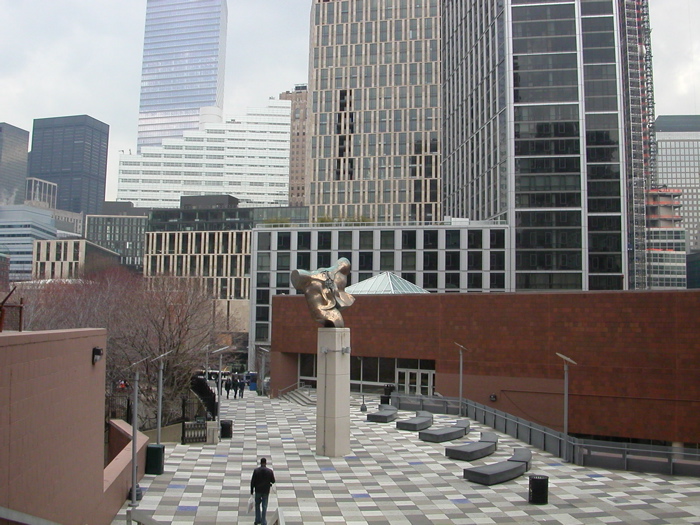
This afternoon, after spending most of my time wandering Tribeca's pretty cobbled streets and looking at nineteenth century manufacturing buildings, I walked west on Duane Street, through Washington Market Park and then up the steps of the Borough of Manhattan Community College.

When I turned around to walk down the steps this vista stopped me in my tracks. The patterned squares of the college's plaza below and the differing rectangular-patterned windows of the tall office buildings in the distance almost made me lose my balance. The sculpture in the middle is perfectly sited and humanizes what could be a frightening glimpse of modernity gone wrong. Instead, modernism looks exciting from these steps.

Image: by Walking Off the Big Apple, March 14, 2008.

See related posts:
The Woolworth Building
Establishing Shots: The Tribeca Film Festival
The Tribeca of Duane: Duane Street and Duane Park
Tribeca Living: A Building for Chocolate, and One for the Wool Trade
In Search of the Lower West Side: Before Tribeca
Walking Off Tribeca and Remembering Mostly Lunch
Walking Off Tribeca: The Lay of the Land
Walking Off Tribeca: Starting at Square One

Thursday, March 13, 2008

Tribeca Living: A Building for Chocolate and One for the Wool Trade

The Powell Building (1892) at 105 Hudson Street (at Franklin St.), shown on the left, was designed by Carrere & Hastings, the architects of the New York Public Library at Fifth Avenue and 42nd Street and the Frick mansion, among other others. In 1890, Henry L. Pierce, the head of a chocolate company in Massachusetts, wanted a nice building for his company, a step up from the plain vanilla of industrial architecture. Hence, this elegant Beaux Arts-style building.

After Pierce died his estate sold the building to candy manufacturer Alexander Powell who, in turn, hired his architect to enlarge the building and add stories. In the 1970s the building's higher floors were converted into residences. The Japanese restaurant Nobu (restaurant website) is on the first floor, in the same place that Powell once displayed his chocolates.

The Renaissance revival building at 260 West Broadway (at Beach St.), its curved entrance shown on the right, was built as the New York Wool Exchange in 1894-96. The wilier wool traders of New York hoped to trump the wool traders of Boston with such an edifice, but the scheme never worked. In 1907 the American Thread Company took over the building, and since the 1920s it's been known by that name. Now, not surprisingly, the building is operated as a condominium.

Images by Walking Off the Big Apple. Part of the series, Walking Off Tribeca.

For those in search of chocolate and were disappointed reading this post, please see Wee Willy WOTBA's Downtown Chocolate Walk, for chocolate locations north of Tribeca.

See related posts:
The Woolworth Building
Establishing Shots: The Tribeca Film Festival
The Tribeca of Duane: Duane Street and Duane Park
Tribeca's Most Tripped-Out Vista
In Search of the Lower West Side: Before Tribeca
Walking Off Tribeca and Remembering Mostly Lunch
Walking Off Tribeca: The Lay of the Land
Walking Off Tribeca: Starting at Square One

Walking News Digest: Prevention's Top Walking Cities, Brits Hurt Themselves While Walking, and Electronic Walking Stick

A few newsworthy items to pass along:

Prevention Magazine Selects New York City as #2 Best Walking City. The college town known as Cambridge, MA comes in at the number one spot. Why? Beats me! Must be the work of Red Sox and Patriots fans. See the feature story here.
• Related story: Residents of Gadsden, Alabama, a city that ranked low on the list, are not surprised and a little ashamed. Gladsden Times.

Brits Slamming Into Posts While Text-messaging May be Fiction. Network World, a website located in the New World, is skeptical of news reports in the British press that 1 in 10 Brits hurt themselves while walking and texting at the same time. Skepticism and links here.

Electronic Walking Sticks May Not Be Totally Useful. Coolest Gadgets.com reviews the Tactile Wand Electronic Stick. The device uses a sensor to detect objects in front of one. The reviewer wonders if the stick can detect other potential walking hazards, "such as an open elevator shaft." See review here.

Image: Giants fans walking through the lower section of Prevention Magazine's #2 walking city.

Wednesday, March 12, 2008

In Search of the Lower West Side: Before Tribeca

I've started to collect older guidebooks to New York so I can understand shifting perspectives on the city. Guides published in earlier decades provide an excellent window on how visitors understood New York as a place and also help me understand the psychogeography of the city's previous residents. When I wrote the extended posts on Greta Garbo's walks around her neighborhood near E. 52nd St., I read guidebooks published in the 1960s and 1970s to help me locate the places she would have likely visited.

No reference to Tribeca appears at all in the 1978 edition of the Michelin Green Guide for New York. The 1985 edition mentions the name "Tribeca " and explains the abbreviation. Michelin lists as its one attraction the Alternative Museum at 17 White Street, a downtown multimedia venue that now exists solely in cyberspace. The guide characterizes the area as a "neighborhood of old factories and warehouses which emerged as an artists' community in the 1970s." It was not until the mid-1980s that Tribeca started appearing on the marketable maps of the city. It was a dead zone in terms of a destination.

Not so in the Depression era. In the late 1930s, the area known as the Lower West Side was one the liveliest parts of the city. The fine WPA Guide to New York (Amazon, reprinted), published in 1939 as part of the Federal Writer's project, describes the neighborhood as pulsing with activity at all times of the day and night. Home to Washington Market, the largest fruit and market in the world, shippers, suppliers, and retailers crowded the Lower West Side to get the perishable goods quickly to their destination.

Beyond these activities, the WPA describes other businesses of the Lower West side, including fireworks dealers, a retail radio district, pet stores, ecclesiastical supply stores, and the enormous trading center for butter and eggs at the Mercantile Exchange at Hudson and Harrison. What particularly excited the imagination of the guide writers was the "Syrian Quarter" with its bakeries, pottery shops and restaurants. From the guide: "Although the fez has given way to the snap-brim, and the narghile* has been abandoned for cigarettes, the coffee houses and the tobacco and confectionary shops of the Levantines still remain."

Many of these older guide books inspire me to wander off in the city to see what remains in 2008. For my next foray into the Lower West Side I plan to take the 1939 WPA guide with me.

Image: New York Mercantile Exchange, 1886. Thomas R. Jackson, architect. 6 Harrison Street. Now condominiums.

*A hookah. Funny how things come back into fashion.

See related posts:
The Woolworth Building
Establishing Shots: The Tribeca Film Festival
The Tribeca of Duane: Duane Street and Duane Park
Tribeca's Most Tripped-Out Vista
Tribeca Living: A Building for Chocolate, and One for the Wool Trade
Walking Off Tribeca and Remembering Mostly Lunch
Walking Off Tribeca: The Lay of the Land
Walking Off Tribeca: Starting at Square One

Tuesday, March 11, 2008

Walking Off Tribeca and Remembering Mostly Lunch

When I returned from my long walk and lunch in Tribeca today, I felt over-stimulated but more tired than usual. Traveling can be both stimulating and exhausting at the same time. Beyond the physical demands of exploration, an encounter with new sources of stimuli can induce mental fatigue. Walking around unfamiliar streets takes more work than the ones you already know.

Some of my haphazard impressions of the day in Tribeca:

enjoying the facades of the buildings along White Street;
the glimpses of the Hudson River and all that blue;
Duane Street and its gentle and elegant restraint;
the jarring presence of neo-Brutalist towers juxtaposed with more human scale nineteenth-century buildings;
a painter putting the finishing touches on a propped-open door of Robert De Niro's not-yet-open Greenwich Hotel and catching a look at some of the fine detailing;
the eight-foot crater on Church Street where a water main blew this morning, and hundreds of city workers trying to fix it;
a flower market with seasonal tulips and hyacinths;
a wide and busy Church Street;
cell phone conversations, 90% of which were about Eliot Spitzer.

Mostly, I remember lunch. I didn't have a particular spot picked out in advance, and I walked around until I was hungry. The Cosmopolitan Cafe at 95 W. Broadway looked good. The cafe was intimate and well-decorated with tables close together and a selection of books lined against the wall. I chose a table in the back. I enjoyed the quiche of the day - spinach and gruyere, and it came with a nice salad with lemony dressing and a selection of fruit. Afterwards, the proprietor surprised me by placing a cup of hot chocolate and a plate with a ginger cookie on the table and saying it was their "treat."

After that gesture, I enjoyed the walk home, even if I'm too tired to remember anything now. I may live in Greenwich Village, but Tribeca seems far away.

Here's a find! A blog about food in Tribeca: Taste of Tribeca.
Website for the Cosmopolitan Hotel.

See related posts:
The Woolworth Building
Establishing Shots: The Tribeca Film Festival
The Tribeca of Duane: Duane Street and Duane Park
Tribeca's Most Tripped-Out Vista
Tribeca Living: A Building for Chocolate, and One for the Wool Trade
In Search of the Lower West Side: Before Tribeca
Walking Off Tribeca: The Lay of the Land
Walking Off Tribeca: Starting at Square One

Walking Off Tribeca: The Lay of the Land

One of the oldest sections of Manhattan and part of the Dutch colony of New Amsterdam, the area now know as Tribeca was originally a fruit and produce market, a shipping center, and a hub of the city's textile industry. Sprawling along the west side of Manhattan, from south of Canal to Vesey Street and the site of the World Trade Center, Tribeca extends from the Hudson River on the west to Broadway as its eastern boundary. The area got its name, an acronym for the TRIangle BElow CAnal, relatively recently.

View Larger Map The area's conversion from a shipping and manufacturing district to a residential neighborhood parallels the loft developments of the SoHo neighborhood to its north. The vast inside spaces of these buildings that once housed 19th century businesses have inspired the modern-day phenomenon of loft living. Where immigrants once worked for low pay, standing long hours spinning cotton on a loom, a wealthy family now lounges on high-end living room furniture, watching reality programming and cable news on a 58-inch wall-mounted plasma TV.

I'm walking through Tribeca this week to shake myself out of the comfort zone of my own neighborhood, to get some exercise, and explore new streets. Leaving my place in Greenwich Village and walking south to Tribeca, I pass through SoHo and its exceptional cast-iron architecture. Yesterday, I arrived at the Square Diner in Tribeca via West Broadway, a pretty street lined with many elegant galleries, fashion stores, and European-style restaurants.

I have a few places on my Tribeca agenda today. I want to see some of the 18th century houses on Harrison Street, and I need to go back to the little shop I saw yesterday on Beach Street that makes homemade Mexican tamales. Other than these stops, I like to leave much of my walk unscripted.

See related posts:
The Woolworth Building
Establishing Shots: The Tribeca Film Festival
The Tribeca of Duane: Duane Street and Duane Park
Tribeca's Most Tripped-Out Vista
Tribeca Living: A Building for Chocolate, and One for the Wool Trade
In Search of the Lower West Side: Before Tribeca
Walking Off Tribeca and Remembering Mostly Lunch
Walking Off Tribeca: Starting at Square One

Monday, March 10, 2008

Walking Off Tribeca: Starting at Square One

The Square Diner at the corner of Leonard and Varick in Tribeca smells of strong coffee and a hot griddle full of pancakes. Housed in one of the last authentic rail cars, with a ceiling of handsome wood paneling and a row of wide sliding windows facing the street, the diner is the kind of place you trust for breakfast and where catsup is comfortably within reach.

This morning, after I sat down in a booth in the Square Diner, I ordered the big breakfast to which many of us have grown accustomed - two eggs, bacon, toast, New York-style breakfast potatoes, and lots of coffee. The meal didn't disappoint, and while drinking the last cup of coffee I turned to look out the window to look at what was happening on the street.

Across the street I could see a little sliver of a park with a handful of trees. Finn Square, it's called, named for a hero of the Great War. To the left, I could see a handsome tall red brick building, and then beyond the park, a couple of buildings with Italianate facades along Franklin Street. Immediately across the street, trucks lined up in front of the non-descript ConEd facility. Over to the right, I watched the construction crews work on the steel skeleton of a new law school building, and just across the street from the diner, more workers digging the foundation for a new condominium development.

After leaving the Square Diner, I walked west on Franklin and then turned north on Greenwich Street. As I crossed the intersections heading home, I could see the bright blue sky and the Hudson River to the west. Along the street, many well-kept and renovated nineteenth century buildings, once storage facilities and the site of textile businesses, now house some of the most affluent residents of the city. As is the case for many sections of Manhattan, the building boom has not ceased in Tribeca for the city's new well-heeled class of global workers.

I don't know much about the lives or interests of these loftiest residents of Tribeca. I hope to find out more in the days ahead. But, at least for the start of my explorations, I've found a good place in this triangular neighborhood for a nice square breakfast.

Note: This is the first of a series of posts about the Tribeca neighborhood in lower Manhattan.

See related posts:
The Woolworth Building
Establishing Shots: The Tribeca Film Festival
The Tribeca of Duane: Duane Street and Duane Park
Tribeca's Most Tripped-Out Vista
Tribeca Living: A Building for Chocolate, and One for the Wool Trade
In Search of the Lower West Side: Before Tribeca
Walking Off Tribeca and Remembering Mostly Lunch
Walking Off Tribeca: The Lay of the Land

Saturday, March 8, 2008

Reflections on Reviewing Art and Culture in the Blogosphere

Google Alert! Here's a post with your name on it!

During the glamorous days of the New York theater on opening night, actors would head to a swell place like Sardi's after the performance to anxiously wait for the reviews. I imagine that during the wait, amidst a boozy haze of cigarette smoke and clinking glasses of scotch-on-the-rocks, one actor would breathlessly run in with the freshly printed early editions of the newspapers, and then someone at the table would start reading the reviews out loud to the assembled party.

Google Alert has now replaced the breathless actor as the delivery device. After posting an art review on this website, for example, I can then trace, thanks to common analytics programs, a "hit" from the location where the artist may live. I don't know for sure if it's the artist or his or her "people," but since I know that many art professionals have created Google Alerts for themselves, I think it's most likely the artist.

There have been occasions, after posting a review, when I can analytically deduce that only the artist has read the post. At these times, I regret not writing the review as a letter: "Dear Artist, I like your work, but I didn't care for the red thing in the corner."

Sorry. A good opening, but Clement Greenberg won't be seeing it.

While many artists protest that they don't pay attention to reviews, it's always good to have someone who takes notice. Many artists work hard all the time and particularly drive themselves hard to prepare for an opening. I walk around New York feeling frustrated that there are too many artists in search of one decent review.

I'm not talking about promotional puff pieces of two sentences with a picture. I'm talking a 500-word review with description, evaluation and interpretation, one that gives the reader a sense of the artist. Writing a real review is hard.

There's little method to my own madness. Sometimes, I will seek out a particular exhibit, but often it's one I've encountered by chance. Out of the zillions of exhibits, I select for review a handful that inspire me to write. That's how I felt with my recent reviews of Rosalind Solomon, Luc Tuymans, Macbeth, and Jasper Johns. And, in my case, I have other things on my blogging agenda. I have to keep walking.

While I've found some excellent examples of arts writing in new media, the blogosphere and the expansion of internet journalism has not yet produced a new golden age of art criticism, I'm afraid. It's very easy to write, "I ate pancakes this morning. Last night I went to the Whitney opening party. The tequila drinks were good. I just broke up with my boyfriend."

When blogging about art becomes as lucrative as blogging about blogging, this new golden age may come to pass. I can't wait.

Image: Man reading newspaper while waiting for streetcar. Streetcar station, Oklahoma City, Oklahoma. Russell Lee, photographer. Library of Congress, Prints & Photographs Division, FSA-OWI Collection, LC-USF33-012324-M3 DLC (b&w film nitrate neg.)

Friday, March 7, 2008

Coming Next Week: Walking Off Tribeca


For the next two weeks on Walking Off the Big Apple, beginning Monday, March 10 and continuing through Saturday, March 22, I am going to walk around and write about Tribeca. In the first of several focused guides on New York neighborhoods, I plan to write about the area's notable architecture, restaurants and diners, businesses, cultural venues, parks, and galleries.

Tribeca surprises me when I walk there. I keep discovering stunning buildings, little pastry shops, unusual vignettes, and stretches of streetscapes that can rival any in the city.

Much of Tribeca is still a mystery to me, although I've recently discovered some gems. That's why I want to spend two weeks just walking through the neighborhood and getting to know it better.

Although I live close to Tribeca, it feels like a whole other country. I'm looking on this enterprise as a cheap (well, maybe not) vacation.

And so, next week, a new walk begins.

Pack Arts Journalism in the Age of Un-Art: Writing About the Whitney Biennial

Though I have yet to see the newly-opened Whitney Biennial, I enjoy my biennial hobby of reading all the reviews before I go. I'm always looking to test my thesis that something I call "pack arts criticism" is at work. I'll explain. "Pack journalism" is a term often used to characterize the tendency of political journalists to cover a story with a single mindset, and I think arts journalism works the same way. Within days of the opening of any Biennial, I start to see a consensus building among the critics, often lead by critics at the major news outlets. The critical reception of the 2008 Whitney Biennial, which opened yesterday, is shaping up in a similar way.

Holland Cotter, in today's review of the Whitney Biennial for The New York Times connects the exhibition with an economy in recession. He characterizes the Biennial, with its "uncharismatic surfaces, complicated back stories," as an "unglamorous, even prosaic affair." Later in the review, he describes the biennial as a "hermetic, uningratiating show." Now that Cotter has set this tone, I'm watching other critics who are less sure of their art critical skills to follow his un-lead.

David Cohen and Alexandra Peers joined Cotter in setting the tone for future critics, penning early reviews, for their respective media outlets. Cohen, in his review at the New York Sun, prefers "anti" over "un" for his evaluation. He writes of the Biennial, "Instead, it is simply the lack of formal cohesion that suffices as the deflationary, antiheroic, anti-Art-with-a-big-A statement for most of these artists." Peers, writing about the opening for New York Magazine, veers toward the word "unfinished." She writes of the less-than-enthusiastic response, "The dominant aesthetic was so tentative and half-done that one rival institution’s curator wondered if artists racing to make deadlines hadn’t finished."

The curators set the tone themselves. Shamim M. Momin and Henriette Huldisch pitched the themes of un-ness in their conceptualization for the exhibit. Time Magazine's Richard Lacayo asked them their thoughts while organizing the show, especially what Huldisch terms as "lessness," a theme on which she elaborates more in the catalogue. In a blog post for Time, Huldisch defined "lessness" for Lucayo as follows: "One is a tendency towards non-spectable, non-monumentalism. I talk about three different directions. One is failure as a key motif. Another is an inclination to use modest, humble materials. And lastly there's this notion of people making smaller, more localized gestures that have an 'in the moment' aspect."

Well. Talk about lowering expectations. And she sure knows how to make up words. "Lessness" is the title of a Samuel Beckett story, but that's about the extent of its use as a real word, as far as I know. "Non-spectable" is also a non-starter. If the curator is arguing, and she may be, that the Whitney Biennial is less than spectacular, without any "spectable" attraction and in which failure is certainly an option, then I'm not too surprised that critics seem to be searching for an artist here and there about whose work there would be something nice to say.

Following the high-profile opening of "Unmonumental" (not a real word either), the inaugural exhibit at the New Museum, the Whitney has ushered in The Age of "Whatever." These early reviews, all restrained and tentative and probably more polite than they wanted, will likely set the tone for others over the next few weeks. In summation: Here's the Whitney Biennial. Come see it or not. Whatever.

Image: Photo of a chair in a gutter in Tribeca, an un-art artifact by Walking Off the Big Apple. March 2008.

See related posts: Best Chance to Get Into the Whitney Biennial? Don't Turn 40 and More on the 2008 Whitney Biennial Selections: The Global M.F.A.

Thursday, March 6, 2008

Earning Her Wrinkles: Rosalind Solomon at Silverstein Photography (A Review)

Looking at photographer Rosalind Solomon's well-composed black-and-white self-portraits – the wrinkles around the mouth, her puffed eyes, the wild gray hair, ample sagging breasts, and the age spots that she presents to the world, I thought anyone mired in our youth-obsessed culture needs to visit this solo exhibit at Silverstein Photography in Chelsea and ask themselves, honestly, if they would have the guts to pull off anything as real as this body of work.

Two fingers on my mouth, one of several imposing self-portraits dating from Solomon's residency at the Macdowell Colony in 2002, says several things. Raising her fingers to cover her mouth and staring straight into the camera, she shows us the gesture of silence. Be quiet. Don't speak. Two fingers on the mouth can also be a thinking person's gesture. One of the other photographs from Macdowell - beautifully printed gelatin silver prints, by the way, presents the aging self in metaphorical terms. She's nude, naked even, squatting on a snow-covered stone path before a white gate. Squeezing the shutter release cable in her right hand, resting her chin on her left hand, she's not quite ready for the pearly gate to open.

Inside Out functions as a mini retrospective, including representative images of her early doll photographs from the 1970s, a collage about the confining expectations and duties of her married life, images from previous monographs, a sculptural configuration representing her dead and buried selves, and a terrific video installation.

With the video, Don’t Eat my Flowers!, displayed on three monitors in the back room of the gallery, Solomon performs the words of intimidating parental interjections -"Don't your dare!," being a memorable one, through menacing close-ups of her moving lips and jutting chin. There's little doubt that the little girl who might be on the receiving end of such words would end up as a defiant one.

The influence of Lisette Model, Solomon's teacher, is apparent, especially in the technical aspects of the work and in some of the content, such as with Nursing home, Lima Peru and Blind girl with dolls, South Africa, but Solomon turned out quite different than Diane Arbus, Model's most famous student. Solomon relies more on herself than Arbus, and she is hyper self-aware, articulate and probing of her own social masks. Photographing close-ups of the dolls that she found in Alabama establish the obsession with the social conventions of appearances, especially within the strict confines of gender expectations, but her other visual investigations outside the U.S. also point to the universality of mask-making.

She is her own best subject. I can't think of many photographs better than After 9/11, Self with frozen turkey, Macdowell, Peterborough, NH. Dressed in sleeveless black clothes and sitting on a stool off-center, Solomon stares matter-of-factly toward the camera, shutter release in hand. Night has fallen. The flash hits the place where two door frames come together. Solomon grasps the leg of a limp feathered turkey splayed out on her lap. After that, I thought, what else is there to say?

Rosalind Solomon's Inside Out continues through April 5, 2008. Silverstein Photography. 535 West 24th Street. New York, NY 10011. Gallery information.

Wednesday, March 5, 2008

University Place: Pedestrian, Yes, But in a Good Way (Slideshow)


University Place, a relatively short street in lower Manhattan, links Washington Square Park to the south with Union Square to the north. A thoroughfare frequented by NYU students, neighborhood residents, and office workers, the street enjoys a democratic mix of bars, coffee shops, diners, restaurants, boutiques, laundries, shoe repair shops, florists, and even a bowling alley. A few haunts of old New York can be found along in here - the Knickerbocker Bar & Grill, a favorite of the late Brooke Astor, and Patsy's, one of Frank Sinatra's preferred stops for pizza pie. Residents try to keep straight three similarly-sounding places - Café Spice, Space Market, and Spice.

University Place is pedestrian in both senses - it's an ordinary street, nothing to write home about, but it's also a good place for walking. I frequently walk up University Place to shop at the green market on Union Square, but sometimes I like to just stroll up the street for no good reason at all. Many of the eateries provide seats at the counter facing the street, the perfect place to sit and watch everyone walk by.

A few changes are afoot, as they say. At the intersection of University Place and 8th Street, Joyce Leslie, an inexpensive popular clothing store for women with bodies and tastes unlike like my own, is relocating to Broadway. Across the street, on the east side, the bbq restaurant, where I often enjoyed watching people drink gigantic frozen margaritas in the summertime, has left the building and will now be the home of a bank. No fun. I hope the rest of the street stays its sweet pedestrian self.

Photos by Walking Off the Big Apple. March 5, 2008

Letter to the Editor - Greetings from the Ormskirk Chapter

"Hi.

I, too, have been bestowed an unexpected (and slightly alarming) honour by the SFSF gents; presidency of the local chapter, in my case Ormskirk, a market/university town near Liverpool.

I found your great site via The Flâneur and am enjoying exploring it.

You might enjoy mine: an account of a long, episodic walk I'm doing between two piers and back to my place of birth: http://walkinghometo50.wordpress.com/

I'd like to install a link to yours if that's OK?

All the best,

Roy"


Editor's Note: As Chair of the New York branch, I heartily welcome Roy to La Société des Flâneurs Sans Frontières (SFSF). As Roy indicates, the hono(u)r is thrust upon us by somewhat mysterious gentlemen who dwell within the higher strata of the organization. Part Dan Brown, part La Rochefoucauld, our benefactors uphold the best of the flâneur tradition through an advocacy of strolling, the connoisseurship of absinthe, and the art of procrastination.

The Flâneur, the official website of La Société des Flâneurs Sans Frontières (Liverpool chapter), inspired me during the early days of Walking Off the Big Apple to explore my inner flâneuse and to make the most of each strolling day. Once again, I welcome Roy to our merry group.

Related: Read, if you have all day or a terminal disease, I Choose Flâneuse: The Founding Legend of the New York Branch of La Société des Flâneurs Sans Frontières.

Image: screenshot of Roy's website, Walking Home to 50.

Tuesday, March 4, 2008

Walking News: British Man Gives Up Trek to India Because He Couldn't Speak French, and Other Stories

For my irregularly-scheduled roundup of walking headlines, I would like to share these choice stories from the global highways and byways:

• Try this, sir: "J'ai faim." A British man planned to walk to India with no money to prove a point, but he gave up in Calais because he couldn't speak French. See UPI story here.

• Hey, man, I own this shopping mall. Mall walkers at Jefferson Valley Mall became upset when the mall managers changed the opening times and shut off the mall's second floor. See In Curbing Walking Sprees, a Mall Sets Off Protests by Kate Stone Lombardi, NY Times. March 2, 2008.

• Be careful walking down an unfamiliar hill in the dark. "How a walk in the dark changed my life" by Geoff Strong from the February 20, 2008 edition of The Age in Melbourne, Australia is a chilling tale of how things can go wrong with one false step. Not for the faint of heart.

• Naturalist John Muir was famous for his treks through the Sierras. Hence, his founding of The Sierra Club. A naturalist writes about Muir's walks through the Feather River area of California in an article for the ChicoEr.

• Losing his chops. A man who lost his dentures while walking in the pretty Lake District of England a year ago was recently reunited with his teeth. Read the amazing story here on a Dentistry UK website.

Image: at Broadway and Houston. March 3, 2008, by Walking Off the Big Apple, who hasn't driven a car in over a year.

Coloring in the Lines: Color Chart at MoMA

After visiting Design and the Elastic Mind at MoMA last week, I wandered into Color Chart: Reinventing Color, 1950 to Today in the nearby galleries on the sixth floor. The exhibit features 44 contemporary artists who've explored the possibilities of color as a readily-available commercial product. The earliest work, Marcel Duchamp's painting, Tu m' from 1918, presents a cascading spray of color samples and establishes the thesis sentence for the exhibit.

Artists include Robert Rauschenberg, riffing on Duchamp and using paint right out of the can, Dan Flavin, the master of the florescent tube, and Sherrie Levine, borrowing LeCorbusier's palette in the same way she borrows everything. After seeing Jasper Johns: Gray at the Met, I found it humorous to come across a series of his numbers in living color. Curating an exhibit is so much about presenting an argument, I thought, that a clever curator could offer us an exhibit in the future titled "Jasper Johns: Green, Blue, Red, and Yellow."

Color Chart does make the distinction between academic traditions of the aesthetic use of color and the contemporary pop love of the readymade, although I think the word "reinventing" is too strong. The artists presented here often randomly play with the selection of colors available to them, as opposed to the artists who've pulled out the color wheel to make choices in the service of other motives. As a modern art phenomenon, color becomes the subject itself, often a dialogue with colors that are found, whether on an Italian sports car (Alighiero Boetti's Rosso Gilera, Rosso Guzzi, 1971) or landscapes in London (David Batchelor's Found Monochromes of London 1997-2003).

I enjoyed seeing Andy Warhol's Do It Yourself series from 1962, his send-up of the popular painting-by-numbers hobby, Richard Serra's film Color Aid, 1970-71, a presentation of Joseph Albers' 220 sheets of color, and Byron Kim's Synecdoche, a color chart based on skin tones.

The concurrent Design and the Elastic Mind and Color Chart provide ample reason to visit the sixth floor of MoMA. See Design first, as it's intellectually the most challenging. On a whole different level, I recommend Color Chart as a way of dealing therapeutically with typical color anxieties, such as what color to paint the living room. Which reminds me - the exhibit is supported by Benjamin Moore Paints.

Color Chart: Reinventing Color, 1950 to Today through May 12, 2008. Museum of Modern Art. Online site.

Related entertainment: A DIY website to turn your digital photos into painting by numbers - PhotoDoodle.

Image: Peppers for sale, market at SE corner of Broadway and Houston, New York, New York. Walking Off the Big Apple. March 3, 2008.

Monday, March 3, 2008

Monday Roundup: Chelsea Planning Tip, Whitney Biennial, Green Peppercorn Sauce, and Other Items

Visiting Chelsea. Maybe the following quick Descent Into Art Hell in Chelsea has happened to others: I hate when I'm in Chelsea and I've just realized I wanted to visit a particular gallery but it's four streets back now and I walked right past it earlier and I don't feel like trying to find the stupid door on the self-important gallery anymore and I hate looking at art in this part of the neighborhood in the first place where there are hardly any trees and curse the person that thought warehouses and factories for baking cookies were good places to view art and where there's no place to sit down and it's kinda far from the subway and I don't feel like going back there now. I'm going home.

Golly. WOTBA needs some HELP. Look at that little girl on the horse. She looks like she's spoiled and could cry. I'm better now, thank you. I've started planning my trips to this well-known art mecca in advance through the website chelseaartgalleries.com, and I am a better person for it. The website includes a feature that allows you to plan shows you want to see by organizing them by street, and then you can print out the list. With organizing my excursions, I can enjoy myself now and even include some impromptu gallery visits.

Food. I've found good places for hamburgers. I like Rare on Bleecker, Soho Park on Prince, and now, I like Stand on E. 12th. I went to Stand last night and ordered the hamburger with green peppercorn sauce. Best thing ever. I prefer the lighting in the other places, however. Inside Stand, the spot lighting is a little too theatrical for me, and where I was sitting I thought I'd be called upon to deliver a monologue.

I met some friends for lunch the other day near MoMA. We gathered at Sushiya (Menu Pages) at 28 W. 56th Street, between 5th and 6th Ave., and I thought the sushi was some of the best I've had in New York. Very fresh, sublime texture. They kept replenishing our green tea, so we had to cover the glasses with our hands.

Lecture on Raymond Hood. For those who enjoyed reading about the architect on this website and will be in NYC this week, Carol Willis, the director of The Skyscraper Museum (39 Battery Place), will be delivering a lecture titled "Raymond Hood 'The Brilliant Bad Boy' of New York Architecture" on March 4th, 6:30-8 p.m.$10. More info here.

The Whitney Biennial 2008 opens this Thursday, March 6. The website is up and running, with bios and images of the participating artists. Ideas of fluidity, ephemera and displacement prevail among this youngish group of artists, and it looks like we'll all be invited to blog along.

Image: Myself, on horse, as a small child. Place: A Bar A Ranch, Encampment, Wyoming. Year: Once upon a time in the West.

Sunday, March 2, 2008

We're Not All Like Dubya: A NY Map for Texas Independence Day

Not all Texans are like the former governor of Texas who currently serves as President of the United States (324 days left, and counting). I have to explain this difference when I meet some New Yorkers and they find out where I'm from. I, for one, prefer to think that the Texas Man, if we're talking gender, is better represented by Robert Rauschenberg, Freddy Fender, Terry Allen, Luis Jimenez, Tommy Lee Jones, Willie Nelson, Bill Moyers, Buddy Holly, Kinky Friedman, Tommy Tune, Stevie Ray Vaughan, Rip Torn, and Alvin Ailey than by Dubya. Call it Texas pride. I, as Texas Woman, like to think that I follow in the kick-ass traditions of Ann Richards, Barbara Jordan and Molly Ivins, women who made some horse sense of politics.

Today is March 2, Texas Independence Day, the day to commemorate the adoption of the Texas Declaration of Independence on March 2, 1836 in the town of Washington-on-the-Brazos. Here I am in New York City. Three Texas cities are in the top ten U.S. cities by population - Houston, San Antonio, and Dallas. That's an important fact, because it's not like all Texans wake up to look out on a vast plain of nothingness. I have to explain this, too. Many people have that image from watching movies.


View Larger MapAnyway, here's a map of some Texas "points of light" on the island of Manhattan. Most of the places on this map are bbq restaurants I like or ones recommended by friends. I threw in some corny places here, such as places to buy western wear and cowboy boots.

Let me tell you an amusing story. I sometimes dress like Johnny Cash, but so do many New Yorkers. One day, while I was living in South Carolina, I decided that I needed more black shirts of the western sort. I went into a vintage clothing store and found nine black western shirts. When I took them up to the cash register, the owner of the store and a friend of mine looked at me and said, "You do not need nine shirts that all basically look the same." So, she picked out three shirts and made me put the others back.

I don't know if I'll do anything in particular for Texas Independence Day, but I know for a fact that many flag-waving native Texans in the Big Apple will at some point today gravitate to Hill Country.

In the News:
Clinton Irks Texas Democrats by June Kronholz (WSJ)

In the Blogosphere:
I recently came across these hilarious Texas sisters and their videos. I urge all New York actors assigned to imitate a Texas accent to study these videos hard. Here's one I particularly enjoy.

Image: Beaumont, Texas. Women shipyard workers leaving the Pennsylvania shipyards. Vachon, John, 1914-1975, photographer. Library of Congress, Prints & Photographs Division, FSA-OWI Collection, [reproduction number, e.g., LC-USF35-1326]

More Walking Off the Big Apple Maps

Saturday, March 1, 2008

Letter to the Editor: The Not-So-Pink Building

"I tried to leave a comment on your blog, but I'm not so good at figuring out how to do that.

Anyway, I just wanted to say that your article on the pink building inspired me to go out yesterday in the cold and see it for myself. It doesn't look as pink or intrusive as I thought it would. In fact, it blends in surprisingly well with the neighborhood, except for its height, of course. It is rather interesting actually. Certainly makes a statement of some sort. There are quite a few other pinkish colored buildings around, which I never would have noticed if I hadn't been put in a "pink frame of mind." I'll attach my photo, which I think renders the color much like I saw it yesterday.

Thanks for the great blog. I have discovered new places because of it."

Stephanie Luke

Photo of Julian Schnabel's Palazzo Chupi, W. 11th Street, by Stephanie Luke.

Ed. note: Thanks, Stephanie, for writing and sending such a great photo! I appreciate the building myself, and it's good to have some company. Maybe you and I can start a fan club for the building. Readers, it is hard to take an image of this building that accurately reflects its true color, and I find that the color changes during different times of the day. Stephanie did a good job here. In a follow-up communication with me, she said she was passionate about photography, and she provided a link to see her images. No kidding - she's awesome. Check out her photo work at photo.net.

Related posts:
Schnabel, WOTBA, and Venetian Masks: Most Popular Search Terms
Julian Schnabel's Tower of Pink Power