Monday, February 28, 2011

New York Museum Exhibitions, Spring 2011: A Selected List, With Openings in March, April, and May

FOR THE MOST CURRENT LIST  - SUMMER 2011 - PLEASE CLICK HERE.

Spring 2011 Preview: In the beginning there was the art and the art was with Andy and Andy became popular. And the art gods said, "Let there be a likeness of Andy in a popular park in the city of Gotham, so that we may worship his form and likeness and fright wig near the dry ground we called the Factory where he madeth art." And it was so.

Will Ryman, The Roses continues on Park Avenue
until all the snow is gone and spring arrives.
Through May 31, 2011
And so, this introduction to spring's art exhibitions in New York in 2011 begins with Andy. Thanks to the Public Art Fund, artist Rob Pruitt will unveil a ten-foot-tall sculpture of Andy Warhol at the northwest corner of Union Square at the end of March. (now on view, image at right, review here.) The monumental sculpture's location is close to the building that housed an iteration of The Factory. Also from the Public Art Fund, two additional exhibitions should add interest to any spring public art tour. Eva Rothschild's Empire in Doris C. Freedman Plaza, a gateway to Central Park at 60th Street and Fifth Avenue, will reference the forms of tree arches. The opening date is March 1. (now on view)  In May, City Hall Park will show a survey of "structures" by Sol LeWitt. Will Ryman's The Roses on Park Avenue, installed this winter, continues through the blooming season into May. If you have already visited the strewn petals and blossoms up the avenue, another visit amid greenery may be in order, not to mention more pleasant.

Going inside the museums, several other exhibitions are worthy of note. Futurefarmers, a San Francisco–based art collective, will take over the Guggenheim for an onsite examination of the lost art of shoemaking, something dear to this writer's tired walking feet. Jewish Museum will present the first museum survey of funny Maira Kalman's designs and illustrations (now on view). The Metropolitan Museum of Art exhibits Richard Serra's drawings, and the Met's Costume Institute offers Alexander McQueen: Savage Beauty in honor of the late British designer.

MoMA reserves its sixth floor for the special exhibitions of German Expressionism: The Graphic Impulse (now on view) and Francis Alÿs: A Story of Deception. In late May, look for Boris Mikhailov: Case History, also at MoMA. At the Morgan Library & Museum, fans of Jim Dine should enjoy his Glyptotek Drawings, the artist's finely-rendered studies of antiquity. In March, The Whitney Museum will present a mid-career retrospective of conceptual text-based artist and Bronx native Glenn Ligon, an exhibition that should generate a lot of talk about race and other social issues in America. In late April, the same museum will take a look at its origins in Breaking Ground: The Whitney's Founding Collection, highlighting the works collected by Gertrude Vanderbilt Whitney.

Out of doors and in the galleries, the spring museum season holds a lot of promise.

"My favorite smell is the first smell of spring in New York." - Andy Warhol


PUBLIC ART

The listings for temporary public art in New York are now listed under the post, A Fine Season for Public Art: Temporary Works in New York City. The list includes a map.

MUSEUM EXHIBITIONS IN NEW YORK, SPRING 2011

Upcoming exhibitions below are noted in bold type.

MUSEUMS AND ART CENTERS

Annual exhibitions are held in the spring. See the nearby Hispanic Society, noted below.
Exhibition of Work by Newly Elected Members and Recipients of Honors and Awards
Through June 12, 2011

 Eugene Von Bruenchenhein
Through October 9, 2011
Perspectives: Forming the Figure
Through August 21, 2011
• Quilts: Masterworks from the American Folk Art Museum
Through October 16, 2011

• exhibits include Race to the End of the Earth (tales of Antarctic exploration); Traveling the Silk RoadMysteries of the Great Lakes, and more.
• Brain: The Inside Story
Through August 14, 2011

Brooklyn Museum
• The Buddhist Heritage of Pakistan: Art of Gandhara
Through May 2011


• Sam Taylor-Wood: "Ghosts"
Through August 14, 2011
Lorna Simpson: Gathered
Through August 21, 2011
 reOrder: An Architectural Environment by Situ Studio
Through January 15, 2012

Cooper-Hewitt, National Design Museum
• Set in Style: The Jewelry of Van Cleef & Arpels
Through June 5, 2011
Quicktake: Tangible Earth
Through Spring 2011
Color Moves: Art and Fashion by Sonia Delaunay
Through June 5, 2011

Drawing and its Double: Selections from the Istituto Nazionale per la Grafica
Through July 24, 2011

• Luis Camnitzer: A Retrospective
Through May 29, 2011

• Rembrandt and His School: Masterworks from the Frick and Lugt Collections
Through May 15, 2011
• In a New Light: Bellini's St. Francis in the Desert
Through August 28, 2011
Read more about The Frick Collection at the post, The Frick Collection at 75: Plain Citizens in a Rich Man's Home.

• Art•Memory•Place: Commemorating the Triangle Shirtwaist Factory Fire
Through July 12, 2011


Solomon R. Guggenheim Museum
• The Great Upheaval: Modern Art from the Guggenheim Collection
Through June 1, 2011
A Year with Children (Annex Level 5 Gallery)
Through June 15, 2011
The Hugo Boss Prize: Hans-Peter Feldmann
Through September 5, 2011

The Hispanic Society of America Audubon Terrace, Broadway between
155th and 156th streets, New York City
• Permanent collection on view.
The Museum of Art and Design

Elliott Erwitt: Personal Best
Through August 28, 2011
Ruth Gruber, Photojournalist 
Through August 28, 2011
Hiroshima: Ground Zero 1945
Through August 28, 2011

Japan Society, 333 East 47th Street:
Bye Bye Kitty!!! Between Heaven and Hell in Contemporary Japanese Art
Through June 12, 2011

• The Line and the Circle: Video bu Sharone Lifschitz
Through August 21, 2011
Maira Kalman: Various Illuminations (of a Crazy World)
Through July 31, 2011
The Art of Matrimony: Thirty Splendid Marriage Contracts from The Jewish Theological Seminary Library
Through June 26, 2011
Collecting Matisse and Modern Masters: The Cone Sisters of Baltimore
Through September 25, 2011

Judy Chicago Tapestries: Woven by Audrey Cowan
Through June 19, 2011
A Bit of Clay on the Skin: New Ceramic Jewelry
Through September 4, 2011

(a partial selection of many exhibitions at the Met)
American Wing, the Metropolitan Museum of Art
• Guitar Heroes: Legendary Craftsmen from Italy to New York
Through July 4, 2011
Reconfiguring an African Icon: Odes to the Mask by Modern and Contemporary Artists from Three Continents
Through August 21, 2011
Rooms with a View: The Open Window in the 19th Century
Through July 4, 2011
Richard Serra Drawing: A Retrospective
Through August 28, 2011
• Anthony Caro on the Roof,
The Iris and B. Gerald Cantor Roof Garden
Through October 30, 2011 (weather permitting)
Read On the Met's Roof Garden with Sir Anthony Caro (review)
Night Visions: Photography After Dark
Through September 18, 2011
Alexander McQueen: Savage Beauty
Through July 31, 2011
Pastel Portraits: Images of 18th-Century Europe
Through August 14, 2011

(a selection below)
MoMA sculpture garden
• Seeing Red: Hungarian Revolutionary Posters, 1919
 ongoing
• Picasso: Guitars 1912-1914
Through June 6, 2011
Standard Deviations: Types and Families in Contemporary Design
Through January 30, 2012
I Am Still Alive: Politics and Everyday Life in Contemporary Drawing
Through September 19, 2011
Impressions from South Africa, 1965 to Now
The Morgan Library
Through August 14, 2011
German Expressionism: The Graphic Impulse
Through July 11, 2011
• Francis Alÿs: A Story of Deception
Through August 1, 2011
Boris Mikhailov: Case History
May 29 – September 5, 2011


• The Diary: Three Centuries of Private Lives
Through May 22, 2011
Illuminating Fashion: Dress in the Art of Medieval France and the Netherlands
Through September 4, 2011
The Age of Elegance: The Joan Taub Ades Collection
Through August 28, 2011
Jim Dine: The Glyptotek Drawings
Through September 4, 2011
Read more about the renovated McKim Building at the post Mr. Morgan's Library.

Museum of the City of New York
Moveable Feast: Fresh Produce and the NYC Green Cart Program
Through July 10, 2011
Joel Grey: A New York Life
Through August 8, 2011

• Virtual Reality
Through June 12, 2011
• Chiho Aoshima: City Glow
• Behind the Screen
ongoing

• Closed for renovations from July 2010 to September 2011

• Birth of the Modern: Style and Identity in Vienna 1900
Through June 27, 2011
Read more about the museum at the post, A Visit to the Neue Galerie.

The New Museum of Contemporary Art
Cronocaos (Rem Koolhaas), 231 Bowery
Through June 5, 2011
Read more about the exhibit at the post, Preservation and Its Discontents: The Word According to Rem Koolhaas.
Gustav Metzger: Historic Photographs
Through July 3, 2011
Apichatpong Weerasethakul: Primitive
Through July 3, 2011

(Note: undergoing major renovations, scheduled to be completed November 2011)

The NYPL maintains an extensive exhibition program, so check the library's website page for what's on display at the various branches.
Celebrating 100 Years
Through December 31, 2011. 


• Tracks: Animal Drawings from Noguchi's Travels
May 25 - September 18, 2011
Read more about the museum at the post, A Sunday Ride to the Noguchi Museum.

• RYOJI IKEDA the transfinite
Through June 11, 2011

Sung Hwan Kim: From the Commanding Heights…*
Through August 14, 2011

Rubin Museum of Art
• The Nepalese Legacy in Tibetan Painting
Through May 23, 2011
• Body Language: The Yogis of India and Nepal
Through July 4, 2011
• Quentin Roosevelt's China
Through September 19, 2011
• Patterns of Life
Through August 22, 2011

• Vertical Urban Factory
Through June 26, 2011
Read a review of the exhibit on Walking Off the Big Apple.

• DecoDence:Legendary Interiors and Illustrious Travelers Aboard the SS Normandie
ongoing

The Studio Museum in Harlem
Stephen Burks: Man Made
Through June 26, 2011
Benjamin Patterson: In the State of FLUX/us: Scores
Through June 26, 2011
• OFF/SITE: Marc Brandenburg
on view at the Goethe-Institut Wyoming Building
Through June 4, 2011


• Singular Visions
ongoing
Glenn Ligon: AMERICA
Through June 5, 2011
Breaking Ground: The Whitney's Founding Collection
Through September 18, 2011

Images by Walking Off the Big Apple.

* Many international cultural centers in New York showcase art work from their respective countries. Several are within walking distance of Asia Society and the Armory. Read more in the post New York as the Stage for the World: Walks Through the City's International Cultural Centers.

Visiting New York on a Monday and want to know which of these museums are open? See the list here. Clicking on museum names above will link to their respective homepages.

Saturday, February 26, 2011

Pictures from 70 Days of Walks: Days 50 - 56

The week began and ended with variable winds, blowing so strong that I felt myself trapped within endless whirlwind loops walking through SoHo and NoHo. It snowed Monday, and while many of us would rather press on with springtime, the snow itself was on the pretty side. One clear and calm day I escaped the neighborhood vortex and walked downtown to Bowling Green. After Monday's snow it seemed  the veil of winter was beginning to lift a little, mercifully, finally. Soon, the long winter will blow itself away.


W. 8th, morning, wind
Day 50. W. 8th Street, Greenwich Village, early morning.  

SoHo corner, evening
Day 51. SoHo, Spring and Wooster Streets. This image, by the way, is made with the new SoHo Pak for the Hipstamatic app for the iPhone.  I thought I would give it a try in the actual SoHo.

Wednesday, February 23, 2011

Buildings to Know in NoHo: An Illustrated Self-Guided Tour and Map

NoHo, the nickname for the neighborhood in New York that generally sits north of Houston and sprawls up Broadway and Lafayette to Astor Place, serves as home to some of the city's most flamboyant architecture. Most of the exuberance comes by way of the existing commercial buildings from the 1880s and 1890s, structures with rich ornamentation and fanciful figures designed to show off the companies that built them. In even earlier days, the 1820s, Lafayette and Astor Place briefly served as one of the city's most fashionable districts for Old Money. While the Bowery is shaping up as one of New York's primary thoroughfares for experimental architecture, with the boldest yet to come, a new look at the old and new architecture of neighboring NoHo yields some pretty wild stuff. All that is required to appreciate this area's rich architectural heritage is to look up.

Schermerhorn Building
Schermerhorn Building, 376-380 Lafayette. NW corner Great Jones St.

A gaze upward reveals several gems of NoHo's visual culture - the two serene classically-draped women aside an oval window above the entrance to the Cable Building (Broadway 611), the fancy French mansard roofs of 1-5 Bond Street, the exaggerated French ornate arch of NYC Fire Department's Engine Company No. 33 (44 Great Jones St.), and dozens upon dozens of sculptured faces on several other buildings, some serene, others rather menacing, staring down on the street. Many of these wonders are the work of big name architects, past and present, from Louis Sullivan, Ernest Flagg and Henry J. Hardenbergh to Thom Mayne, the late Charles Gwathmey, and Herzog & DeMeuron.

Engine Company No. 33
Engine Company No. 33., 44 Great Jones St. 

Here's Walking Off the Big Apple's guide to buildings you must know in NoHo. The definition of the boundaries is a little slack here, so a few buildings near Astor Place and on the west side can be included. Many of these buildings house popular shops, cafes, or theaters, so it's quite possible that many of you already know these structures.

Monday, February 21, 2011

For Presidents Day: U.S. Presidents in New York City

In celebration of Presidents Day, enjoy this compilation of presidential-themed posts previously published on Walking Off the Big Apple.

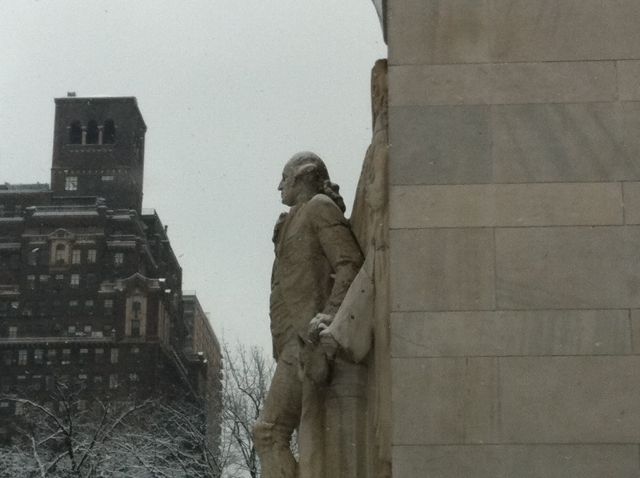
George Washington, Washington Square Arch, Washington Square Park.
February 21, 2011.
The arch served to commemorate the Centennial of Washington's Inauguration, an event that took place downtown. The pier statues were added later -"Washington at War" on the left of the arch by Herman MacNeil in 1916 and "Washington at Peace" on the right by Alexander Stirling Calder in 1918. Yes, Calder was the father of the famous mobile artist, Alexander Calder.

The President on Sullivan Street
Jul 29, 2010
I've become so familiar with President Barack Obama's frequent trips to my neighborhood, such as his appearance last night at a fundraiser at Vogue Editor Anna Wintour's townhouse on Sullivan Street, that I know the routine by heart. ...

The Reagan-Bush-Gorbachev Meeting on Governors Island: A Debriefing and a Walk
Aug 15, 2010
On December 7, 1988, President Ronald Reagan and Vice President George HW Bush met with Soviet leader Mikhail Gorbachev on Governors Island, then the headquarters for the Coast Guard. Documentation of the events that day remained secret ...

Chester A. Arthur's Neighborhood, and A Hint of Vindaloo Masala
Jan 14, 2009
President Hayes asked him to leave his post. Later, as President, he ran a clean administration, signing the Civil Service Reform Act of 1883, and he vetoed a bill that would have limited the immigration of Chinese laborers. ...

Saturday, February 19, 2011

Pictures from 70 Days of Walks: Days 43 - 49

The week was a little cold, a little breezy, a little too work-oriented, but then it warmed up for a day or two, and the city was a little exciting again. Friday was beautiful. Today, we're back to blustery conditions, and it's uncomfortable to be outside. But the past week of walks did bring some excitement. Dogs were involved. I visited Bellevue Hospital. The snow melted.

On February 12, Lincoln's birthday, the color red began to announce itself, especially at night in the East Village. Nothin' but heartbreak.

Day 43 Heart Break
Day 43. Second Avenue, walking toward 2nd St. Ahead - Heartbreak Restaurant, serving German & Swiss food. Fondue.

A pleasant day for a visit to Bellevue Hospital and a stroll along the East River. Waterside Plaza has nice  views of the river, but it's a little out of the way. Getting there involves walking on a pedestrian bridge over the FDR.

Day 44 Waterside Plaza
Day 44. Waterside Plaza, view of the East River and modern Long Island City.

Thursday, February 17, 2011

Recalling New York's Recent Past in Google Street View Images

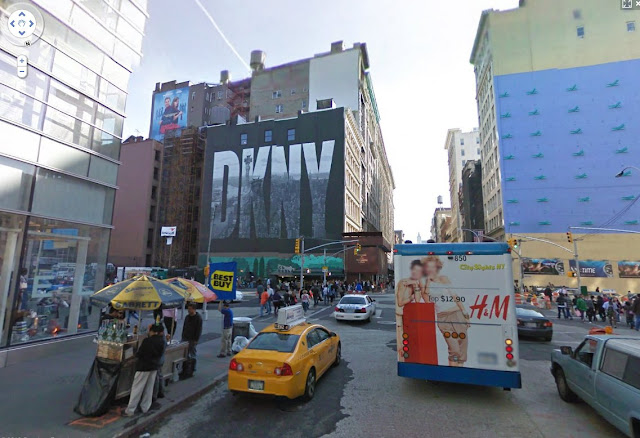
It's easy to get lost in Google Street View, the images made by Google's roving spinning cameras. The company's pictures, while sometimes criticized for their invasion of privacy, make a strange but useful record of the recent past. They're strange because of the POV, captured from atop a moving truck, and therefore, from the slightly high and unusual vantage point in the middle of the street. No one normally experiences the street this way, unless they're riding on the top of a truck or on a hayride. The Street View images are nevertheless useful as a compendium of images of the recent past. What's lost today may still exist in the virtual reality of Google's cameras. Here's just a small sample of what I found in Google Street View from a virtual walk this morning.

The DKNY sign on Houston Street and Broadway has since been painted over by Hollister, the occupant of the building.
Coming from another direction on Houston Street, the mural is gone.
The cameras caught the intersecting streets at different times.

With the incessant concerns in the city over the status and future of historic landmarks, it's time to check in again with the current Google Street View maps and see if we can capture images worth saving. This week, for example, a 200-year-old building at 35 Cooper Square faces an uncertain future. If the demolition order goes through, then we'll not see it again. It's time to snap a screen grab and send it to the archive folder.

Behind the green tree - 35 Cooper Square, an endangered structure.

Wednesday, February 16, 2011

A Walk to Bellevue and Beyond

The next time you New Yorkers have visitors from out of town and are planning to show your guests the famous sights of the city, tell them that you've planned something a little different than the usual trips to Times Square, Central Park, and Rockefeller Center. Surprise them by suggesting a walk to the Bellevue Hospital Center. Yes, Bellevue, the hospital in Kips Bay. They may look at you a little strange, knowing from old movies and television that Bellevue tends to serve as a code word for psychiatric care, but truly, walking to Bellevue on First Avenue and 27th Street and seeing the sights in and around the oldest public hospital in the United States is a great treat. You may want to hold off telling them that the trip will also include a walk over and under FDR Drive and a windy river walk on the East River to see massively-scaled modernist architecture and a future ferry landing. (update - ferry service began June 13, 2011. See official site for details.)

gate, Bellevue Hospital

Bellevue South Park

facade, Bellevue Hospital

Tuesday, February 15, 2011

Good Dogs: Backstage Portraits from the 135th Westminster Kennel Club Dog Show

They're all good dogs. And while they might have long fancier names as they step out into the rings of Madison Square Garden for the Westminster Kennel Club Dog Show (February 14-15, 2011), backstage - while getting groomed, taking a nap, or licking a fan's hand  - they're just your friendly dog with a normal good dog name like Baron, Blitzen, Woody, Kallie, or Hunter. So many sweet faces! While out on the show floor, the judges will evaluate the dogs on many characteristic ideals of their breed, but hanging out in the "benching area," it's their faces that will inspire the dog love. 


The 135th Westminster Kennel Club Dog Show concludes tonight at at Madison Square Garden. The proceedings will be televised live on the USA Network. 8/7C.

Images from Madison Square Garden by Walking Off the Big Apple from February 15, 2011, taken with the Hipstamatic app on the iPhone 4. Walking Off the Big Apple is the proud owner of a beautiful mixed breed dog of rottweiler-chowchow-shepherd heritage that originally came from the animal shelter and who would win an award for Best of Three Breeds.

Saturday, February 12, 2011

Pictures from 70 Days of Walks: Days 36 - 42

The week alternated constantly between the exciting and the mundane - from watching the uprising in Egypt on social media and TV to picking up milk at the grocery store. This week's walks also veered from the sublime to the tedious, but none of them came close to cheering on those who braved walking to Tahrir Square.

Day 36 Rain Astor Place
Day 36. walk to Astor Place, sloppy rain

In New York, we are now entering the late winter where an occasional pleasant day will interrupt the exhausting winter.

Day 37 The High Line
Day 37. Observing a thaw on the High Line

Walking in the evenings afforded glimpses of the city at work. In SoHo and Tribeca, the art world still thrives in converted factories and lofts.

Friday, February 11, 2011

Lower Manhattan: The Changing Skyline and the Challenges of Community

The skyline of Lower Manhattan is changing. A 76-story shimmering skyscraper at 8 Spruce Street, the tallest residential building in the city, is nearly finished. The skyscraper known as One World Trade Center, or 1 WTC (formerly Freedom Tower), rises a little more each week, gradually asserting itself into the new visual consciousness of the city. It's clear that a reconfigured built environment is emerging downtown, but what is unclear is how the new buildings, imposed on the old Dutch city and built in the aftermath of September 11, will affect a nascent sense of neighborhood in this part of town.

8 Spruce Street Revisited

In yesterday's New York Times, architecture critic Nicolai Ouroussoff offered a glowing review of Frank Gehry's design for 8 Spruce Street, calling the building "the finest skyscraper to rise in New York since Eero Saarinen’s CBS building went up 46 years ago." Writing about the building this past October, I similarly praised the building: "Eight Spruce Street shows some respect, acknowledging the city's classic skyscraper tradition with just the right amount of flash." While many will praise the building in terms of architectural style, it's important to also discuss how the highest of the residential hi-rises will affect the life on the street. Several questions remain to be answered. The residents of the building will be people who can afford luxury market housing, but how will their wants and desires affect the neighborhood? Will they take part in the social and economic life of downtown, or will they remain aloof and lofty, importing their goods and sending their kids to school elsewhere? It's fascinating to note that the Gehry building sits on top of two critical institutions of social life, a school and a hospital, but how these groups will interact, if at all, remains to be seen.

8 Spruce Street during a snowstorm, January 26, 2011

Access Restricted: A Conversation on "Unbuilding"

In a fascinating conversation this past Wednesday (2/9/2011), part of the series Access Restricted hosted by the Lower Manhattan Cultural Council (LMCC), cultural journalist Jeff Byles pitched questions to architecture critic and CUNY professor Michael Sorkin about the future of our shared urban spaces. The setting was the lobby of the Woolworth Building, the "cathedral of commerce" built in 1913 and designed by Cass Gilbert. Normally off-limits, the lobby served as a reminder that even our most cherished icons often limit access to the public.

inside the Woolworth Building lobby, February 9, 2011

Musing on the topic of Lower Manhattan, where he is now a resident after years in Greenwich Village, Sorkin reflected on the transformation of downtown into what he called "a complete community." Defining a strong neighborhood as "a place where one satisfies daily requirements within walking distance," Sorkin emphasized the importance of the street. He proposed taking fifty percent of existing streets back for pedestrian, park, or agricultural uses and even dismantling FDR Drive. An advocate for turning empty lots into green space and converting concrete spaces into plots for sustainable agriculture, he humorously proposed, but with some seriousness, "Let's put the orchard back in Orchard Street." Among his proposals for alternative transportation, Sorkin advocates extending the idea of mixed-use development to the street, India-style, mixing modes of walking and motoring with people on foot "on top of the heap."

Wednesday, February 9, 2011

The New York of By Nightfall: A Novel by Michael Cunningham

By Nightfall: A NovelFor fans of his popular novel, The Hours (2000) and subsequent works, a new novel by Michael Cunningham titled By Nightfall: A Novel (Farrar, Straus and Giroux, 256 pages, 2010) has been anxiously awaited. The reviews of the novel, released this past fall, have been mostly positive. Ron Charles of The Washington Post (October 6, 2010) credits Cunningham for mastering the fashionable mid-life crisis novel. For her review in The New York Times ("Sibling Rivalry," October 1, 2010), Jeanette Winterson praises his prose -  “Cunningham writes so well, and with such an economy of language, that he can call up the poet’s exact match." In addition to the merits of the story and prose, New Yorkers may want to check out the novel for its portrayal of the contemporary city. References to specific places abound. For those curious about characters that dine at Prune, live in an art-filled loft on Mercer Street, walk through the galleries of the Met to see Damien Hirst's shark, or venture to the wilds of artistic Bushwick, then By Nightfall will provide rich rewards.

The situational plot is easy enough to tell. Caught somewhere between the worlds of loft living in SoHo with an attractive editor wife and a gallery business in Chelsea, 44-year-old art dealer and insomniac Peter Harris trips into an unexpected encounter with Beauty. The platonic form manifests itself in the arrival of his wife's beautiful and much younger brother, Mizzy. As a dealer of contemporary art, Peter has yearned for an artist of beauty, a seemingly unattainable quest, but with this well-proportioned young man, one who reminds him of his wife in their younger days, he may have found the object of his desire. He wants to “curate” him.

While the character-driven plot relies on the time-honored conventions of the interrupted ritual and arrival of the stranger, Cunningham displays great skill in expressing the internal longing of his main characters. Caught up in role-playing and dressing for the part, these contemporary New Yorkers find their lives too often circumscribed by social expectations and ambition but completely bereft of spontaneity, desire and passion. There's a great deal of loss that haunts them. Peter remembers his dead glamorous older brother. The couple’s own daughter, Bea, has moved to Boston and settled for a life of low expectations. Cunningham describes Peter as wanting to be "a denizen of the present" but who “can't stop himself from mourning some lost world." He senses Mercer Street isn't the place to make him happy, with its "streetside piles of black garbage bags and shrill little boutiques that come and go."

While the drama plays out within a rather claustrophobic city, the novel expands the setting in unexpected ways. A particularly evocative scene involves Peter strolling downtown at night. As he walks south on Broadway, he passes through SoHo and the Lower East Side, complete with tart characterizations for each neighborhood. As he passes through Chinatown, he takes out his cell phone to call his daughter. She is a mystery to Peter. Of the setting, Cunningham writes, "the farther you go from your own fiefdom, the more ludicrous are your haircut, your clothes, your opinions, your life." By the time he reaches the Battery, Peter’s conversation with Bea will leave him that much more out to sea. In the next scene, Peter wanders through Bushwick, another mysterious unchartered territory. His emotional life also veers off the charts. It will take some time for him to get back to Mercer Street.

Monday, February 7, 2011

A Thaw, However Briefly: The View from the High Line

Many New Yorkers, having not seen their shadows in over a month, left their respective burrows/boroughs yesterday to investigate the phenomenon of the sun. More than that, it was the rare climatological phenomenon of the appearance of the sun along with the emergence of temperatures above freezing. Instead of watching the snow pile up, as has been the custom for two months, the snow actually started to melt away.

On the High Line, February 6, 2011

New Yorkers who live in Chelsea and the Village, together with the far-flung residents and visitors who flock to these areas for the mandatory meal known as brunch, gravitated to the High Line. This high perch afforded excellent views of the melting snow, the skaters at The Standard Hotel's small rink, the skylines of Jersey City and midtown Manhattan, and importantly, a big blue and party cloudy sky. Lounging in their winter coats on the wooden park recliners, the assembled group looked like well-dressed refugees on an icy voyage to an uncertain port o'call.

On the High Line, February 6, 2011

Saturday, February 5, 2011

Pictures from 70 Days of Walks: Days 29 - 35

This post is the fifth in a ten-part series titled Pictures from 70 Days of Walks. To recap: The idea is to take a walk of 2.5 miles every day for ten weeks, observe the sights along the walk, take a picture, and maintain a photo diary of the walks. Why? Since the typical New Year's resolution to get in shape often fails, usually within the first weeks of January, the resolution may take something else to make it interesting. Exploring the neighborhood and city makes the plan potentially more exciting.

Grand Central Terminal
Day 29. Grand Central Terminal is a good place for indoor walking. On this day, a film crew was shooting a commercial. 

Let the spirit of adventure take charge. Sometimes, just getting out of the house or apartment and into fresh air may be enough. The fitness goals will take care of themselves. Modest weight loss should ensue, provided the walks are accompanied by some concerted effort to control pastry and/or beer consumption. The sorry truth is that walking doesn't burn as many calories as cross-country skiing or running, so it's necessary to reign in the baguettes.

Central Park
Day 30. Central Park, near the southeast corner. Frozen, timeless.

Even if the weight or fitness goals fall short of expectation, you can still get out of this the memory of new adventures and a meaningful visual diary.

Cargo Cafe, Staten Island
Day 31. Now we're getting somewhere. After a trip on the Staten Island Ferry, a walk on Bay Street in Staten Island
turned up sad and silly clowns on the facade of Cargo Cafe. Notice the winter sky and bridge in the window reflections.

Wednesday, February 2, 2011

Coping With the New Arctic Normal: Lessons from the Central Park Zoo

(Update: Sadly, Ida the polar bear was euthanized in early June 2011 after developing liver cancer. NYT story.)

Like an endless Groundhog Day of winter snow, sleet, and ice, New Yorkers may finally be settling into patterns of adaptation to our polar climate. The novelty of the deep snow has long worn off, the winter wonderland seems a little less wonderful, and life goes on. Boots are pulled on, parkas zipped up high, and it's time to depart the igloo for the office. Perhaps now is an opportune time to check in on our most acclimatized Manhattan neighbors and pick up coping tips for life during the wintery blasts.

The Central Park Zoo, while a varied artificial environment within the larger artificial landscape known as Central Park, nevertheless provides a good home for polar bears, snow leopards, red pandas and other creatures, especially if nature helps out with a bountiful snowfall. During a recent Sunday visit to the park's Polar Circle, everyone seemed fine, kind of mellow, and even nonchalant about the weather. Gus and Ida, the park's two popular polar bears, slept off the afternoon, sunbathing on blankets of snow on separate rocky outcroppings.

Winter at the Central Park Zoo

A couple of snow leopards, normally accustomed to the mountains of Central Asia but now seemingly well adapted to the exhibit built for them in 2009, engaged in more alert activities than the bears. One crouched regally on a tree limb, frozen in position, the kind of stillness that precedes a lethal pounce. Another snow leopard, curled up right next to the viewing glass wall that separates them from their human visitors, ignored the small children banging on the wall and proceeded with the necessary business of cleaning its paws and tail.

Moving around the Polar Circle, the large party of snow monkeys spent their time engaged in mutual grooming, dozing off under rocks, or lounging in the hot tub. Nearby, in the battle for cuteness, and winning, a red panda practiced its balancing act on top of a snow-covered tree stump. In all, many of these beautiful creatures have escaped the hunter or have lost their natural habitats due to deforestation and climate change. Let's not begrudge them for their seeming idleness, their expensive Fifth Avenue real estate and Central Park views.

Related Posts Plugin for WordPress, Blogger...