Sunday, October 30, 2011

Storm Scenes: A Nor'easter Plows Into a Surprised New York City

We're still talking about the storm that came in yesterday, the surprisingly early wintry nor'easter. The hard rain, wind, and snow battered the city and pounded all of us who happened to be out in it. This morning, many folks are still dealing with the power outages and the broken tree branches with full sets of leaves. My phone rings regularly with notifications from Notify NYC about the precarious state of thousands of damaged trees, cautioning people of the ongoing dangers of wandering into the city's parks.

Storm Scene: the Nor'easter in Manhattan
October 29, 2011. 12:02 p.m. Lexington and 60th Street.

Storm Scene: the Nor'easter in Manhattan
October 29, 2011. Lexington and 60th. 12:04 p.m. 

Storm Scene: the Nor'easter in Manhattan
October 29, 2011. Lexington and 60th. 12:09 pm.

Friday, October 28, 2011

Visions of the New Metropolis: A Steampunked Ride to Roosevelt Island

This is the third and final post in a series on Steampunk culture.

Steampunk, explored in the previous posts on Union Square and Dumbo, is powered by alternative visions of the city, usually the sort of neo-Victorian futuristic cities as imagined by Jules Verne or H.G. Wells or even the American writer Edward Bellamy (1850-1898). The latter's utopian bestseller, Looking Backward (1887), dreams of the America of 2000 - Boston, to be specific - when a more equitable distribution of wealth has replaced an unfair economic system and where fantastic inventions have revolutionized the comforts of everyday life.

From a Trip to Roosevelt Island
Leaving Manhattan. View of the Queensboro Bridge and east side near E. 60th Street.

Bellamy imagined an ideal society where everyone spends the same amount of money, dispersed on cards (how odd!), and even listen to live music in their homes via a wire (nah, would never happen). Bellamy's ideas about the future of cities influenced many others during this time, including Ebenezer Howard and his Garden Cities of To-morrow (1898; re-issued in 1902). Howard's work, in turn, influenced American literary and architecture critic (and native of Flushing, Queens), Lewis Mumford (1895-1990).

From a Trip to Roosevelt Island
arriving on Roosevelt Island via the Tram.

In many ways, Roosevelt Island has often served as a template for similar utopian thinking. Long a site of welfare institutions, in the 1960s and 1970s urban planners reconceptualized the island as a new community for mixed income families. One of its craziest futuristic features is its Automated Vacuum Assisted Collections facility (or AVAC) that sucks out its garbage via pneumatic tubes. (consult "Fast Trash" link below the post for more info.)

From a Trip to Roosevelt Island
A Tram carriage as viewed from Roosevelt Island

The Roosevelt Island Tram, reopened this time last year after an upgrade, was launched in 1976, replacing the original trolley line that crossed over the bridge. The old trolley ran only part of the way over the Queensboro Bridge, stopping at midpoint to let passengers debark and then take an elevator down to the island. The trolley ended its last journey in 1957.

Wednesday, October 26, 2011

A Steampunk Walk Down Under the Manhattan Bridge

For a second steampunk excursion into New York - Union Square was the first - Dumbo in Brooklyn provided a most suitable location. With its industrial built environment, heavy infrastructure, and fantastical views of the bridges and Manhattan, the area down under the Manhattan Bridge overpass hardly needs visual alteration for this sort of aesthetic.

A Scene from Steampunked Dumbo
Tunnel under the Manhattan Bridge, Water Street

While its warehouses and factories now serve as repurposed spaces for apartments, retail stores, and arts groups, it's not too difficult to imagine the waterfront streets populated by velvet-wearing inventors, top-hatted mad scientists, or eccentric 19th century archivists. In short, Dumbo hardly needs steampunking. It's already there.

A Scene from Steampunked Dumbo
remnants of the Jay Street Connecting Railroad
A Scene from Steampunked Dumbo
In Dumbo, a view of the Manhattan Bridge
A Scene from Steampunked Dumbo
Steampunk 2011 at The Dumbo Loft
 
In point of fact, I happened to visit the area this past Sunday where several merchants had gathered in the Dumbo Loft for a Steampunk fashion market and show.

Sunday, October 23, 2011

Steampunking Union Square

Just when the steampunk genre seems to wane in popularity, it comes back again even stronger than before. New fans are constantly being drawn to the aesthetics of this alt brand of neo-Victorian futurism and its civilization built on steam. Steampunk sets the imagination afloat with airships streaming across the sky, dark-paneled rooms with wunderkabinetts, bookshelves of imaginative objects, cogs and wheels, top-hatted and velvet-wearing cyborgs, catalogs of curiosities, and wondrous clocks. Any fan of the 19th century with a fascination for gizmos or an interest in the worlds of Jules Verne, H. G. Wells, Dr. Who, or even Tim Burton may be a candidate for steampunk fandom.

Steampunked Scene from Union Square
Union Square, steampunked, with steam 

While the Victorianism of steampunk may conjure the dark streets of London, New York's 19th century and early 20th century architecture and infrastructure will do. We have plenty of the 19th century urban Gotham landscape to work with. The point is not to live in the past, for the steampunk era is a fiction, but to imagine ways of enlivening the present through acts of creative digging, archiving, and repurposing. New York makes a fine place to imagine alternative histories of the city.

Steampunked Scene from Union Square
31 Union Square West, originally Bank of the Metropolis building. 1902-1903

Friday, October 21, 2011

Brief Excursions Into Central Park: Photos from an Autumn Day

Many people arrive at this website via a search for "favorite walks in Central Park," or some such phrase. While I like to take long strolls in the park, I can't say I have a favorite one. I'm all for improvisation. Many times I'm doing something close to the park, maybe just a block or so near the edge, but while walking on the street, I'll catch a view of the park in the distance and then I'm invariably drawn to Central Park like a magnet. I enjoy these brief unscripted excursions. Yesterday, I found myself in the park twice, once in the morning near the southeast corner, and later in the afternoon near Central Park West and W. 67th Street. I couldn't help it. But lucky me!

Morning excursion: I walked from The Pond north to the Central Park Zoo, then through the Zoo and beyond to the Balto statute and the rocky outcroppings near the east side.

October 20, 2011 Central Park
The Pond

October 20, 2011 Central Park
Sea lion on a rock, Central Park Zoo

Wednesday, October 19, 2011

The Revolution Inside the Morgan

Surely one of the timeliest art exhibitions currently on display in New York must be David, Delacroix, and Revolutionary France: Drawings from the Louvre at the Morgan Library & Museum. Given the general state of occupation, just how did the likes of artists Jacques-Louis David, Jean-Auguste-Dominique Ingres, Eugène Delacroix, and Théodore Géricault manage to sneak in so close to the private library of powerful Wall Street investment banker John Pierpont Morgan (1837-1913)? Well, we can thank the Louvre for the current occupation of eighty excellent drawings by these revolutionary artists, a reciprocal gesture for the Morgan loaning the Louvre a hundred fine drawings during the 1990s.

Beyond the storming of the Bastille, the French Revolution unleashed a creative fervor in France, one that rippled through the nineteenth century. Even before the first wave of revolutionary engagement, artists were sweeping away the wretched excess of the royal Rococo in favor of classical models in order to illustrate the useful parallel lessons from Imperial Rome. The orderly structure of reason then gave way to the Romantic's fondness for feelings, emotion, and subjectivity. The revolution may have begun in an orderly assembly, but in time, after the collective exhaustion following civic unrest, imperial power, and a reconstituted monarchy, individuals occasionally drifted off to find themselves in Nature. This story is apparent in the sequence of drawings in the exhibition, from the French Revolution of 1789 through the reign of King Louis-Philippe and the establishment of the Second Empire in 1852. 


Jacques-Louis David (1748-1825), the first artist represented in the Morgan exhibition, put himself in the thick of revolution. The Rome-trained artist painted the Oath of the Horatii, his famous painting depicting a band of Roman brothers declaring their fierce patriotic public duty, in 1784, a precursor to the Tennis Court Oath of June 17, 1789. David was on hand to make a sketch of the event, and he himself joined the National Assembly, becoming a member of the Jacobin Club and a friend to Robespierre and Jean-Paul Marat. Upon Marat's murder, David not only painted the extraordinary image of the martyred Marat in his bathtub (La mort de Marat, 1793), he also took charge of Marat's public funeral. As impresario for The Terror, Marat choreographed a festival extolling a new civic faith, a cult of the Supreme Being.

Jacques-Louis David (1748–1825), The Sabine Women Intervening to Stop the Fight Between the Romans and the Sabines, graphite, retouching in pen and black ink, gray wash, heightened with white, on two joined sheets of beige paper. Réunion des Musées Nationaux / Art Resource, NY. Photo: Thierry Le Mage

The Morgan exhibit picks up the story after Robespierre has been taken to the guillotine. David is now imprisoned in the Luxembourg Palace. The first image is David's careful profile drawing of a fellow prisoner, a middle-aged man in the clothes of the haute bourgeoisie. Before being sprung from jail, David conceived of a new painting depicting the hope of reconciliation, The Sabine Women Intervening to Stop the Fight between the Romans and the Sabines (1799). The exhibit features David's compositional studies for the work, a brilliant depiction of a woman asserting peace in the midst of tumult. The painting drew the admiration of Napoleon, giving the artist a convenient segue into the next phase of Revolutionary France. With the later restoration of the monarchy, David took his leave and lived in self-exile in Brussels.

The Morgan exhibit includes representative drawings by many others who would follow David as influential artists of their time - among them, Pierre-Paul Prud’hon, Baron Antoine-Jean Gros, Théodore Géricault, Camille Corot, Jean-Auguste-Dominique Ingres, Eugène Delacroix, and Honoré Daumier. Several are preparatory drawings for now famous paintings. A highlight is a black and white chalk portrait by Prud'hon, one of Empress Josephine's favorite artists, of his lover and artist Constance Meyer. Their story would have a sad ending, but this drawing of her, caught in carefree smiling moment as she glances over her shoulder, gives a human face to life in often overwhelming times.

Pierre-Paul Prud’hon (1758–1823), Portrait of Constance Mayer, black and white chalk, with stumping on blue paper, darkened to brown. Réunion des Musées Nationaux / Art Resource, NY Photo: Jean-Gilles Berizz

Tuesday, October 18, 2011

OHNY Weekend, Part III: A Ballroom, A Penthouse, and the Streets Between

My final excursion on OHNY (openhousenewyork) weekend included two sites in the Financial District - an Art Deco ballroom on Broad Street and a contemporary luxury condo building on John Street. As my Sunday morning routine usually includes coffee, Battery Park, Trinity Church, and (now) Zuccotti Park, but hardly ever in the same order, I was already downtown and close by.

Broad Street
Broad Street, looking north. The Broad Street Ballroom is inside the building on the far right,
the Léman Manhattan Preparatory School. The New York Stock Exchange is in the distance
on the west side of the street.

• The Broad Street Ballroom is located just down the street from the New York Stock Exchange, right where the street takes a gentle bend. The investment bankers at Lee-Higginson built their headquarters here at 37-41 Broad Street in the late Jazz Age, 1928-29, to show off their financial power. The bank's lobby, now a ballroom frequently rented for private events, is decorated with fluted mosaic columns and a wraparound painted harbor scene by artist Griffith Baily Coale.

Broad Street Ballroom

Broad Street Ballroom

Monday, October 17, 2011

OHNY Weekend, Part II: Sacred Institutions of the Upper West Side

Churches and synagogues constituted the vast majority of the Upper West Side sites open for visits during this weekend's 9th Annual OHNY (openhousenewyork). While I didn't have the time to visit the ones open only on Sunday, the three sites of worship I visited on Saturday - First Baptist Church, the Church of St. Paul & St. Andrew, and St. Ignatius of Antioch Episcopal Church - revealed a spiritual side of New York City that many visitors never see (with a few notable exceptions such as St. Patrick's Cathedral, Trinity Church, and Cathedral of St. John the Divine).

Walking to the churches involved passing by several well-known Upper West Side landmarks, certainly not on the OHNY list - for they lack architectural distinction - but, for sure, worshipped and glorified for more secular (and delicious) reasons.

Fairway
Not on the OHNY list but an important institution in its own right - Fairway on Broadway at 74th Street.


For this moveable self-guided walking feast, plan on starting at the subway station at Verdi Square. On Saturday, when I emerged from the subway and headed north on Broadway, I was immediately tempted by a food cart from Screme Gelato, the first of many culinary wonders on my sacred tour. The more powerful food magnets were still ahead - Fairway on Broadway at 74th Street, "like no other market" as the store describes itself, an institution at this location since the 1930s, and Zabar's, the sprawling gourmet emporium at Broadway and W. 80th St. By all means, give in, for these stores are a vibrant part of New York's spiritual life, providing bounty for many a celebration.

Zabar's
Another sacred location for some - Zabar's


And now, let's visit three church buildings, official sites of the 9th annual OHNY weekend:

• First Baptist Church, 265 W 79th St and Broadway
Architect: George Keister; 1890-1893

First Baptist Church
First Baptist Church, 265 W 79th St and Broadway, exterior

Sunday, October 16, 2011

OHNY Weekend, Part I: A Lobby and Two Libraries in Midtown

The 9th Annual OHNY (openhousenewyork) event took place this weekend, opening up rarely seen New York interiors to the public. Designed to promote architecture and design excellence, OHNY featured many venues and special programs at sites around the five boroughs, and as always, even seasoned New Yorkers found more surprises hidden within their city. Many places were open by advanced reservation only, with reservation limits filling up quickly, but several fascinating places were open for walk-ins during certain hours on either Saturday or Sunday or both.

Making the rounds for the open houses proves something of a challenge, like a marathon for architecture enthusiasts. Nevertheless, I managed to take in a few of the sites in three separate parts of Manhattan this weekend - Midtown, the Upper West Side, and the Financial District. Walking between the OHNY sites, I occasionally stopped to study other interesting buildings and street views along the way. I'll discuss a few of the Midtown sites here and save the other neighborhoods for subsequent posts.

• 505 Fifth Avenue
Architect: Kohn Pedersen Fox Associates (KPF)

505 Fifth Avenue, entrance lobby
505 Fifth Avenue, light installation by James Turrell


The first stop of my OHNY weekend took me to the lobby of 505 Fifth Avenue to see the light installation by artist James Turrell (2005). The owner of the building commissioned Turrell to work with the architect from KPF to design this fascinating lobby. Stepping out of the frenzied world of 42nd Street and into the lobby seems both an extension of the neon world outside the doors but also a retreat from it.

505 Fifth Avenue, entrance lobby
505 Fifth Avenue, light installation by James Turrell


The light sculpture changes throughout the day. The work has a kinship with the paintings of Mark Rothko, and indeed the architect said that Rothko was an inspiration for this design. The pink, green, and aqua colored lights work in tandem with the careful chosen values of the wall paints. Turrell also designed the building's exterior lighting.

• General Society of Mechanics and Tradesmen, 20 W 44th St
Architect: Lamb and Rich. 1890

General Society of Mechanics and Tradesmen, 20 W 44th St.

Friday, October 14, 2011

French Lessons from the Lower East 60s

In Truman Capote's novella Breakfast at Tiffany's, Holly Golightly sprinkles her conversations with just a little bit of French, or more typically, with a mélange of French and English. Par exemple, she decribes one of her suitors as "quel beast." Speaking a few words in French gives our self-made heroine, born poor in rural Tulip, Texas as Lula Mae Barnes, the air of charm and sophistication necessary to succeed in cosmopolitan New York. In an early passage in the book we learn that before she fled to New York a Hollywood agent named O.J. Berman aspired to help Holly make it in the movies. He thus sent Holly to French classes in order for her to sound less like a country girl. A little French seems useful in New York, too, especially if one aspires to move up in the ranks of Old New York.

French Institute Alliance Française (FIAF)
FIAF offer programs for New Yorkers interested in French language and culture.


Since the late 19th century and early 20th, wealthy New Yorkers living on the fashionable Upper East Side near Central Park often mimicked the trappings of French royalty, establishing their tony neighborhood as the center of New York with a French accent. Many built their mansions in the highest French styles of the École des Beaux-Arts. Subsequently, New York luxury retailers followed suit, moving their stores from the once fashionable Ladies Mile district to areas uptown to be closer to their customers. In 1886 the pioneering Bloomingdale's opened its expansive emporium on 59th and Lexington Avenue. In 1928 Bergdorf Goodman built its Beaux-Arts store on Fifth Avenue, just south of the Plaza Hotel, on the site of the demolished Cornelius Vanderbilt mansion. Tiffany's was actually a late-comer to the trend, moving to its present location at 727 Fifth Avenue and 57th in 1940. In order to make one's way through this word, it helps to know a little French.

Grand Army Plaza, Sherman Monument
Sherman Monument, designed by Beaux-Arts trained sculptor Augustus Saint-Gaudens.
Grand Army Plaza, 60th and Fifth Avenue. The Plaza Hotel is in the background.


Aspiring to circulate in the upper echelons of New York society is not my reason for taking French classes at the French Institute Alliance Française (FIAF) on East 60th Street, although I realize, like Holly's Hollywood agent, studying the language could help me smooth out a little Texas twang. I also studied French from 3rd grade all the way through college, and I've found a lot of it is still there, just waiting to be refreshed. Today, French is the official language of 29 countries, with expanding usage in Sub-Saharan Africa. (Wikipedia) In New York, a significant portion of the immigrant population speaks French, including people originally from Haiti and Quebec.

I've long understood that my strolls in New York and social observations of the city draw enthusiastically on several strains of French social and cultural thought, including Alexis de Tocqueville's Democracy in America (published 1835 and 1840), poet Charles Baudelaire's idea of the flâneur ("a person who walks the city in order to experience it"), and works of the theorist and writer Guy Debord, the founder of the Situationist International. Plus, I sound really cool to myself when I speak French.

After my French class at FIAF each Thursday morning, I like to stroll the neighborhood, sometimes sauntering through the aforementioned department stores to get a whiff of French perfume. Mostly I walk the streets in search of lunch. In my walks, however, I've discovered that my French lessons extend way beyond the classroom.

• French Institute Alliance Française (FIAF). 22 East 60th Street
Major French cultural organization in New York hosts language classes, cultural events, a cinema, and more. fiaf.org

Wednesday, October 12, 2011

How to Check Out eBooks from the New York Public Library, and A Suggested New York List

Surely most of us have experienced at one point in our lives the dreaded realization that we've failed to return our library books on time, and we've racked up fees. A friend of mine in graduate school was so chronically late in returning her books that at one point, after accumulating hundreds of dollars in fines, the school's library staff called her in for a little counseling. One of the chief advantages of checking out eBooks from the New York Public Library, the new high tech means of borrowing, is that no late fees will accrue. The borrowed items will simply vanish from the patron's e-reading device at the end of the loan period, magically returned to the library e-shelves.

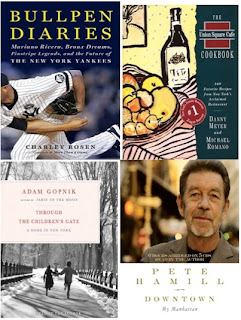
Amazon's Kindle has recently joined other e-readers in making library e-books available, including the thousands of books and audio books from the eNYPL. A simple search for New York-related titles turns up travel books of the conventional and unconventional variety, classic literature such as Edith Wharton's The Age of Innocence, biographies, books on the Yankees (Charley Rosen's Bullpen Diaries), contemporary cookbooks (Union Square Café and Alice's Tea Cup), and much more. The library makes audio books available, too, often providing samples. Check out an abridged audio version of Pete Hamill's Downtown: My Manhattan to listen to the Brooklyn native give voice to his memories of working "on the long, skinny island called Manhattan" or hear an unabridged version of Adam Gopnik's Through the Children's Gate: A Home in New York.

The How To: You'll need a library card just like for a real library. The NYPL card will have a number, and you'll need a PIN. Search for a book or browse the eNYPL catalog online. Some books will have various formats such as a Kindle book, an Adobe EPUB eBook, or an Adobe PDF eBook. Audio files are typically formatted as a WMA Audiobook and can be used on a PC, an iPod or another device. Books can be saved to a "wish list." Saving the item to an "eList" allows continued browsing, with the item remaining on the list for 30 minutes. As only a certain amount of e-books can be circulated, the "Request item" allows notification by email if the eBook is unavailable at the time.

Checking out: After selecting the format for the preferred e-reader device (I've chosen Kindle), proceed to checkout from the eList. Upon confirming checkout, you'll go to a page with instructions. The Kindle version will lead to a new page and a "Get for Kindle" button. A second outside window opens in Amazon with the final button and the dates of the loan period. The Kindle book is then transferred wirelessly within seconds (I still find this speedy delivery like magic.) Checking out an Adobe EPUB eBook leads to a page to begin downloading the book. These versions first require downloading software - OverDrive Media Console for mobile or Adobe Digital Editions for computer reading and transfers. Don't worry. It's fairly easy. The Help section of the library site includes instructions. The eNYPL allows a maximum of 12 items at one time.

Now, let's browse the catalog for New York books.


Steps of the main branch of The New York Public Library at 5th Avenue and 42nd Street.
The main branch of the library includes a great reading room but not books for circulation.
That's OK. Bring your e-reader and read a checked-out book while sitting on the steps.

A selection of New York-related titles available from the eNYPL as eBooks or as audio book files:

Overheard in New York Updated: Conversations from the Streets, Stores, and Subways by S. Morgan Friedman (Penguin Group USA, Inc.) As New Yorkers, we're always overhearing crazy things. This book from 2008 collects some of the best.

A Race Like No Other: 26.2 Miles Through the Streets of New York by Liz Robbins (HarperCollins) A portrait of the 2007 New York City Marathon with profiles of the elite runners.

The Union Square Café Cookbook: 160 Favorite Recipes from New York's Acclaimed Restaurant by Danny Meyer (HarperCollins) The popular restaurant, founded in 1985, serves American cuisine with an Italian influence.

New York Graphic by Adam Lloyd Baker (Knopf Doubleday Publishing Group). Noir-ish black comedy from a British writer.

97 Orchard: An Edible History of Five Immigrant Families in One New York Tenement by Jane Ziegelman (HarperCollins). Highly regarded book from 2010 reconstructs the lives of Lower East Side families through their potatoes, pickles, sauerkraut, and pushcarts.

Bullpen Diaries: Mariano Rivera, Bronx Dreams, Pinstripe Legends, and the Future of the New York Yankees by Charley Rosen (HarperCollins US) A look at the games of the 2010 season and the important role of the relief pitchers.

Tuesday, October 11, 2011

Walking the Talk: Zuccotti Park to Union Square and Beyond

In addition to raising consciousness about the inequality of wealth in the United States and the lack of accountability of the new robber barons, the Occupy Wall Street movement is also providing the public a few activist lessons in New York geography. Members of the amorphous group, along with their community and labor supporters, have routinely taken to the public streets and parks of the city since September 17, and in the process, led us to new places both literally and figuratively. Who knew of Zuccotti Park before, right? Well, at least not the name.

Zuccotti Park/Liberty Square September 25, 2011

Today's schedule includes a "NYC Billionaires Walking Tour" of the Upper East Side, a walking tour organized by labor and community groups to highlight the homes of the city's wealthiest men, including those of Rupert Murdoch, financier Howard Milstein, John Paulson, David Koch, and JP Morgan Chase CEO Jamie Dimon. It was Dimon who presented the NYPD a large check to pay for the extra security expenses incurred by Occupy Wall Street actions. Because it's always "plus ça change, plus c'est la même chose" with New York, the sites on this planned activist tour represent our equivalent to the Gilded Age mansions of Henry Frick, Andrew Carnegie, John D. Rockefeller, and J. P. Morgan. I have no idea what kind of artwork our current corporate overlords are collecting, but with any luck, future generations may be able to visit their homes in another hundred years as nice art museums.

Foley Square October 5, 2011

Washington Square Park October 8, 2011

So far, today's action on the Upper East Side will add more places to a growing tour of sites in the city - Zuccotti Park/Liberty Square, Union Square, the Brooklyn Bridge, Foley Square, and Washington Square Park. Other sites on the Occupy Wall Street itinerary will no doubt follow. For those interested in following along, either on the Internet or in real life, I'm including a map here of recent actions and sites. I will add to the map's list as necessary.


View Sites of Occupy Wall Street actions in NYC in a larger map


For further reading:

Occupy Wall Street Heads to Upper East Side for 'Millionaire's March' (DNA)

Facebook page for NYC Billionaires Walking Tour

Millionaires March Targets NY's Richest (NBCNew York) Note: story includes addresses

See Walking Off the Big Apple's page on Wall Street and Social Class for a timeline of events and related walks.

Sunday, October 9, 2011

For Occupy Wall Street, It Was Next Stop, Greenwich Village

On Saturday afternoon, October 8, the Occupy Wall Street protesters marched from their encampment at Zuccotti Park/Liberty Square north to Washington Square Park to convene a General Assembly. As with the other days of late, the weather could not have been better for a public demonstration - clear, even warm, with no clouds in the sky. A few hundred people marched uptown to the park, surrounded by a hefty police presence. Many local supporters had come to the park to greet the marchers, joining the usual park crowd of book readers, musicians, and dog walkers. Several mounted police stationed themselves a block south of the park on W. 3rd, and many unformed offers flanked all the park entrances.

Occupy Wall Street: Washington Square Park


Neighbors of the Washington Square area awoke to the news on Saturday morning that Washington Square Park had been selected as a place for a second General Assembly, the deliberate process of announcements and decision-making that has come to characterize this movement. It wasn't clear, however, if the park would become a second and larger encampment, one that would surely test the park curfew rules late Saturday night.

Occupy Wall Street: Washington Square Park

Washington Square Park and the larger Greenwich Village made an appropriate setting for Occupy Wall Street's move to the north. With its history of radical politics and bohemian culture, though one largely dissipated in our era through high rent and gentrification, Greenwich Village can still rise to the occasion as a beacon for alternative thought. A hundred years ago, in the 1910s, the Village served as the home for progressive-minded intellectuals, poets, artists, and playwrights. In 1917 artists Marcel Duchamp and John Sloan, together with poet Gertrude Drick, illegally broke into the arch, climbed to the top, and proclaimed Greenwich Village to be an independent nation.

Occupy Wall Street: Washington Square Park

Thursday, October 6, 2011

The Scene at Foley Square: A Rally of New Yorkers

Several thousand New Yorkers came to Foley Square late yesterday afternoon to participate in a community and labor rally in support of the Occupy Wall Street protests. The rally ended with a march to the Financial District and Zuccotti Park, the current home base for the demonstrators.

Community & Labor Rally & March, Occupy Wall Street

The weather for the event was clear and bright, a stellar afternoon in early October. Foley Square is located in the Civic Center of the city. Two courthouses dominate the east side of the square - the Thurgood Marshall United States Courthouse and the New York State Supreme Court. If you've seen any episode of Law & Order, you're already familiar with the steps of the Supreme Court building.

Many New Yorkers, along with hundreds of supporters from beyond the state and passersby and the curious, assembled in Foley Square.

Some were wise owls.
Community & Labor Rally & March, Occupy Wall Street

And some were people with ancient wisdom.
Community & Labor Rally & March, Occupy Wall Street

Wednesday, October 5, 2011

At the National Museum of the American Indian: An Infinity of Beauty

Now that Occupy Wall Street has at last garnered some mainstream media coverage, we may want to turn our attention to the language, geography, and cultures of occupation. One good way to do so would be to take a walk downtown on Broadway, strolling all the way past the lively encampment at Zuccotti Park/Liberty Square and past the dark canyons of Wall Street and past the circle of bright red geraniums of Bowling Green.

As the thoroughfare ends, pause for a moment to look at the formidable building at the street's base - the Alexander Hamilton U.S. Custom House (built 1900-1907), designed by Cass Gilbert and featuring four large figurative sculptural groups representing the Four Continents. The building is used for multiple purposes in our era including the Federal Bankruptcy Court and the Smithsonian's National Museum of the American Indian, the latter the subject of this post. But before you make your way inside to see the museum’s excellent exhibition, Infinity of Nations, which you must, turn around and consider for a moment the august avenue you’ve left behind. The Lenape and other Native nations first pounded out this path as a favorite trail. Indeed, in pre-Dutch days, the Wickquasgeck Trail ran all the way up to near Boston.

National Museum of the American Indian, George Gustav Heye Center
At the National Museum of the American Indian: Infinity of Nations.
Warrior's robe, Fort Benton, Montana.


With Infinity of Nations: Art and History in the Collections of the National Museum of the American Indian, on display at the George Gustav Heye Center, the museum is showing off two hundred stellar objects in its formidable collection, with fifty special works serving as exemplars of the infinite variety of Native cultures. With descriptions authored by new Native scholars and people the museum call "community knowledge-keepers," the many paradigmatic objects on display represent nations from the southernmost reaches of South America in Patagonia all the way north to the Arctic Circle.

National Museum of the American Indian, George Gustav Heye Center
At the National Museum of the American Indian: Infinity of Nations.
The polychrome jar on the left is by Rosalia Medina Toribio (Zia, 1858–1950),
Zia Pueblo, New Mexico 

The exhibition is novel in its geographical presentation, but the contexts of climate, region, and ecologies inform the works on display, whether an Olmec jade head, an ancestral Hopi bowl, a Pipe tomahawk presented to Chief Tecumseh (Shawnee, 1768–1813), a mask from the Northwest coast, or a wedding dress worn by Inshata-Theumba (Susette La Flesche or Bright Eyes, Omaha, 1854–1903). In keeping with current Smithsonian practices, the richly evocative and well-preserved works on the exhibition are presented with care in contemporary display cases under subdued and respectful lighting.

National Museum of the American Indian, George Gustav Heye Center
At the National Museum of the American Indian: Infinity of Nations

George Gustav Heye (1874–1957), the man responsible for collecting these works, was a New York native and a Wall Street dropout. He started acquiring artifacts in Arizona in 1897 and later hired teams of anthropologists to gather more from Native sites. According to the museum, "Over time, Heye gathered some 800,000 pieces from throughout the Americas, the largest such collection ever compiled by one person."(from the highly recommended exhibition website). The Museum of the American Indian–Heye Foundation opened to the public in 1922 in Audubon Terrace, part of that extraordinary complex of societies and academies uptown in Washington Heights, one that you must also visit and that still includes Archer M. Huntington's mind-blowing collection of Spanish art at the Hispanic Society.
Related Posts Plugin for WordPress, Blogger...