Sunday, August 30, 2009

Art and Spectacle in Nineteenth Century New York

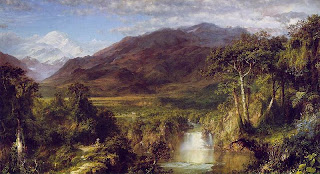
In the spring of 1857, artist Frederic Church (1826-1900) traveled throughout Ecuador, making sketches of the country's mountainous landscapes. Two years later, working in his studio in the Tenth Street Studio Building in New York, he painted a large canvas titled The Heart of the Andes, a spectacular and detailed landscape that opened a window into another world. White-capped mountains under a partly cloudy sky set off the closer rugged peaks of the mountain range. In the middle, a golden-lit green peaceful valley serves as home to a small mountain village, Christianized with a humble church on the lake. A waterfall tumbles toward the viewer, a miracle of playful nature. In the foreground to the left, a well-beaten path takes us to the sight of two reverent souls, clad in the traditional custom of the region, visiting a gravesite marked with a white cross. On the right, delicate blue flowers and large-leafed plants frame the bottom of the picture. Native birds of South America perch in trees. On the left, on a tree trunk lit by a speck of sunlight, just to the left of a branch on which sits a colorful plumed bird, the artist has carved his name. The Heart of the Andes invites a long look and a sense of wonder, for both the beauty of the region and for the skill of the artist in painting such bounty, especially in his meticulous rendering of abundant trees.

In New York, this painterly revelation of a new world was first shown privately in Lyric Hall at 765 Broadway, and then in late April the painting was moved back to Tenth Street. There, it went on view to the public for an admission price of 25 cents. Frederic Church hired an agent to help maximize the impact of its exhibition and its subsequent press, and this early foray into in-person and offline social media marketing, bypassing distributors, certainly made its mark. Church’s people hung curtains to dim extraneous light, and they framed the painting to simulate the affect of a window frame. Gas jets cast the painting in dramatic light, accentuating its features, most certainly the waterfall. The Heart of the Andes, an armchair vacation in oil paint, took New York by storm, with over twelve thousand people lining up to see it. Many brought opera glasses in order to view the exquisite details. The phenomenal painting then toured London and eight American cities. People wrote home about it.

Saturday, August 29, 2009

The Tenth Street Studio Building and a Walk to the Hudson River

The Tenth Street Studio Building at 51 W. 10th Street was demolished in 1956 to make way for an apartment building. Though not as high profile as the destruction of McKim, Mead, and White's Penn Station, the Greenwich Village building nevertheless held historical importance as the center for artistic life in New York in the 19th century. In 1857, enlightened entrepreneur James Boorman Johnston hired Richard Morris Hunt to design a workspace specifically for artists, some that included living quarters. Finished in early 1858, the three-story building featured studios designed around a communal gallery space. The gallery had a domed skylight at the top, a source of light that would provide the right kind of luminosity for the paintings below.

Tuesday, August 25, 2009

An Unconventional Summer in New York: When Geography, Nature and the Weather Dominated the Conversation

The summer is not technically over until September 22, 2009 at 5:18 p.m. (for those of you in the Northern Hemisphere), the date of the autumnal equinox, but with the nearness of Labor Day (Monday, September 7) and the subsequent start of the school year, it's nearly over for most practical purposes. It's not just the calendar that's bringing the season to a close but the subtle perception of the shortening days as the north pole tilts away from the sun. Along the shoreline of the Hudson yesterday afternoon, with the sun playing hide-and-seek from behind the clouds, the summer looked like it was winding down.


From Summer 2009

Summer never fully hit its stride this year in New York, with June and July staying under the 90 degree mark, and many August days have been compromised by erratic pop-up storms. A recent violent storm caused an extraordinary amount of damage to trees in the city, with the northern section of Central Park particularly hard hit. The storms became a frequent topic of conversation, both in person and online, with many people sharing their images of lightning strikes over the city or of a particularly colorful sky after a storm's passing.

Monday, August 24, 2009

Bye Bye Penn Station: Mad Men Takes on an Epic Battle

In Season 3, Episode 2 of AMC's Mad Men, titled "Love Among the Ruins," Pete Campbell, the Co-Head of Accounts for Sterling Cooper, the fictional Madison Avenue advertising agency at the center of the series set in the early 1960s, chairs an office meeting with the representatives of Madison Square Garden. The plans to raze one of the greatest Beaux Arts buildings in New York, designed by McKim, Mead and White and built in 1910, and replace it with the more modernist arena has set off a storm of protest. The Garden officials have a PR problem on their hands. During the meeting, the copywriter Paul voices his opposition to the destruction, siding with the protesters. The conflict sets up the ensuing drama. Don Draper, the series' central character, a man with a shadowy past, woos the Garden men in a subsequent meeting with a line out of John Winthrop's 1630 sermon to the Puritan colonists. The past, he argues, should be ignored in favor of a new New York, a modern and clean metropolis, a "city on a hill."


The old Penn Station was by most accounts one of the most spectacular monumental buildings to grace the New York landscape. Classical to the max, the massive granite building featured the largest indoor space in the city, welcoming travelers into a grand space fit for Roman emperors. The station was even more grand than Grand Central Terminal, and it was featured in several Hollywood films and novels (i.e. The Great Gatsby). During the 1950s, as highways and air travel became the more common means of transportation, the Pennsylvania Railroad looked to replace the building with a smaller structure. Plans for a new Plaza and a new sports venue called Madison Square Garden were announced in 1962. The idea that Penn Station could be razed set off a storm of protest, a heartbreaking struggle that would lead to the city adopting statutes for architectural preservation.

Friday, August 21, 2009

The Educated Artist: A Guide to Continuing Education Classes and Workshops in the Fine Arts in New York City (Revised and Updated)

Living in a city with so much art, it's not surprising that so many people who are not professional artists occasionally like to draw, paint, sculpt, and take pictures. So it shouldn't be surprising that many area arts schools, colleges, and other institutions offer a range of art courses and workshops. Nevertheless, in compiling this survey of continuing education classes in studio (and outdoor) art classes, many of which begin in the next few weeks, I was impressed with the range and scope of offerings for all levels of artistic skill - beginning, intermediate, and advanced. A few of these programs offer a drawing course, or at least a class session, at the Metropolitan Museum of Art, a classic way to improve artistic vision.

In addition to improving artistic skills and learning new techniques, participating in an art class is a fun way to meet others in the city who share the same interests. Based on my own experience taking continuing education art classes, classmates will come from all areas of the city, with different backgrounds and experience that shape their individual visions. You'll be amazed at what kind of work is out there among the amateur art population. Do not worry about your own level of talent. Someone will be worse than you. Others will blow you away.

Most have daytime, evening, and weekend classes, plus intensive workshops. Classes with multiple meeting times over the course of a few months. Many multi-week courses fall in the $425-$475 range. Some include model fees. Particularly popular courses with well-known artist instructors can fill up, so register early. A few of the schools listed below hold information sessions prior to the beginning of semester course. Be sure to attend, because it's always helpful to find a good match between your inner artist and its new instructor.
These listings are constantly being updated.

School of Visual Arts Continuing Education, 209 East 23 Street, New York, NY 10010
Painting, drawing, figure drawing, anatomy, drawing at the Met, drawing New York City, sculpture, printmaking, jewelry. Also many courses in photography, animation, illustration and cartooning, etc.

New York Studio School of Painting, Drawing and Sculpture, 8 W 8th St, New York, NY 10011
Evening and Saturday classes are open to members of the public. Drawing, painting, and sculpture courses last 11 weeks.

Wednesday, August 19, 2009

Some Serious Wi-Fi: The Edna Barnes Salomon Room at the New York Public Library

Needing a change of work space other than my own living room, one with more gravitas than a place where dogs bring me squeaky toys, I went uptown to the main branch of the New York Public Library this afternoon. I mainly wanted to try out the new wi-fi room the library made available this summer - the Edna Barnes Salomon Room. on the library's 3rd floor. Across the way from the Bill Blass Public Catalog Room and the Deborah, Jonathan F. P., Samuel Priest, and Adam R. Rose Main Reading Room (we can sure name them here, right?), the 4,500 square foot space has just the right amount of ambient light and classical proportions for concentrated work. After looking at the paintings along the wall, including many portraits of the Astors as well as other notables, I chose a space at a table in the back of the room near a 1971 portrait of Truman Capote. I remembered that Capote set an important scene in Breakfast at Tiffany's in the reading room of the main library.

Monday, August 17, 2009

Cooper Union's Architectural Advancement

Visitors to Astor Place, the Bowery, or the East Village may find themselves stopped in their tracks these days, confronted for the first time with the Cooper Union's new, although unfinished, academic building on Cooper Square between 6th and 7th Streets. Designed by architect Thom Mayne and his firm, Morphosis, in collaboration with Gruzen Samton LLP of New York City, the building appears like an oversize robot caught in the middle of some sort of action or in the midst of a mechanical speech. The big gash on the building facade looks a bit like the Kool-Aid Man - "Oh yeah!," as if the building is beckoning the students inside.

Actually, the building creature can cool off its academic visitors. The exterior mesh screen will help cool the building in summer and warm it in winter. A green roof with low maintenance plantings will keep the city atmosphere at bay. Carbon dioxide detectors will detect empty rooms and turn down power. The smiling gesture on the outside also appears to suck the building inward and down, creating the illusion that the building appears smaller than its actual size. Inside, a sweeping staircase from the lobby to the fourth floor apparently narrows at the top, also playing with perception. Nicolai Ouroussoff, the New York Times architecture critic, noted the friendly gesture in his review. He writes, "From certain angles the facade’s concave form seems to exert a magnetic pull, as if it were trying to embrace the neighborhood in front of it."

Sunday, August 16, 2009

New York Museum Exhibitions, Fall 2009: A Selected List, with Openings in September, October, and November

PLEASE SEE UPDATED LISTINGS FOR WINTER 2009-2010 HERE.

Celebrations of abstraction, several fine drawing exhibitions, a major Kandinsky retrospective, a visiting Vermeer, an imaginative filmmaker, and the continuing celebrations of the New York in its 400th year of discovery highlight the fall cultural season at area museums. What follows is a list of selected (meaning, not all) museum and other art center exhibitions opening in New York City in September, October, and November of 2009. I have starred * my recommendations.

For continuing exhibitions, please consult list the Summer 2009 list.

American Folk Art Museum, 45 W. 53rd St.:
• Perspectives: Setting the Scene in American Folk Art
Opens September 1, 2009
* •Thomas Chambers (1808-1869): American Marine and Landscape Painter
Through March 7, 2010
"America's first modern"
• Approaching Abstraction
Through September 6, 2010

Brooklyn Museum, 200 Eastern Parkway, Brooklyn, New York:
• James Tissot: "The Life of Christ"
Through January 17, 2010
• Who Shot Rock & Roll: A Photographic History, 1955 to the Present
Through January 31, 2010

Cooper-Hewitt, National Design Museum, 2 East 91st St.
:
Design USA: Contemporary Innovation
Through April 4, 2010

El Museo del Barrio, 1230 Fifth Avenue at 104th Street:
Nexus New York: Latin/American Artists in the Modern Metropolis
Through February 2010

Frick Collection, 1 East 70th Street:
• Watteau to Degas: French Drawings from the Frits Lugt Collection
Through January 10, 2010
• Masterpieces of European Painting from Dulwich Picture Gallery
March 9, 2010, through May 30, 2010
• The Spanish Manner: Drawings from Ribera to Goya

October 5, 2010, through January 9, 2011

Wednesday, August 12, 2009

A Guide to Gramercy Park: A Checklist, But Not a Key, & Dining Suggestions

From Summer 2009

"At noonday the landscape is just as fine, just as mysterious and just as significant as it is at twilight." - Robert Henri, The Art Spirit (1923)

The scene is cool, summery and inviting, but this attractive corner of Gramercy Park is off limits to those without a key. It's one of the only two private parks in New York City. The other is in Queens. When I walked around the park last week, the only residents I glimpsed through the fence were toddlers in strollers accompanied by their nannies. An older residential section of Manhattan to the east of Park Avenue South and between E 20th St. and E 21st St., Gramercy Park exudes an aura of elite privilege and discretion.

Home to well-known actors and famous artists as well as members of New York society and politics throughout its history, the neighborhood makes a particularly good strolling destination. There's not much to do here except look at the buildings surrounding the park and on nearby streets (especially the so-called Block Beautiful on E. 19th), but since Gramercy Park sits at the center of one of the city's best restaurant areas, the streets around the park are perfect for a pre-dinner or post-lunch walk.

• The Park. The locked, fenced private park is accessible only to those with a key. An article in the NYT from June 19, 2008 profiles the park's guardian and self-appointed mayor and discusses some of the disputes among the neighbors about access. According to the article, about 400 keys exist. Many do not use them.

Monday, August 10, 2009

Architectural Highlights Along NYC's Summer Streets: A Guide and a Map

Update 2010: Summer Streets for August 2010 will take place August 7, 14, & 21.

For three consecutive Saturday mornings in August, the city of New York shuts down major north-south thoroughfares to vehicular traffic so that residents and visitors alike may enjoy the streets without the presence of cars and trucks. Most ride bicycles, some walk, and a few skate, but by whatever preferred means of transportation thousands of New Yorkers have been taking advantage of the Saturdays to exercise and to explore the streets in this novel way.

Summer Streets 08/08/09

The event offers a rare opportunity to look at some of the city's great architecture from a new perspective. Sitting in a moving car, a driver can't fully enjoy urban architecture, or they shouldn't be, and even passengers who might be interested in sightseeing can't see through the roof of the car (unless they are in a convertible) in order to admire the top floors of buildings. On normal days, walking along the sidewalk allows views of the opposite street, but being able to walk in the middle of the street opens up a whole new world. It's a giddy feeling, this sense of the city and the sky, the kind of freedom you get marching in a parade. Biking the route may be the most pleasurable, because it allows the easiest and fastest access to all 6.9 miles of the route.


View Architectural Highlights Along NYC's Summer Streets: in a larger map

This map features architectural highlights along NYC's Summer Streets route. Buildings are listed from the south to the north. Many lovely late nineteenth-century buildings line the route, especially to the south in the older sections of the city, and the stretch of Park Avenue north of Grand Central features some of the most important buildings in the history of modern architecture - the MetLife Building, the Seagram Building, and the Lever House, among them. Turning west on 72nd Street and into Central Park simply opens up another adventure.

Summer Streets is not just for exercise. It's for an exciting course in Architecture 101.

Please see NYC DOT's Summer Street website for official site map and information about the event.

Image by Walking Off the Big Apple from August 8, 2009. Here, remembering the late Charles Gwathmey (link to NYT obit), architect of "Sculpture for Living" (the shimmering glass building ahead on Astor Place), while participating in NYC's Summer Streets. More images on Flickr.

Wednesday, August 5, 2009

E. B. White and the New York of Stuart Little

Stuart LittleOf the many books that give young people their first and almost always glamorous introduction to New York City, one of the most loved is E. B. White's Stuart Little, published in 1945. Yet, while Hollywood made an enchanting film of the classic in 1999, one that further glamorized the city adventures of Mr. and Mrs. Frederick C. Little's proper little mouse boy, the original tale is a curious story that breaks several conventions. For starters, in White's book, unlike in the movie where the Littles find him in an orphanage, Stuart is the Little's biological child (!), albeit an unusual one. He looks like a mouse, can walk within weeks after he's born, and he never gets taller than a fraction over two inches. In modern parlance we might describe Stuart as "a special needs child." He requires necessary adjustments in his domestic arrangement so he can climb up to the bathroom sink to brush his teeth. The largest problem is that he's so small that his family could lose him, but another issue arises with the presence of Mrs. Little's cat, Snowball. Concerned with his potential identity problems, his sensitive parents shield him from widespread derogatory references to mice, going so far as to change one word of a line of Clement Clark Moore's Christmas poem (another made-in-New York classic) to read "Not a creature was stirring, not even a louse." (E. B. White, Stuart Little. New York: HarperCollins Publishers, p. 10)

White, who finished writing the book while living on W. 11th Street in Greenwich Village, describes the location of Stuart's house, as follows: "The home of the Little family was a pleasant place near a park in New York City." While this imprecise location could be fulfilled by many different neighborhoods with parks, the charming adept illustrations by Garth Williams (also the illustrator for White's Charlotte's Web) suggest Gramercy Park (see related feature). One illustration in particular shows a streetscape with individual townhouses on the left and a park to the right. The ivy-covered houses could fit in several New York neighborhoods, but the gate to the park looks just like the one around Gramercy Park's famously private space. In the illustration (on page 74, if you have the book handy), Williams has sketched in a tall building with a spire that closely resembles the real-life Met Life building. The tower would not come into perspective from this particular view of the park, but perhaps the artist was inspired to substitute the graceful ornamentation of the Met Life tower for another less beautiful building. The houses themselves are not exact matches to ones we’d find there today, but they bear the same scale and general aesthetic. Anyway, a story about a talking mouse boy who likes to sail boats does not require such geographical realism.

Scott Elledge, the foremost biographer of E. B. White, points out many parallels between Stuart and the author, as well as some similarities between the mouse and White's father. His list includes "Stuart's love of boats, cars, canoes, skating, and travel; the call of the north and the love of morning and summertime." (Scott Elledge, E. B. White: A Biography. New York: Norton, 1985, p. 262) One memorable episode in the book (it's also in the movie) recounts Stuart's triumph in a sailboat race in Central Park's Conservatory Pond. Stuart dresses up like a sailor, "saunters" toward Fifth Avenue, hitches a ride on an uptown bus to 72nd Street, and arrives at the pond where he meets the owner of a "big, black schooner flying the American flag." He takes on a rival boat belonging to an obnoxious boy. As a storm gathers, Stuart successfully cuts the boat away from a paper bag that has blown over it and pulls away from the rival boat that has plowed into the rigging. He triumphantly wins the race.

Readers may remember subsequent scenes from the book such as Stuart's love for Margalo the bird, the intrigue with Snowball and the cat's scheming feline friends, and Margalo's rescue of Stuart from a garbage truck in the East River. What's troubling to some parents and to others in need of a happy movie ending is a perception that the final chapters lack closure. After Margalo flies the coup, so to speak, Stuart packs up a little hobo stick and walks out the door. As Elledge puts it, "He simply leaves home. He doesn't run away from home with a child's desperation or desire to hurt his family. He avoids a useless argument by not telling anyone his plans." (p. 256) After borrowing a toy car from a dentist, he drives up and around Central Park to the Henry Hudson Parkway and then on to the Saw Mill River Parkway. He's bound for the north and the ways of New England.


View Stuart Little's New York in a larger map

In Ames’ Crossing, Stuart meets a tiny girl, Harriet Ames, and after fantasizing about the great perfect date with her on the river in his little gift shop souvenir canoe, the eventual meeting turns into a disaster. In retrieving the canoe, Stuart finds the boat displaced and wrecked, presumably by children, and while normally a mannerly young mouse, he loses emotional control. The girl is willing to make the best of the situation, but Stuart can't wrestle away his disappointment. She walks away, also dispirited. He’s learned a lesson, however, and he presses on with his journey. Meeting a philosophical telephone repairman, Stuart inquires if he has seen the illusive Margalo. The man has not, but he points our tiny hero toward the north.

At the end of Stuart Little, there’s no easy reunion with a warm family within the charming confines of Gramercy Park. Instead, there’s the promise of finding happiness and self-knowledge in the unknown journey ahead, a promise based firmly in the conviction that the traveler is "headed in the right direction."

Lake Placid


Images of Gramercy Park, the Met Life tower, the Hudson River, and a stream in the upstate by Walking Off the Big Apple. Note: Garth Williams' illustration of the Little's street shows a tree bent at the same angle as the one at the top, as well as a similar tree in the background. The trees shown above are taller and more fully grown.

Monday, August 3, 2009

Home Again, and The Road North

During the drive home to the city on Saturday afternoon, capping a week's vacation in the Adirondacks, meandering south on Albany Post Road (Route 9) and passing its gentle towns on the Hudson - Sleepy Hollow, Tarrytown, Ardsley-on-Hudson, Dobbs Ferry, Hastings-on-Hudson, I spotted the skyline far to the south. We were driving through Yonkers, I think, when the apparition of the city caught me by surprise. At that distance, the tall buildings appeared in a shade of soft violet blue and as nondescript rectangular shapes, with only the Empire State Building discernible in identity. After days looking at the shapes of mountains, the fog and the mist settling in valleys, the still waters of lakes and the flow of clear streams, approaching the city through the Hudson Valley seemed a more gentle transition to the landscape of streets and avenues than a ruder awakening via the Lincoln Tunnel. Driving though the tree-covered reaches of Upper Manhattan and the Bronx and then easing onto the Henry Hudson Parkway not only calmed my nerves but also properly situated New York City within the larger ecology of the region. From this angle, the city emerges as a continuous part of the state and not as a complete aberration. The city makes sense. Now here's a good place to build a city of eight million people - where the rivers flow and meet the harbor and the wide ocean.

We had traveled north for a change of scenery and the pleasures of mountain air, shifting into the north woods with a stay at Lake George. We sat on Adirondack chairs at the edge of the water, looked at ducks and boats, walked into town for lunch and dinner and generally unfettered ourselves gradually from worldly obligations. And then the road took us north again, to the High Peaks near Lake Placid. We walked in the woods with dogs, breathed in the balsam-scented air, visited the John Brown Farm Historic site, watched the sun rise and set over the mountains, and shopped in the stores along Main Street. I had no idea the purveyors of fashion have packaged the Adirondacks as a complete lifestyle, but they have, making available for purchase a large number of household items of rustic charm, many of which sport a great diversity of images of forest animals, but mostly likenesses of black bears.

It was great comfort to wake up for several consecutive mornings to see the mountains and smell the air. Quiet, too. I even liked driving, especially through the hairpin turns near Whiteface Mountain. But on the sixth day, late in the afternoon, we arrived quickly at the general consensus that it was closing time. We missed cafes and good coffee and Washington Square Park and doormen and cushioned chairs. I love knowing when it’s time to go home. And we’re home now. Life returns to normal on our busy little crowded island.

"'I rather expect that from now on I shall be traveling north until the end of my days.'"
- E. B. White, Stuart Little

Images of Lake George and the High Peaks near Lake Placid by Walking Off the Big Apple. July 2009. For more images of the trip see this slideshow on Flickr WOTBA. I brought along the essays of E.B. White to read on the trip, and I'll have more to say about the writer and New York in upcoming posts.
Related Posts Plugin for WordPress, Blogger...