Tuesday, June 30, 2009

New York's Theater District: The Legacy of the Golden Age, A Walk and a Map

Even without a ticket to a Broadway play, a walk around New York's theater district can reveal the story of the American theater. In this relatively small piece of real estate, landmark plays and musicals unfolded on the stage and enriched individual lives. Here, decade after decade, actors, playwrights, producers, directors, stage managers, and the millions of theater fans who love them have assembled at this brightly-lit location for shows such as A Streetcar Named Desire (Ethel Barrymore Theatre), West Side Story (originally at the Winter Garden, now in revival at the Palace), Oklahoma! (St. James Theatre), Waiting for Godot (John Golden Theatre), A Chorus Line (Shubert Theatre), Born Yesterday (Lyceum Theatre), Death of a Salesman (Morosco Theatre, destroyed 1982), and thousands more. Stretching north on Broadway from Times Square and concentrated between 8th Avenue and Broadway, the Theatre District and its historic venues constitute a living museum of drama and the stage.

"Again at eight o'clock, when the dark lanes of the Forties were lined five deep with throbbing taxi-cabs, bound for the theatre district, I felt a sinking in my heart. Forms leaned together in the taxis as they waited, and voices sang, and there was laughter from unheard jokes, and lighted cigarettes made unintelligible circles inside. Imagining that I, too, was hurrying toward gayety and sharing their intimate excitement, I wished them well."
- from The Great Gatsby (1925) by F. Scott Fitzgerald

During the decade of the 1920s, people took the theater seriously, and many Americans beyond New York were intimately aware of the plays, actors, and theaters of the New York theater world. The demand for tickets led to a surge in theatre construction. During the 1927-28 season, over 260 productions debuted on Broadway.


View New York's Theater District: The Legacy of the Golden Age, A Walk and a Map in a larger map

The map above (click and enlarge for details) lists many of the existing Broadway theaters that were constructed in the first decades of the 20th century, culminating in the feverish boom during the Golden Age of Broadway in the 1920s. With the arrival of the Great Depression, new construction ceased, and many theatres were converted to movie houses. While many theaters from the era have since been demolished, some of the famed theatres on Broadway have been restored. A few are in need of serious repair. Recent productions continue to add to the individual and collective legacy of these remarkable places, with new plays and musicals speaking to the concerns of our own era and revivals celebrating Broadway's history.

Readers interested in exploring the theatre district may want to wind back and forth through the numbered streets from south to north, beginning on W. 42nd Street. Theatres in the West 50s were once considered the fringes of the district, as theatre constriction most often followed a trend northward. In the 19th century, the fashionable playhouses were centered toward the south near Madison Square. Noted on the map, too, are some spots of leisure that were born in those glory days - Sardi's, Gallagher's Steak House, and the pleasures of conversation at the Algonquin.

Images: top, New Amsterdam Theatre on 42nd St., bottom left, the Barrymore Theatre; bottom right (top) Belasco Theatre, (below), theatres on 45th Street. by Walking Off the Big Apple.

See many more photos of the theatres in this set on Flickr WOTBA.
Related posts: Walking Arcades of the Theater District and The Marx Brothers on Broadway, & Notes on New York Theatres in the 1920s

Sunday, June 28, 2009

The Marx Brothers on Broadway, & Notes on New York Theatres in the 1920s

This post is the fourth in a series about the Marx Brothers in New York.

After playing the Palace Theatre, the pinnacle of the big time, the Marx Brothers drifted about on the lower rungs of the vaudeville circuit following a series of contractual disputes with the powerful moguls, E.F. Albee, and then the Shuberts. Fortune changed with their major Broadway debut on May 19, 1924, a stage review titled I'll Say She Is. Compiled mostly of recycled routines and music numbers, the play nevertheless showed off the talents of each brother.

I'll Say She Is played at the Casino Theatre, an extravagant theatre located near the intersection of Broadway and W. 39th St. Built in 1882 and designed by Francis H. Kimball and Thomas Wisedall, the theater boasted a facade showing off an eclectic mixture of Islamic and Gothic details. The circular corner tower was particularly eccentric. In their survey New York 1900: Metropolitan Architecture and Urbanism 1890-1915, Robert A.M. Stern, Gregory Gilmartin and John Massengale describe the Casino as "a theater with an exotic, individualistic, even hedonistic character that exemplified the values of the Cosmopolitan Era." (p. 206)

In his memoir (Harpo Speaks), Harpo writes that he had long anticipated the opening, as the show had been in tryout for a year and a half. The routine of the road was getting old, and the Marx brothers threatened to quit the road shows unless the review opened in a theatre in New York. They got their wish, though they believed their manager were just humoring them. Harpo was glad to finally be home in the city - his mother and father had rented a place on Long Island, and he spent his days at Lindy's or Reuben's. "I was back with my own people," he writes, "who spoke my language, with my accent - cardplayers, horseplayers, bookies, song-pluggers, agents, actors out of work, and actors playing the Palace."

The show was a smash success. In his review of the play for The New York World, legendary theatre critic Alexander Woollcott singled out the silent one for the most praise, calling Harpo "a shy, unexpected, magnificent comic." He describes the funny eldest brother "as a craft comedian with a rather fresher and more whimsical assortment of quips than is the lot of most refugees from vaudeville." So taken was Woollcott with Harpo that the big portly critic bolted into his dressing room the following evening and told Harpo he was the funniest man he's ever seen on a Broadway stage. The two became great friends, with the critic inviting the clown to join his legendary vicious circle at the Algonquin Hotel. Harpo joined the Round Table.

The success of I'll Say She Is led to more famous Broadway triumphs with The Cocoanuts and then Animals Crackers. The Cocoanuts, a zany production about the Florida real estate boom, with music and lyrics by Irving Berlin, opened on Broadway on December 8, 1925 at the Lyric Theatre on 42nd Street. The theatre, built in 1903 and featuring sculpture in a Renaissance style, was originally planned for opera productions. The Shuberts took it over for their lighter theatrical purposes. Later, the Lyric suffered the same fate as many other venues in the 1930s when it was converted into a movie house. It was later shut, with parts incorporated into the Hilton Theater. After the show closed its run in August of 1926, the Marx Brothers took The Cocoanuts on tour. In 1929 it was made into a motion picture, billed as "Paramount's All-Talking-Singing Musical Comedy Hit." The brothers didn't have to travel far for the filming. In 1920 Paramount Pictures built a studio in Astoria, Queens, New York to be near the Broadway theater district. The Cocoanuts and Animal Crackers (1930) were both filmed at what is now known as the Kaufman Astoria Studios.

The Marx Brothers were unable to attend the film premiere of The Cocoanuts at the Rialto Theatre on Broadway and 42nd Street, as they were playing that night in their third and final Broadway show, Animal Crackers. A musical built on a thin plot of an African explorer (Groucho as Captain Spaulding) attending a party in his honor (hosted by the great Margaret Dumont as Mrs. Rittenhouse) while a valuable painting goes missing, Animal Crackers opened on October 23, 1928 at the Forty-Fourth Street Theatre. A Shubert house, the Forty-Fourth Street Theatre was located just off Broadway and had opened in 1912 as the New Weber and Fields Music-Hall. Animal Crackers was one of the theater's most successful productions until the advent of World War II. The New York Times bought the theater in 1940 and tore it down in 1945 to make room for its postwar expansion.

The 1920s on Broadway constituted the so-called "Golden Age" of the Broadway theater. Many new theaters were constructed along the Great White Way during the boom years of the 1920s, serving a burgeoning number of actors, designers, playwrights, critics, directors, and production companies seeking stardom in New York. The stage in New York was spectacularly successful financially. During the 1926-1927 season alone, over 260 shows opened on Broadway. By comparison, during the 2008-2009 season, 43 new productions opened.

"Strange figguhs..."

But wait, am I intruding?


Images: Broadway Theatres, c. 1920, and Casino Theatre, c. 1900, from The Library of Congress Prints and Photographs Division, Detroit Publishing Company Collection; image of Hilton Theatre by Walking Off the Big Apple; YouTube clip from Animal Crackers (1929).

Note on clip from Animal Crackers: Strange Interlude, a play by Eugene O'Neill and produced by the Theatre Guild, opened at the John Golden Theatre on January 30, 1928. Actress Lynn Fontanne played the featured roll of Nina Leeds. Contemporary audiences for Animal Crackers would have been familiar with Broadway culture and would easily readily understand Groucho's parody of O'Neill's internal monologues and the play's production history. Strange Interlude won the Pulitzer Prize for drama in 1928.

To read the other posts in the series, click on The Marx Brothers.

For much more on the theater district, see the post New York's Theater District: The Legacy of the Golden Age, A Walk and a Map

Wednesday, June 24, 2009

Moveable Feasts in the City: New York Food Trucks and Carts

My lunch yesterday consisted of one pollo asada taco, small but tasty, and for dessert, a mini-wafelini. The taco consisted of chopped grilled chicken with a dash of pico de gallo and a creamy avocado sauce served on a couple of soft corn tortillas. The mini- wafelini was essentially a little piece of waffle on a stick tucked between slices of banana and strawberries. Both were delicious, and each came from a different food cart or truck parked on separate streets south of Houston Street.

The latest craze in gourmet street food may be found in other cities throughout the country, but the phenomenon has garnered lots of attention of late in New York. While eating at food carts is nothing new in the big city, the availability of gourmet quality food and adorable desserts has added an extra amount of fun to New York street life. In the past, I've frequently bought coffee off the Mud Truck, a movable coffee bar with a particularly nice brew, and near to home, I often pick up a cup of coffee and a pastry from a friendly guy with a cart on W. 4th Street. Buying food on the go is especially nice when I'm headed to the park with dogs.

This summer, the Cupcake Stop arrived on the streets, parking often on Fifth Avenue and loaded with mini and normal size cupcakes, and now the Big Gay Ice Cream Truck has made its dramatic entrance. Because so many of us are acting like screaming teeny-boppers at their very sight, I'm sure more entrepreneurs are thinking of new additions for our burgeoning culinary street life. The new brand of food trucks and carts are especially welcome in New York, a place where too often the only portable fare comes in the form of lukewarm and disappointing hot dogs. I often feel bad for poor tourists who are forced to sustain themselves in Central Park on hot dogs and ice cream sandwiches alone. But in addition to these new dessert trucks that serve up red velvet cupcakes and cha-cha ice cream, mobile culinary units like the Calexico Carne Asada Cart and the Rickshaw Dumplings Truck feature substantial and delicious food. By pairing their offerings with seasonal fare from fresh fruit stands it's possible to eat very well on the streets of the city.

The Calexico Carne Asada Cart, winner of the 2008 Vendy Award for street food, has achieved such a success that they've opened a sit-down place in Brooklyn this week. I mostly visit their cart when it's parked near the intersection of Wooster and Prince in SoHo, though the wait can be 15 to 20 minutes. The California Mexican food they offer reminds me of some of the places I liked in Austin (Guero's comes to mind), and between Calexico and Pinche Taqueria, an unmovable but small place at 277 Mott St., I feel I have met my Mexican comfort food cravings close to home.

For sweets, I recently tried out the new Big Gay Ice Cream Truck. The beauty of this operation is with its operator, a charming man named Doug, and the variety of toppings for soft serve ice cream. Doug recommended that I try vanilla with a blueberries and saba reduction, and this combo hit the spot. I look forward to going back and trying other flavors. I'm also fond of Van Leeuwen Ice Cream, especially their pistachio and ginger flavors.

Many of the new food cart and truck operations take advantage of social media, namely Twitter, to alert potential customers of special locations and giveaways. Here's a partial list:

Calexico Truck: Twitter: @CalexicoCart
Wafels & Dinges: Twitter: @waffletruck
Cupcake Stop: Twitter: @CupcakeStop
The Big Gay Ice Cream Truck: Twitter: @biggayicecream
Cravings Truck: Twitter: @nyccravings
Dessert Truck: Twitter: @desserttruck
Le Gamin Truck: Twitter: @legamintruck
Rickshaw Dumplings: Twitter: @RickshawTruck
Treats Truck: Twitter: @TheTreatsTruck
Van Leeuwen Ice Cream: Twitter: @benwvl
LCB Burger Truck: @LCBBurger Truck

For further reading about New York food carts and trucks:

"Foodies Flock to Twitter-Friendly Carts" from NBC New York

• See other carts and trucks throughout the country with Twitter accounts on List of Street Vendors Using Twitter from Serious Eats

• New York Magazine. Grub Street: Street Fights: Food Carts and Trucks vs. the Brick-and-Mortars

Images: Calexico Cart, Big Gay Ice Cream Truck, Cupcake Stop, Wafels & Dinges.

Monday, June 22, 2009

The Marx Brothers in New York: Interlude - On Groucho Walking

This special new series about the Marx Brothers in New York continues this week, following the brothers into a career in Broadway and into the movies, but first I would like to take a little time to discuss Groucho's peculiar way of walking. Sometimes described as a "lope" or "stoop," Groucho's silly and often lecherous walk became just as an important part of his persona as his glasses, eyebrows, cigar and greasepaint moustache. He didn't walk this walk all the time, but as you recall from the films, Groucho would often bend his knees and lean forward as he proceeded from point A to point B. To imitate Groucho properly at a costume party, it's important to get this part down.

• Groucho explained that it was simply a bit of inspired improvisation. From the book Hello, I Must Be Going by Charlotte Chandler, he says, "I was just kidding around one day, and I started to walk funny. The audience liked it, so I kept it in."(pps. 153-154) Chandler adds a funny comment by the inimitable Oscar Levant, who commented on Groucho's walk, 'I wouldn't stoop so high.' On the other hand, the Wikipedia entry on Groucho suggests a more deliberate satire: "The exaggerated walk, with one hand on the small of his back and his torso bent almost 90 degrees at the waist was a parody of a fad from the 1880s and 1890s. Then, fashionable young men of the upper classes would affect a walk with their right hand held fast to the base of their spines, and with a slight lean forward at the waist and a very slight twist toward the right with the left shoulder, allowing the left hand to swing free with the gait." Well, well. As much as I would like to believe the Wiki explanation - and madly so, really, because Groucho would have been making fun of a flâneur fashion, I think it's more likely an adaptation of the kinds of exaggerated walking gestures Groucho would have seen in melodramas.

• Walking like Groucho, bending the knees slightly and leaning forward, proves to be a good strengthening exercise. Try this at home (or while walking along E. 93rd St.), and you'll feel a good stretch of the quads, hamstrings, and ankles. The Groucho walk is so effective that it's been recognized and so named in exercise literature. For examples, see these pages in the book, Walk Yourself Well by Sherry Brourman and Randy Rodman, and the instructions on this webpage, "Exercise: Groucho Walk" from Stack Magazine.

• For her book, Hello, I Must Be Going, Charlotte Chandler interviewed the aging Groucho Marx while she accompanied him on his daily walk around Beverly Hills. Walking around Beverly Hills is a bit unusual in itself, because Southern California is a car culture, but Groucho used the occasion to meet social needs, to greet people, friends and strangers alike. In addition, he was aware of the perils of aging. Chandler writes, "His appreciation of physical well-being had been enhanced by the negative blow of seeing about him so many friends becoming much less physically fit than he was." Chandler leaves out an additional explanation for Groucho's walking routine. Walking around Beverly Hills may be unusual, but not if you're someone accustomed to walking around an older city, for example, like New York, the Marx Brothers' home town. Walking around New York is perfectly normal, even for the most reclusive of celebrities.

• I must share one additional item on Groucho walking, a news bit dating from the spring of 2003: "Researchers Say Elephants Walk Like Groucho Marx," April 05, 2003 in LA Times.

Well, it's "a gala day" in Freedonia!


Images: frame shots and You Tube video from Duck Soup (1933).

To see other posts in this special Marx Brothers in New York series, follow this link.

Thursday, June 18, 2009

The Long Road to The Big Time: The Marx Brothers Play The Palace

This is the second in a series about the Marx Brothers in New York. See the first post A Walk in the East 90s: At Home with the Marx Brothers and "the Brownstone People."

Before their debut on Broadway and success in the movies and television, the Marx Brothers spent years on the road in the vaudeville circuit. Run by powerful impresarios such as B. F. Keith, E. F. Albee, the Shuberts and later Martin Beck of the Orpheum, the circuits ran their diverse groups of acts through towns big and small across the country. "Small time" acts played several times a day in converted theatres and for little money while "medium time" acts played for more money and in more established venues. The pinnacle of success was to play in large theaters in the big cities and for big money contracts. Theater managers watched the audiences respond to the acts, and if the performers proved popular and met success at the box office, they would promote the entertainers to better theaters and better pay. Playing the big theaters in the big cities was considered hitting "the big time."

In the spring of 1907, Minnie Marx, a classic stage mother with aspirations to the big time, sent her boys Julius (Groucho) and Milton (Gummo) to Ned Wayburn's College of Vaudeville at 143 West 44th Street in New York. Wayburn, a performer turned producer and teacher, had already established a successful dancing school. A reporter for the New Jersey Sun attended an evening performance at the new vaudeville school, calling all the performers "perfectly fine." The review mentioned the presence of "the Marks boys" as well as "the Astaire children" (Fred, 8, and his sister Adele, 10). The two brothers, along with a girl, sang in Atlantic City as Wayburn's Nightingales, but soon thereafter Minnie assumed the management of her boys' careers, and thus began a seemingly endless remaking of musical and comedy acts. Additional non-family personnel would come and go. Over his protestations that he couldn't sing, Harpo soon joined them. In October of 1909, Minnie decided to move the boys and her husband and sister (excluding her wayward eldest Chico, who had gone into vaudeville on his own, playing piano in a duo and apparently adopting an Italian persona) to Chicago. The family would live away from New York for ten years, but they would return for visits.

Essentially ripping off the idea of a Broadway musical titled School Days that had opened in 1908, the Marx Brothers created a production called Fun In Hi Skule. The show represented a shift away from a music-centered act toward one that played up the comedy. Groucho portrayed Herr Teacher, a strict school master with a heavy German accent, and the show made much hay out of every available ethnic stereotype. Over time, Fun In Hi Skule evolved into Mr. Green's Reception, with Chico joining Harpo and Gummo as students in the schoolroom. Groucho's turn as a professor in these "tabs" or tabloids would influence many more famous skits to come. The Marx Brothers took the ever-changing school room routine on the road for seven years, playing to increasingly enthusiastic audiences in Boston, Tusacaloosa, Ann Arbor, Denison, Ada, Youngstown, or wherever they found themselves.

In 1914 their uncle Al Shean wrote a new review for his nephews titled Home Again. Requiring a large cast of 15, the musical comedy was structured in two acts and set in New York. The first act was set on the piers of the Cunard Line, and the second at the villa of the main character (Henry Schneider, played by Groucho) on the Hudson River. The script of Home Again has not survived, though there's every indication that the comedy was not scripted much at all, benefiting from improv, sight gags, and the brothers' general gift of anarchism. Though Uncle Al had given him only a few lines, Harpo nevertheless stayed on stage without saying much, making most of his mute presence.

Home Again provided the ticket to the big time. Opening at the RKO Royal Theatre (423 Westchester Avenue at 3rd Avenue, demolished in 1962) in the Bronx in February of 1915, the show was a hit. A review published in Variety had praise for each of the brothers, especially for "Arthur" (born Adolph): "This Arthur Marx is marked as a comedian for a Broadway show, just as certain as you are reading this." A week later, Home Again opened as the beginning of a vaudeville program at the Palace Theatre in Times Square. Within the week, the act moved up the bill, so that by the end of the week, they were closing the show. Billboard noted in its review of February 22, 1915 (by that date they were in the 4th position), "Their tabloid ran forty minutes, and during that time the audience was either rocking with laughter or electrified with applause."

At any rate, the Marx Brothers were playing New York City's Palace Theatre, the premier venue of the Keith-Albee vaudeville circuit. They were back home in New York and playing the Palace. They had hit the big time. In 1919, four years later, the family moved back to the city. Broadway would come next.

This is the second in a series about the Marx Brothers in New York. See the first post A Walk in the East 90s: At Home with the Marx Brothers and "the Brownstone People."

Images: top: lobby lights, The Majestic Theatre, New York; middle: the former location of Ned Wayburn's College of Vaudeville (143 West 44th Street), demolished, now the Millennium Broadway Hotel; bottom: Times Square and The Palace Theatre (if you can find it!) at 1564 Broadway. The Palace was built in 1913 (same year as the demolished Royal Theatre in the Bronx) by Martin Beck, but Beck lost control of the theater before it opened. In its vaudeville days, the Palace ran two shows per day at $2 per show. Many consider the death of vaudeville to date from 1932 when the Palace converted into a movie theatre.

To see other posts in this special Marx Brothers in New York series, follow this link.

Monday, June 15, 2009

A Walk in the East 90s: At Home with the Marx Brothers and "The Brownstone People"

This is the first of a series of posts about the Marx Brothers in New York.

At the turn of the twentieth century, after moving several times, the Marx family finally settled into the fourth floor of a tenement at 179 E. 93rd St. One of the brothers, Adolph, later described the area as "a small Jewish neighborhood squeezed in between the Irish to the north and Germans to the south in Yorkville." Ten family members lived in a handful of rooms, dependent on the meager earnings and cooking of their father, Frenchie, a native of Alsace-Lorraine and an incompetent tailor. The family spoke a dialect of low-country German, and Frenchie often found new customers based on his understanding of "Plattdeutsch." Minnie, the mother, believed that the best way to climb out of poverty was to put her younger brother and her five sons on a theatrical stage. In a role reversal, the father stayed home to do the domestic chores.

While his brothers Leonard (Chico), Julius (Groucho), Milton (Gummo), and Herbert (Zeppo) played or went to school, Adolph (Harpo) learned to read by studying street signs and to tell the time by looking at the clock on the tower of a brewery at 93rd St. and Second Ave. His grandfather, Minnie's father, told him about the Torah, taught him to speak German, and passed on stories of his own early days as a ventriloquist and magician. His wife played the harp, and after she died, the instrument sat in the corner of the grandfather's room.

Groucho recalled that the grandparents couldn't find work: "For some curious reason there seemed to be practically no demand for a German ventriloquist and a woman harpist who yodeled in a foreign language." In his memoir, Adolph (Harpo) talked about getting the harp repaired and learning to play it, but he ended up spending more time with his delinquent brother Chico. Groucho tells the story in the memoir, Groucho and Me, that the harp disappeared one day, and everyone knew to search the pawn shop on Third Avenue. That's where Chico traded to pay his gambling debts.


View Carnegie Hill & Yorkville: A Walk in the East 90s in a larger map

In Memoirs of a Mangy Lover, Groucho tells a funny story about Chico's stay in a city in the South. His brother had gone on the road to play night clubs in order to pay off some gambling debts. Chico befriended the mayor of one city, an Italian-American, who loved Chico's big personality, mistaking Chico's famous Italian shtick for the real thing. The mayor implored Chico to stay, promising he would set him up as an overseer of the city's brothels. Groucho writes, "But Chico never told the mayor that he born in Yorkville in New York City, a neighborhood that was not only Italian but almost a hundred per cent German." It was time for Chico to press on to Birmingham, but he told Groucho later that he often reflected on this other life.

While visiting 179 E. 93rd St., on a quiet and pretty block between Lexington and Third Avenue, it's hard to get a sense of the bustling tenement neighborhood in which the Marx Brothers lived. Today, it's possible to walk down the street and see some of the houses still standing. Though gentrified long ago and missing some of the anchors of the old German Yorkville, the block is nevertheless vulnerable. A quick look east shows the encroachment of imposing condominium construction that threatens to take over the block. For these reasons, the neighborhood association has been rallying support to save the Marx Brothers' house. The members are asking the city's Landmark Commission to extend the Carnegie Hill historic neighborhood designation to the east, encompassing the block and therefore affording them the same protections. On the south side of the block one sees some pretty houses, but a few on the east side have already fallen to new development. (see note at end for more info about the preservation efforts) In his autobiography, Harpo commented on the difference between their house and the nicer ones across the street. They would call these neighbors "the Brownstone people."

During the youth of the Marx Brothers, the west-east numbered streets of the neighborhoods and even the blocks within the streets were ethnic-specific. In Harpo Speaks, Harpo noted the dangers of running into "Other Streeters," as he called them, without bringing something "to fork over for ransom" when caught by Irish or German kids. When quizzed about his block, he would confess, "Ninety-third between Third and Lex." "That pinned me down," he said. "I was a Jew." Harpo took the rough treatment in stride, however, reflecting later, "It was all part of an endless fight for recognition of foreigners in the process of becoming Americans."

To escape the poverty of his block, Harpo walked four blocks west to Central Park, "safe territory for lone wolves, no matter what Streeters we were." Along the way, he encountered the homes of the wealthy. Like in the Marx Brothers' youth of the early twentieth century, walking west toward the park today from 1st or 2nd Avenue often signifies greater affluence with each block. The Yorkville neighborhood is just several blocks from the mansions that constitute Museum Mile, the great palaces that now house the Jewish Museum and the Cooper-Hewitt Museum and so forth. Though the residents of the mansions along Fifth Avenue (see the Loew House at right) yielded power in their day, it can be easily argued that the poor boys on a certain block on E. 93rd made the longest lasting, and certainly the funniest, contribution to cultural history.

Wandering west and east through the East 90s allows a sampling of several different genres of architecture, some delightfully surprising, others mindnumbingly oppressive. Be sure to check out the three wooden frame houses as noted on the map, especially the Richard Hibberd House (right) at 160 E. 92nd St., built 1852-53 and once home to Eartha Kitt. The well-known 92nd Street Y is in the neighborhood. President Obama lived at 339 E. 94th St. in the 1980s. Two restaurants - Fetch and the Barking Dog, attract those who like to dine outdoors with their furry friends. The subway at 96th St. (6) on the Lexington line affords easy access.


"I still talk with an East-93rd-Street-New York accent. - from Harpo Speaks, by Harpo Marx with Rowland Barber (Limelight Editions, 1961), explaining what his voice sounds like.

Images: 179 E. 93rd St., picture of Marx Brothers, c. 1917, towers east of 3rd Ave. & E. 93rd St., houses facing 179 E. 93rd St., Loew House, Richard Hibberd House. "Where's the Seal?" is a scene from Horse Feathers (1932).

Note: For more information about this valued landmark, see the website Save Marx Brothers Place.

To see other posts in this special Marx Brothers in New York series, follow this link.

Tuesday, June 9, 2009

Walking the Rails Above Death Avenue: High Noon for the High Line

In the genre of the western, the advent of the railroad marked the transition of a community from a wild natural order to a state of organized civilization. When steam engines replaced horses and the stagecoach, other things followed - lawyers and sheriffs replaced anarchy, and schoolmarms took the place of saloon girls. More railroads began to link region to region, culminating at places like Promontory Point in Utah, in moves that signified national aspirations to empire. Soon, trains engendered their own myths and legends. Bandits held up trains, villains strapped girls to the track, and in the 1930s vagabonds and hobos jumped the cars to vague destinations. So deep is the romance of the rails that kids like me, growing up on stories like Gertrude Chandler Warner's The Boxcar Children, fantasized a life on the tracks and looked for adventure in the right of ways on many a train track.

During the 1840s, the city of New York mistakenly allowed the building of train tracks along Manhattan's West Side. Soon after, trains and street-level vehicles collided in frequent accidents, leading the Eleventh Avenue freight line to be nicknamed "Death Avenue." To provide more safety, the West Side Cowboys were formed, a contingent of several men on horseback who rode ahead of the trains to signal their arrival. In the 1930s a large project to reconfigure the West Side included the relocation of the dangerous tracks to an elevated High Line. Furthermore, the trains could move through factories and warehouses, delivering and picking up supplies. The trains hummed along until they faced competition with interstate trucks, and the southernmost section was torn up in the 1960s. The last train moved through in 1980.


Robert Hammond and Josh David, two West Side residents who shared a vision of repurposing the space as an elevated walk, formed the Friends of the High Line in 1999 and subsequently raised millions of dollars necessary to realize the dream. (See article from NYT, July 2008 ) For years now, many New Yorkers have highly anticipated the moment of its unveiling, to view Manhattan and the river from this new venue and to see out the work of the design team led by James Corner Field Operations and Diller Scofidio + Renfro. The moment is now. Phase One, the section from Gansevoort to 20th Street, opened to the public this week.


View The High Line in a larger map

The slideshow follows the path from the entrance at Gansevoort and Washington Streets up to West 20th Street. Among the highlights - the plantings of native species, the walkway's serrated plank design, artist Spencer Finch's temporary installation, the sundeck between 14th and 15th Streets, and the 10th Avenue Square, a place that includes an unusual amphitheater as well as surprising views of the Statue of Liberty. The High Line offers particularly good views of Frank Gehry's IAC (CEO Barry Diller and Diane von Furstenberg are major High Line backers) and its neighbor, Jean Nouvel's 100 Eleventh Avenue, along with the Empire State Building, various industrial oddities, boats in the Hudson, and near the end on W. 20th St., the General Theological Seminary.

As a boho hobo, I have always believed that the act of bumming along the railroad tracks should be interrupted at some point with the serving of cookies and slices of leek and cheese pizza. So, naturally, I was delighted to encounter the presence of carts from City Bakery and its sister, Birdbath Neighborhood Green Bakery, at the entrance and in the not-too-challenging section of the path entering the Chelsea Market.

If the arrival of the railroad in the western signifies the arrival of civilization and its discontents, the deconstruction and renovation of a rail line should symbolize a counter trend - a return to wild beauty and natural balance, and to the more gentle pounding of the earth, even far off the ground, by ordinary feet.

Walking up from the South Village to the High Line and then all the way to W. 20th is a fer piece. But near 23rd Street and 8th Ave, take a staircase down, and you can most often find a train to bring you back.
_____________
The High Line opens every day from 7 a.m. to 10 p.m. Enter at Gansevoort and Washington streets. See the official High Line website for much more information, including a timeline of its construction, key events, and archival photos of West Side Cowboys.

Picture show images of the High Line by Walking Off the Big Apple, Monday, June 8, 2009. Photo of hobos by unknown photographer, in the collection of the Library of Congress.

Related Post:
Under the High Line: A Guide to Art, Food, Cars and Theology

Monday, June 8, 2009

Aernout Mik at MoMA: Something is Happening Here, But I Don't Know What It Is

Last weekend, when I stood for two hours with a crowd behind barricades watching the Secret Service and police accompany the First Couple's motorcade to the restaurant on Washington Place for date night, I thought about the video installations I had seen earlier in the week at MoMA by Aernout Mik. Like the Dutch artist's works that recreate and loop recognizable but ill-defined moments of a mediated police state, the action that I saw before me seemed equally generic. A helicopter flies overhead. Secret service personnel in suits, some with sunglasses, scan the crowd. The police stop a guy on a bicycle. Another lets a few residents and diners through the barricades. Car doors open and shut. If anyone has spent some of their lives watching breaking news on television, the unfolding crisis often contains within its boundaries long passages of lull and boredom. The events on Washington Place could have been the spectacle of any leader of a powerful state arriving at a previously undisclosed destination.

"Because something is happening here
But you don't know what it is
Do you, Mister Jones?"
- Bob Dylan, Ballad Of A Thin Man, 1965

The exhibition of Mik's installations at MoMA, each individually sited within the museum in its own spatial configuration, invites a new look at broadcast news, as we've come to know it, and the types of spectacle crises we've come to accept as situation normal - crises of state legitimation, terrorism and civil disruption, boundary disputes and immigration, student unrest, and so forth. The action of these recreated spectacles does not begin and end as a traditional narrative; rather, the events loop, always seemingly on the verge of a high-end dramatic moment but then falling away again into repeated moments. The videos are silent, focusing our attention to contemplate the architectural space and the location of cameras. With Vacuum Room (2005), the surveillance cameras play an important part of the piece. When I was watching the President's security entourage, my consciousness had been heightened by seeing Mik's work, and so I easily located the security cams outside buildings.

The exhibition at MoMA is spread out throughout the museum, and each re-situates the viewer within the space. The configuration of aforementioned Vacuum Room, a multi-camera investigation of a political crisis, mirrors the sense of being in a chamber, while a new commissioned work on two screens, Schoolyard (2009), is sited along the corridor leading to the museum's cafe. Beyond the schoolyard, looking down at the edges of the screen, the viewer can see MoMA's own yard, the Sculpture Garden. Particularly effective is Scapegoat (2006), a one-screen installation evoking the tensions of a long hostage episode. Mik's videos allow and even encourage the viewer to scan the scene for clues and information.

The video below, produced by MoMA in conjunction with the exhibit, features the artist explaining the work (and he's very forthcoming, unlike many artists), and it shows how the museum has set up the installations.


So many of the scenes and images of this artist's videos have sadly become an unexamined part of our visual landscape. By looking at them, however, and reflecting on how we've come to see events of the world through the eyes of video cameras, the more likely we'll question our equally important assumptions about how we define reality.

Aernout Mik continues at MoMA through July 27.
Video from MoMA.
Image at top right by Walking Off the Big Apple.

Sunday, June 7, 2009

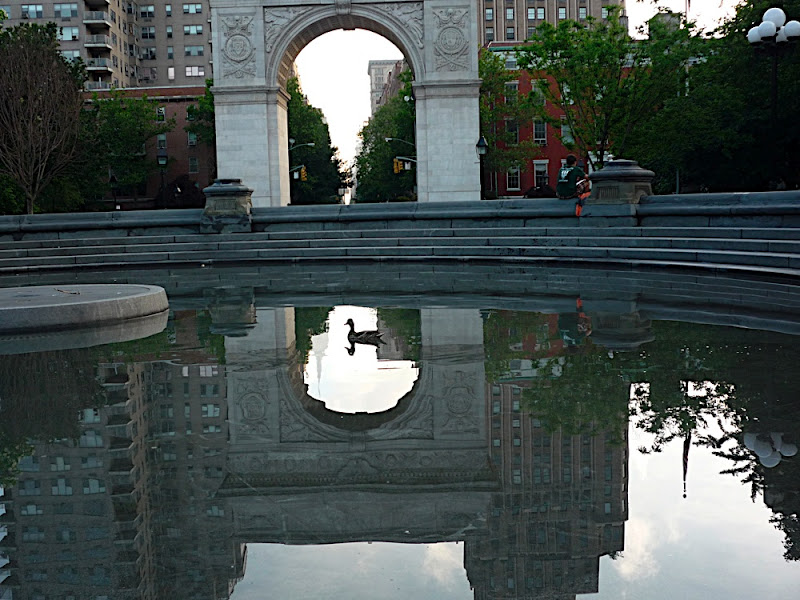
The Early Bird Gets the Picture of the Duck in the Fountain

From Summer 2009

Morning larks in the city enjoy a rare peace and quiet that night owls frequently miss. Early Saturday morning, while out with the dogs in Washington Square Park, the big dog became obsessed with something in the fountain. So, 'twas a duck. Make that two ducks, a Mr. and Mrs. Duck, although the male duck flew away for awhile, like guys will do in the Village, leaving Mrs. Duck to circle the fountain and occasionally quack. As more Villagers arrived in the park, the pair took flight, perhaps for the more open waters of Central Park. Night owl shutterbugs missed this photogenic moment - a picture of a duck in watery reflection within the arch, a hint of the city's most famous skyscraper beside her, the silhouette of a swan.

Image by Walking Off the Big Apple. More in a set on Flickr WOTBA.

Related news item: "Darker outlook for night owls, study finds" (msnbc.com)

Friday, June 5, 2009

Towards a New Amsterdam: Celebrations of Henry Hudson's Voyages to the New World for the Dutch East India Company

(Ed. note: Consult the post from September 10, 2009 for additional listings.)

In 1609 Londoner Henry Hudson, hired by the Dutch East India Company to find an easy passage to China, sailed his ship, the Halve Maen, into New York Harbor and then up what is now known as the Hudson River. With no China in sight, he had to turn back. Hudson's 3rd voyage allowed the Dutch to claim the region and to establish fur trading. The rest is history.

"Sept. 12, 1609. Very fair and hot. In the afternoon at two o'clock we weighed, the wind being variable, between the north and the north-west; so we turned into the river two leagues and anchored. This morning at our first rode in the river, there came eight and twenty canoes full of men, women and children to betray us; but we saw their intent, and suffered none of them to come aboard us. At twelve o'clock they departed. They brought with them oysters and beans, whereof we bought some. They have great tobacco pipes of yellow copper, and pots of earth to dress their meat in. It floweth south-east by south within. - Robert Juet, crewman aboard the Halve Moon, Henry Hudson's Third Voyage to the New World."

400 years have passed since these moments, and New York and Amsterdam are celebrating all year. The culmination of the celebration will take place in September, but many special events and exhibitions are ongoing. Explore more at these websites:

Henry Hudson 400: Celebrating the history of Hudson, Amsterdam, and New York.
Download their walking tour of 17th Century Dutch New York, the New Amsterdam Trail, for a self-guided tour of sites in lower Manhattan.
NY400 Events: Holland on the Hudson
Note: NewYorkology has the skinny on the flotilla this weekend.
New Netherland Museum and Half Moon

Also note the exhibitions at the Museum of the City of New York, 1220 Fifth Avenue:
• Amsterdam/New Amsterdam: The Worlds of Henry Hudson
Through September 27, 2009
• Mannahatta/Manhattan: A Natural History of New York City
Through October 13, 2009
• Dutch Seen: New York Rediscovered
June 10 - September 13, 2009

Coming up this weekend on WOTBA: A review of the video installations of Aernout Mik at MoMA. If you're wondering, the artist is Dutch, born in 1962.

Wednesday, June 3, 2009

Jazz & Culinary Notes: Pianists, Guitarists, Saxophones and Cupcakes, All Close to Home

Some of you may have noted infrequent postings of late, but my excuse was that I was attempting to take a vacation. I didn't plan an ordinary holiday - the kind that requires packing a suitcase and going somewhere, but I did feel a need to be less busy for awhile. The plan failed. One of my dogs got sick, and my spouse was in Argentina. The little guy is better now, and the spouse is home, but the sweet aging terrier and the vet had me scurrying around the neighborhood most of the last two weeks for special foods and supplies. I coped with this unpredicted development by spending some time with friends, watching the American Ballet Theatre Gala, seeing the Aernout Mik exhibit at MoMA, visiting the Jazz & Sketch night uptown, waiting for the First Couple to come out of Blue Hill, lounging in Times Square, shopping for summer clothes (mostly at UNIQLO), taking pictures of sad bicycles, and getting my hair done (Sam Brocato, formerly Oscar Bond, on Wooster). The rest of the time was spent in dog land, mostly at the park. Not so bad, really.

Walking around the Village while on errands, I glanced at posters in the club windows and couldn't believe how many amazing musicians are lined up for gigs in the neighborhood. Gato Barbieri, for real, at the Blue Note? And then Ute Lemper a few days after at Le Poisson Rouge? People may complain that Greenwich Village isn't the same as it was, and of course that's true in many respects, but we have serious jazz here, and I don't need to walk far to enjoy it.

MUSIC CALENDAR NOTES

Here's just a sampling of some musical events in or near my Village neighborhood in the coming week. Please visit the website links included here to survey their extensive music calendars. Though the city has lost its JVC Jazz Fest, the music still plays.

• Through June 7. Guillermo Klein y Los Guachos. Argentine pianist based in Barcelona and his ensemble play at the Village Vanguard, 178 Seventh Avenue. http://villagevanguard.com/

• Thursday, June 4. Bill Sims, Jr. and Chaney Simms. Terra Blues, 149 Bleecker St. http://www.terrablues.com/

• Friday, June 5 - Sunday, June 7. Gato Barbieri, tenor saxophone. Blue Note, 131 W. 3rd St. http://www.bluenote.net/newyork/index.shtml

• Saturday, June 6. Brazilian Bossa Jazz on Saturday Nights at Zinc Bar, 82 West 3rd Street. Featuring Marianni: Sultry Sounds of Bossa. http://www.zincbar.com/

• Sunday, June 7. Every Sunday. Klezmer Brunch, City Winery, 155 Varick St. Tickets: $10, children 13 and under free. http://www.citywinery.com/

• Sunday, June 7. Todd Sickafoose’s Tiny Resistors at 55 Bar, 55 Christopher St. 9:30 p.m. Free. http://55bar.com/

• Monday, June 8. Ari Hoenig Group "Punkbop" at Smalls, 183 W. 10th St. Tickets: $20. 10:30 p.m. and midnight. http://smallsjazzclub.com/

• Tuesday, June 9. Ute Lemper plays Le Poisson Rouge, 158 Bleecker St. http://lepoissonrouge.com/

See many more jazz event and club listings at gothamjazz.com

CUPCAKES & CULINARY NOTES

Street vendors of the creative variety are increasingly trolling the streets of Gotham. Today, I visited the first day of the CupcakeStop Truck, a high-end cupcake mobile that was parked on Fifth Avenue between 13th and 14th Streets. http://www.cupcakestop.com/

Also, while out and about the last two weeks, I gathered some formal and informal dining notes:
• Good black bean burritos at Doja (14 W. 4th St.).
• Split an appetizer and entree at Lure Fish Bar (142 Mercer St.) for economical fine dining.
• Martini at the Temple Bar (332 Lafayette St), as only they can make them. Convenient break from pressing dog errands, as it's next to Happy Paws.
• Breakfast at Le Pain Quotidien, corner of Fifth Avenue and 8th St.
• LaGuardia Place, the name for the blocks of West Broadway from Washington Square South to Houston Street, is home to several good restaurants. I enjoyed shrimp avocado rolls at the reliable Marumi, an affordable prix-fixe breakfast at Favela Cubana, and Cashew Chicken at Rhong Tiam.
• A wonderful chicken taco from the Calexico truck on Wooster and Prince St.
• Special Pondicherry extra spicy dosa at NY Dosa, a truck parked on Washington Square South.
• A mini red velvet cupcake at the Cupcake Truck.
• There are also rumors of the impending roll-out of A Big Gay Ice Cream Truck.

So, obviously, it's possible to eat well in New York no matter what's taking place, even from a truck, and to listen to world-class live music without venturing north of 14th Street.

Images by Walking Off the Big Apple. I'm coming back, slowly but surely. Some reviews of museum exhibitions are in the works, and I'm feeling a special extended walk coming on.

Monday, June 1, 2009

A Special Date Night in the Village: The First Couple Dines at Blue Hill

Those of us who gathered along Washington Square West at the intersection of Washington Place early Friday evening made our own fun as we stood patiently waiting for a glimpse of the special guests. After hearing a little earlier the helicopters fly over and then the sound of police sirens, I had a hunch that President Obama and the First Lady were somewhere in the neighborhood. I walked over to the park, and sure enough, a crowd was gathering at the aforementioned intersection. It was quickly determined that the First Couple had chosen Blue Hill, an elegant but unpretentious restaurant that emphasizes fresh seasonal food, for dinner before heading to see a Broadway play.

For two hours, while the couple dined inside, we watched the slow and deliberate motions of the New York police officers and Secret Service personnel as they worked to keep us in line. Much attention was directed toward the heavily-armed men and the suited men from the Secret Service. All wore ear pieces, maintained a look of cool and calm, and in general, lived up to what we think of Secret Service from the movies. Our own New York police officers outwardly showed more humor with the assembling crowd, as they're accustomed to humoring us.

Standing around for two hours waiting for some sign of the First Couple to emerge from the restaurant created the condition that any little thing could be a source of amusement. When the group of Secret Service guys in the van rolled up one of the tinted windows, part of our group made audible sounds of disappointment, and when they rolled the window back down, it was greeted with cheers. Mostly we just chatted with one another about the restaurant, the circumstances of us being there, or how one of the suited Secret Service members never moved. We all enjoyed the low passing of an NYPD helicopter and another incident when a guy obliviously drove his bicycle into the intersection before being stopped.

Two hours later, as the sun was going down, a roar rose up from the crowd. In the middle of Washington Place, a couple of figures moved quickly to an open car door, and if we didn't blink, we could see the friendly and familiar wave. Then the entourage headed west to Sixth Avenue and up to Broadway where other crowds gathered to greet the Obamas at the theater.

Walking home, I thought how lucky I was to live in an historic neighborhood in which the First Couple chose to dine, how I'd seen the President speak at the park in late September of 2007 when he was a candidate and how much his life had changed. For most people, going out to dinner doesn't require that much fire power. Nearing home, I passed by on the sidewalk the singer Tony Bennett who was out strolling with a friend. He looked really good and had on a handsome tan suit. It was back to normal life in the Village.

Image by Walking Off the Big Apple, May 30, 2009.
Related Posts Plugin for WordPress, Blogger...