Saturday, April 30, 2011

New York Street Scenes: Pictures from April 2011

As April ends and May begins, here are a few everyday pictures of spring unfolding in the city. While we're a city of walkers, the sights of New York are hardly pedestrian.

In some pictures, the natural world is barely visible, so it's the quality of the light that signifies the season. In others, new blooms are apparent. In all, this is the look of a city that's ready to be young again.

A Scene from April
April 6, 2011. Pinche Taqueria, Lafayette, Mulberry, Bleecker


A Scene from April
April 7, 2011. Untitled (Bear/Lamp) by Urs Fischer, Seagram Plaza

Friday, April 29, 2011

New York's Legendary Club Days: In the Limelight

One of the Spotlight selections at this year's Tribeca Film Festival, the feature documentary Limelight by drug-specialist filmmaker Billy Corben (Cocaine Cowboys) explores the story of nightclub owner Peter Gatien and the creative drug-infused party world of New York in the 1980s and early 1990s. At Gatien's places like Limelight, Tunnel, Palladium, and Club USA, disco queens and Club Kids mixed it up with celebrities and the bridge and Tunnel crowd, partying under strobe lights all night long to the throbbing rhythms of techno and hip hop. While girls danced in cages, partygoers found discrete places for quick sex or brief romance, and commonly, they found Ecstacy. The film contends that Gatien, an eye-patched business genius surrounded by outlaws and poseurs, fell victim not to his own questionable associates but to Mayor Rudy Giuliani's quest to clean up the city.

Peter Gatien reflects on his days as New York's king of clubs in Limelight.
Image: Tribeca Film Festival

Though Corben at times loses his core story focus, the documentary does prove an eye-opener for those thinking Charlie Sheen invented the wild man. Back in the late 1970s, when the rising disco sun ended with nights of dancing, Ontario native Gatien created his own highly successful role as the impresario of nightlife. After ventures in Miami and Atlanta, in 1980 he found in New York the thing he was looking for, a former Episcopal church on the corner of 6th Avenue and W. 20th St. in Chelsea. After paying $1.7 million for the property and pouring more than $5 million into its renovation, Limelight opened its doors in 1983, and the party started.

During the early days, from roughly 1983 to 1985, the club business suffered, as the film documents, from fears about AIDS. But with a growing public awareness about how AIDS is contracted, anxieties diminished and patrons returned to the clubs. Gatien's empire eventually expanded to Club U.S.A. on 218 W. 47th St., the Palladium on 14th St., and Tunnel, a vast multi-room space in the Wild West of Chelsea. The business boomed when associates concocted potent cocktails of techno, raves, and Ecstacy. Love was in the blood stream. When Mayor Giuliani cranked up efforts to clean up the city, Gatien and his clubs came into sharp focus as major perpetrators of illicit activity.

The former Limelight, now Limelight Marketplace. 6th Avenue and W. 20th St.
Image by Walking Off the Big Apple

The documentary mixes delicious archival footage, news reports, interviews with many of these associates (and one notable figure, Club Kid Michael Alig, from behind bars), and on-screen recounting from Gatien himself, fixed in a neon-suffused bar scene. Credit goes to director Corben for maneuvering around potentially sticky personal politics and for not disclosing too much too early about the eventual outcomes of the key players. It's important to note that the nightclub king's daughter was one of the film's producers, so it's fair to raise questions vis-à-vis the portrayal of Gatien as victim and scapegoat. While the film makes for a good story of crime, unjust exile, and city politics, its attempts at cultural history prove somewhat weak. If we're going there, the creativity of disco culture may be overplayed, yet more could have been made of the important role Tunnel played in East Coast hip hop, for example. Yet, if we flash-forward to the present, Limelight answers a lot of questions. Once there was a party where everyone was invited. Where did that scene go?

Note: At the Tribeca Film Festival, Magnolia Pictures acquired world rights to Limelight. According to media reports, the company plans to release the film in theaters this August.

Updated at 5:47 p.m.: In order to make a few clarifications, this is a slightly revised post from one published earlier.

Wednesday, April 27, 2011

On the Met's Roof Garden with Sir Anthony Caro

Anthony Caro, Met Roof Garden
Anthony Caro on the Roof, The Metropolitan Museum of Art. In the foreground, After Summer, 1968. Painted steel.
Collection of Audrey and David Mirvish, Toronto. In the background, on the left, Midday, 1960. Painted steel. The Museum of Modern Art, New York, Mr. and Mrs. Arthur Wiesenberger Fund, 1974; on the right, Blazon, 1987-90. Steel painted red. Courtesy of Mitchell-Innes & Nash, New York, and Annely Juda Fine Art, London.
In the far background, Central Park South.

On Monday morning, an overcast but warm spring day on the rooftop of the Metropolitan Museum of Art, the younger-than springtime British sculptor Sir Anthony Caro (b. 1924) turned around and gestured toward his artworks and the sweeping backdrop of Central Park, proclaiming the scene "a lovely place to show." Indeed, this week's opening of the Metropolitan Museum of Art's Roof Garden, with its heady mixture of park views, social mingling, and world-class art, has now become one of the perennial signs of springtime in the city. With this "mini-retrospective" for the one of the most influential sculptors of his generation, the five abstract steel works fit well in the lofty urban landscape. "I have a great affection for New York," Caro said. "It's a spiritual home for my work."

Caro, who lives and works in London, represents a living, breathing connection to the traditions of both modern and contemporary sculpture. In creating works of art meant to sit on the ground, a move that literally and figuratively knocked sculpture off its pedestal, and in his use of found objects and architectural allusions, he ensured his own place in the history of the medium. He still works every day, "always looking forward," he said, "veering toward craziness but not going too far."

Anthony Caro, Met Roof Garden
Anthony Caro (British, b. 1924). End Up, 2010. Steel rusted, cast iron and jarrah wood.
The artist, courtesy of Mitchell-Innes & Nash, New York


Following his studies at the Royal Academy Schools in London, Caro worked as assistant to Henry Moore (1898-1986), the most prominent sculptor of the era, in the early 1950s. In the late 1950s and early 1960s, he traveled to the U.S. where he met painter Kenneth Noland (1924-2010) and sculptor David Smith (1906-1965). He began to steer away from figurative work and toward postwar abstraction. As with the best of abstract art, the most basic gestures and elements of his work function as elegant “notes” – and he himself has made the musical analogy - in the overall composition. In this mini-retrospective, his Midday (1960), the first of his painted works, reveals his ideas from this formative period of creative change. While welded and bolted, as in David Smith's constructivist works, the bright yellow Midday assumes a horizontal orientation balanced with its upright and precarious points.

Monday, April 25, 2011

Beats, Rhymes And Life: The Travels Of A Tribe Called Quest (A Review), 2011 Tribeca Film Festival

A word to the wise - Those wishing to make a documentary about live human beings should get ready for a potentially rough ride. They risk a post-production drama that may overshadow the film and thus leave those of us who would like to talk about the film itself to force such discussions into a lengthy footnote (see footnote).

This is not entirely the situation of Beats, Rhymes & Life: The Travels of A Tribe Called Quest, receiving its New York premiere at the 2011 Tribeca Film Festival and directed by actor Michael Rapaport, but according to some media reports, some of it may be true. Unfortunate, but not surprising. The documentary tells the twenty-plus-year story of the influential jazz-influenced hip hop group, A Tribe Called Quest, leaning heavily on the remembrances and sometimes divergent points of view of its four members - Q-Tip, Phife Dawg, Ali Shaheed Muhammad, and Jarobi White. Audience members with some objectivity, unlike the band members who may be too close for such a perspective, should quickly glean the divergent personalities and group dynamics, understanding what brought the four together and what kinds of personal tensions may have driven them apart. It's a good film and well-worth seeing, especially for contemporary music history in New York. Yet, its real strength rests in allowing the central players involved, in addition to the commentary from the likes of Kanye West, Red Alert, the Beastie Boys, Moby, and Mos Def, to talk about their moment in hip hop, all the while revealing a universal story about the life and demise of a band. Good specifics make for the best universality. It borders on cliché, for sure.

Beats, Rhymes & Life. Left to Right: Phife Dawg, Q-Tip, and Jarobi White.
Photo by Robert Benavides, Courtesy of Sony Pictures Classics.

Taking as its point of departure a 2008 reunion concert in Seattle, the film looks back to the beginnings of the group in St. Albans in Queens in the mid-1980s. A Tribe Called Quest emerged out of a time and place when music literally started on the streets and in the parks of the city, with live tape players broadcasting improvised rhythms and rap. The sounds of the city's inventiveness was infectious. Q-Tip, a charismatic performer who soaked in every genre of music, Ali Shaheed Muhammad, a thoughtful and creative DJ, Phife Dawg, a master lyricist whose struggle with diabetes creates one of the film's narrative arcs, and Jarobi White, considered to be the group's soul and spirit but who left the group early, took the music to a new place. Together the group helped shape a new jazz-infused, liberating Afrocentrist music sound, a positive affirmation of culture and community that set itself in counterpoint to gangsta rap. It was a musical movement that came from the city and was of the city, a Brooklyn and Queens moment merging with the hip hop scene evolving in the Bronx, blended with an extraordinary time of cultural creativity at Murry Bergtraum High School for Business Careers in Lower Manhattan, where Q-Tip and Phife Dawg met in high school.

ATCQ made five albums from 1990 to 1998, each evolving musically. They experimented with sampling an enormous range of musical styles, propelling the group into an even greater fusion of rap, jazz, and world music. Their acclaimed album Low End Theory from 1991 features not only throbbing drum beats but also Ron Carter on bass on one track. With Phife and Q-Tip bouncing back and forth, the work achieved new heights in hip hop creativity. Alt hip hop had arrived. As they reminisce about the times on film, never together and most frequently as individuals, we can feel their great discovery of one another through musical and personal companionship. Pity it didn't last.

See Tribeca Film Festival website for ticket information.

Wed, Apr 27, 6 p.m. BMCC Tribeca PAC
Thu, Apr 28, 1 p.m. AMC Loews Village 7 - 2

Related: New York, New York Films at the 10th Tribeca Film Festival.

Friday, April 22, 2011

In Chelsea: Movies, Food, and Walks

For those out and about in Chelsea, perhaps catching a movie at the Chelsea Clearview Cinemas or the SVA Theatre on W. 23rd St. (among the venues for the Tribeca Film Festival this week), the map here provides bountiful food choices as well as local diversions.

Chelsea Clearview Cinemas
Chelsea Clearview Cinemas, 260 W. 23rd St.

The 23rd Street subway stop is close to the cinema.


View Chelsea: Movies, Food & Diversions in a larger map

Wednesday, April 20, 2011

New York, New York Films at the 10th Tribeca Film Festival

The Tribeca Film Festival begins this week, and following tradition, the 10th iteration of the homegrown festival includes several films that show off the enduring cinematic power of the home city. This year's documentaries include a portrait of a 1980s-era New York club owner (Limelight), the story of September 11 survivors who help other communities in rebuilding (New York Says Thank You), the influence of a hip-hop group from the early 90s (Beats, Rhymes & Life: The Travels of A Tribe Called Quest), and the journey of a brilliant young chef trying to find his moment (A Matter of Taste).

Of the New York-centered featured narratives, look for the story of an ex-roadie looking for meaning as he returns to his home neighborhood in Queens (Roadie) and a tale of a successful married New York couple testing fidelity (Last Night). The festival closes with Edward Burns’ Newlyweds, shot on location in Tribeca, about the often challenging extended family relationships inherited in marriage. Several short films also make ample use of the city. What follows is a selection of films in this year's Tribeca Film Festival that prominently feature New York. Just don’t trip over the movie set as you make your way to the theater.

Elton John and Leon Russell in Cameron Crowe's The Union
OPENING NIGHT EVENT
Cameron Crowe’s The Union

The Tribeca Film Festival kicks off Wednesday night, April 20 with a free outdoor screening of the world premiere of Cameron Crowe’s documentary, The Union, at 8:15 p.m. at The World Financial Plaza The film centers on the making of an album by Elton John and Leon Russell. It's not a New York film per se, but it's a free city event worth celebrating.

A TFF wristband is required to be seated at the event.
• On April 20 at 4:00 pm, wristbands will be distributed to the public on a first-come, first-served basis at the BMCC Tribeca Performing Arts Center, West Side Highway entrance, just north of Chambers.
• There will be a limit of two wristbands per person.
• The screening will begin at 8:15 pm, with programming beginning as early as 7:30 pm, on April 20 at the World Financial Plaza. Get there early.

NEW YORK FILMS

For information about schedule, theater locations, and tickets, please visit the official website. The festival, which offers a wealth of films and programming beyond the local fare mentioned here, continues through May 1, 2011.

Many films at the festival touch upon New York as a setting or topic, so the following selected list is not comprehensive.

DOCUMENTARIES

Limelight
Limelight. Spotlight. Feature Documentary, 2011, 92 min. Directed by: Billy Corben. A portrait of 1980s-era New York club owner Peter Gatien and his famous clubs including the Limelight, a former church in Chelsea (now the Chelsea Marketplace). Read Walking Off the Big Apple's review.

New York Says Thank You. Spotlight. Feature Documentary, 2010, 86 min. Directed by: Scott Rettberg. The story follows New Yorkers who were affected by the events of September 11 and who have since helped communities rebuild after disasters.

A Matter of Taste. Spotlight. Feature Documentary, 2011, 68 min. Directed by: Sally Rowe. The decade-long culinary journey of precocious novel cuisine star chef Paul Liebrandt, from falling out of food fashion to the heights of Nobu.

Beats, Rhymes & Life: The Travels of A Tribe Called Quest. Spotlight. Feature Documentary, 2011, 98 min. Directed by: Michael Rapaport. The history of the jazz-inflected A Tribe Called Quest before disbanding in 1998. Featuring De La Soul, Kanye West, Common, Mos Def, Ludacris, Beastie Boys, and more. Read Walking Off the Big Apple's review.

Beats, Rhymes & Life. Left to Right: Phife Dawg, Q-Tip, and Jarobi White.
Photo by Robert Benavides, Courtesy of Sony Pictures Classics.

Carol Channing: Larger Than Life. Spotlight. Feature Documentary, 2011, 83 min. Directed by: Dori Berinstein. Stage star Channing still exudes the unmistakable charisma and charm of her popular Hello Dolly years.

Carol Channing: Larger Than Life.
Not just any closet....Carol Channing finds her original "Hello, Dolly!" headdress.
Photo: Dramatic Forces

FEATURE NARRATIVES

Roadie. Spotlight. Feature Narrative, 2011, 95 min. Directed by: Michael Cuesta. Jimmy (Ron Eldard), having long lived the rock-and-roll dream as a roadie for Blue Oyster Cult, returns home to Queens only to find his mother losing her memory and his high school crush (Jill Hennessy) married to his childhood rival (Bobby Cannavale).

Roadie. Old friends reunite at their favorite bar. 
Photo: Mara Webster

Last Night. Spotlight. Feature Narrative, 2010, 90 min. Directed by: Massy Tadjedin. When temptations strike, a happily married and successful New York couple (Keira Knightley and Sam Worthington) find themselves at a crossroads. With Eva Mendes, Guillaume Canet, and Griffin Dunne.

Newlyweds
Newlyweds. Closing Night Gala. Feature Narrative, 2011, 93 min. Director: Ed Burns. Married people soon find that they also marry their spouse's family, friends and past. Ed Burns, Caitlin Fitzgerald, Max Baker, Marsha Dietlein Bennett, and Kerry Bishé star. Burns filmed the movie in his home neighborhood of Tribeca on a $9,000 budget.

SHORTS

Several of the short films at the festival make ample use of the city. Look for Nightlife (two Manhattan teenagers out on the town), Year Zero (surviving the zombie apocalypse), and Garden Roll Bounce Parking Lot (memories of a Bangladeshi immigrant family's Brooklyn garden).

DRIVE-IN

The festival’s free outdoor screening series at World Financial Center Plaza is family fare entertainment. Seating is available on a first-come, first-served basis. The programs will also begin at 6 pm, with screenings starting at dusk, approximately 8:15 p.m.

• Thursday, April 21. Fame. Drive-In. Feature Narrative, 1980, 134 min. Directed by: Alan Parker. Aspiring musicians, actors, and dancers try to get in and graduate from New York City's High School for the Performing Arts. And live forever. With the first-ever Tribeca’s Got Talent, an open-call song and dance competition.

• Friday, April 22. When the Drum is Beating, a documentary about Haiti’s oldest and best-known Haitian-Caribbean-Jazz fusion band, Septentrional.

• Saturday, April 23. The Muppets Take Manhattan. Drive-In. Feature Narrative, 1984, 94 min. Directed by: Frank Oz. The Muppets dream of Broadway. Featuring Dabney Coleman, Joan Rivers, Elliott Gould, Liza Minnelli, and Gregory Hines.

CITY EVENTS & RELATED PROGRAMS

• The Tribeca Family Festival Street Fair and Tribeca/ESPN Sports Film Festival. Saturday, April 30 10:00 am. - 6 p.m. On Greenwich Street, North of Chambers Street. Free.

• At the Apple Store, April 22 – 30. The Apple Store, SoHo, and the Apple Store, W. 14th Street, are hosting free, exclusive events celebrating the 2011 Tribeca Film Festival. See website.

• Consult the festival website for many more programs, including the Tribeca Talks series.

TRIBECA (ONLINE) FILM FESTIVAL

New York Says Thank You. Bringing hope on the anniversary of September 11th,
New York Firefighters march into Greensburg, Kansas to rebuild the devastated town
95 % destroyed by an EF-5 tornado. Photo: Sophia Litchfield

From April 20 – May 1, visitors to the Tribeca (Online) Film Festival can stream select feature and short films from the 2011 Tribeca Film Festival, as well as a selection of award-winning shorts from past Festivals. The 2011 feature, New York Says Thank You, is included in the online lineup. Visit the website. Reservations are required for the virtual seats.

Images: courtesy and credits noted with each image.

Monday, April 18, 2011

Finally, the Look of Springtime in New York

Over the past week, many of the flowering trees in New York have started to announce themselves, and rather than setting out on a fixed path, I've let the sight of trees pull me in their direction. Around the neighborhood in Greenwich Village and south into SoHo, the streets flow under graceful canopies, many of which are furnished by callery pears. In Central Park, especially deep into the Ramble, young green leaves of many trees catch the light, setting off a fine contrast with the pink Saucer Magnolias and Yoshino Cherry trees. In winter, when the trees are dormant, we hardly notice their existence. But when they wake up, it's difficult not to stare.

April in New York
Spring and Thompson Streets, SoHo/South Village


April in New York
West Village

Saturday, April 16, 2011

Scenes from a Visit to the United Nations

Because of its high-profile global role in matters of war and peace, the United Nations complex on 1st Avenue between 42nd and 48th Streets, just off the East River, attracts a million visitors a year, many of them from overseas. While several of the most notable art and architectural features of the General Assembly Building can be viewed for free in the Visitors Lobby, including the hauntingly beautiful Chagall window and a Cold War model of Sputnik, a paid guided or audio tour beyond the Visitors Centre provides access to much more - the important assembly hall itself, several galleries of donated artwork, and exhibits highlighting the organization's humanitarian mission, among others.

From a Visit to the UN
United Nations Visitors Centre. Lobby, with stairs to lower levels of shops.

From a Visit to the UN
United Nations Visitors Centre. Information desk.

When the narration gets into the latter topic, this is not a lightweight tour. In fact, the tour comes on pretty heavy, assuming the weight of the world.

Wednesday, April 13, 2011

A Walk for the Optimistic Modernist: From MoMA to the United Nations

Great modernist architecture and design, in form and function, should be uplifting, utopian, and optimistic, embed with hope for the future. Some people loathe modernist architecture, but it's usually a dislike directed toward the sort of buildings that have corrupted and ravaged this hope, structures that end up crushing the human spirit rather than uplifting it. For fans of sleek International Style and postwar design, and I am one of them, a walk connecting several fine modern buildings and public spaces in Midtown can lift up the spirits.

An architect friend, a self-professed fan of modernist architecture, claims New York is still basically a 19th century city. He has a point. Many of us spend our New York days surrounded by less-than-modern buildings, from the residential townhouses dating from the mid-19th century to cast-iron buildings popular in the 1870s and 1880s to Beaux-Arts-style commercial buildings and monuments. We're well-versed in Gothic Revival, Italianate, Romanesque Revival, Queen Anne, and Roman Revival. In many places, however, such as in Midtown, the historical trends in architecture from the 19th century to the present are often assembled in the visual field all together at once. The older buildings often nicely set off the modernist ones and vice versa.

From A Walk from MoMA to the UN
Lever House, Park Avenue and E. 52nd St.


This self-guided architectural walk from MoMA to the UN highlights the promise of New York at mid-century and the civic optimism of the postwar years.

The walk begins at the Museum of Modern Art (MoMA), a symbol of the modern movement and one of the first American museums to advance modern art. The term "International Style" derives from the name of the book by Henry-Russell Hitchcock and Philip Johnson, a treatise on the landmark 1932 exhibit at MoMA that defined the emerging global trends in modernist architecture.

Monday, April 11, 2011

Negotiating a Walk Through Steinunn Thórarinsdóttir’s BORDERS at Dag Hammarskjöld Plaza

A Sunday walk to the United Nations complex turned up a lot of revelations, but near the top would certainly be the surprising encounter with several statutes stationed along Dag Hammarskjöld Plaza (consult for place and map). Presented by the New York City Department of Parks & Recreation, BORDERS by Icelandic sculptor Steinunn Thórarinsdóttir (b. 1955) consists of twenty-six life-size figures, half in aluminum and half in cast iron, created specifically for the urban park. It's the largest exhibition to date at Dag Hammarskjöld Plaza.

Steinunn Thorarinsdottir’s BORDERS at Dag Hammarskjöld Plaza


Steinunn Thorarinsdottir’s BORDERS at Dag Hammarskjöld Plaza


Friday, April 8, 2011

Ludwig Mies van der Bear: Urs Fischer's Giant Teddy Bear Meets the Seagram Building

Urs Fischer Untitled (Bear/Lamp), Seagram Plaza


The steel and bronze Seagram Building (1958) by architect Ludwig Mies van der Rohe (1886-1969) at the corner of E. 52nd and Park Ave, set back from Park Avenue behind sleek fountains, stands as a paradigm for the well-made modern glass office building. Sleek, soaring, and minimalist, clad in bronze and glass, the building recalls the type of structure that the architect envisioned for Berlin in the 1920s. Along with Philip Johnson, who was responsible for the interiors, the Seagram influenced many copy-cats, but few were as successful in sensitivity to site or design. The building introduced the modern plaza, a space still frequented by midtown workers during pleasant weather.

Fischer Bear/Lamp, Seagram Plaza


Wednesday, April 6, 2011

A Sunday Ride to the Noguchi Museum

For those who have been meaning to go to the Noguchi Museum but never have quite gotten the hang of getting there, please be advised that on Sunday afternoons a comfortable shuttle bus is parked outside the Asia Society on Park and E. 70th St., and for a one-trip price of $5 or round trip for $10, the driver will be happy to take you there. You'll want to go. A peaceful, balanced and reposed garden museum awaits on the Long Island City shores of the East River, affording an escape from Manhattan madness.

The main attraction, however, is getting to know the life and work of Isamu Noguchi (1904-1988), the prolific Japanese American sculptor and landscape architect. As an artist he was involved in the most important art movements of the 20th century - modernism, surrealism, social realism, and abstract expressionism, and he was in many places - Paris, Mexico City, Greenwich Village, Tokyo, among them - at just the right time. A special exhibition at the museum illustrates this man of the world. But how he came to this industrial stretch of Queens is an important part of the story.  

After arriving at the Noguchi Museum and walking through the old industrial building to look at these abstract and elegant sculptures of various stones, rough and smooth, hard and porous, I discovered that I knew so little about him. I had seen many of his sculptures in museums, most recently at MoMA, and I had often walked past one of his well-known works in New York, The Red Cube (1967) on Broadway downtown. So, on site, flipping through the biographies and catalogues in the museum's gift shop, I brought myself up to speed.

The Red Cube, 1967, (as seen from the back side) by Isamu Noguchi, 140 Broadway

Monday, April 4, 2011

A Twilight Walk on Thompson and Sullivan Streets

The old English word "gloaming" as a synonym of twilight brings with it a slightly mournful sound, and indeed the gloominess of gloaming implies a melancholy light. An early evening walk through the South Village down Thompson Street and then back up Sullivan Street can at times feel tinged with a little sadness. The shops that are lively by day have closed, and bars and restaurants are beginning to fill up with patrons. At sunset, these pleasantly-scaled streets, the kind suitable for human interaction, can envelop a solitary walker in a wistful mood. "Twilight" works fine, too, especially for those of us who do not immediately equate the word with vampires.

From an Evening Walk in the South Village

The South Village was settled by Irish and Italian immigrants with the latter group becoming dominant in the area by the 1900s. Many residents were working poor. Look up above the storefronts. That's where they lived. In fact, several of the Italian-American young women who died in the Triangle Fire lived on Thompson and Sullivan Streets. In recent decades, this area of the Village and nearby SoHo has become a sought-after address, leading to the opening of upscale shops and restaurants.

From an Evening Walk in the South Village

Fortunately, the South Village still retains some of the area's historical flavor with a mix of stores and restaurants. Milady's, for example, is a casual bar and restaurant, completely comfortable and so unlike many of its uptight SoHo neighbors to the east. Even the French restaurants along in here are informal and affordable. This is an excellent neighborhood for dining and speciality food shops.

Friday, April 1, 2011

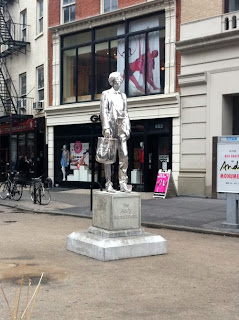
The Statue (and Stature) of Andy Warhol

Artist Rob Pruitt unveiled his statue of Andy Warhol in Union Square on Wednesday, and it didn't take long for passersby to whip out their cell phones and take pictures of the famous artist. Such is fame. Covered in chrome, Warhol is dressed in jeans and a jacket with tie, the kind of mix of informality and formality that signifies the departure of buttoned-down culture and the dawn of the a more liberated era in the United States. We recognize the figure is Warhol from the chiseled cheekbones, wig, and glasses. In his right hand he's carrying a "medium brown bag," the signifier of the upscale Bloomingdale’s department store, the kind he would use to hold copies of Interview magazine, the oversize splashy publication he started in 1969. Around his neck is the strap for the Polaroid camera, one of the artist's favorite and instantly gratifying media for capturing an image, a necessary component of fame.

It seems fitting, of course, that in the presence of a famous man sporting a film camera, people seem instinctively driven to snap a picture. At the unveiling, members of media organizations brought out their high-end digital cameras, devices mostly confined to the inventor's laboratory during the Warhol 70s. One can presume that people take pictures of whatever sort for the many reasons that Susan Sontag noted in her book On Photography, among them, just to prove that they were there. "Photographs will offer indisputable evidence that the trip was made, that the program was carried out, that fun was had," Sontag writes. In this case, that the Warhol statue was seen. Viewers may also feel some connection to the artist, and they take pictures to reaffirm their relationship. What's funny is that this chrome statue, reflecting light back out onto the environs of Broadway and E. 17th Street, is particularly hard to photograph. Fittingly so, because as Warhol scholars have pointed out, he used his camera not only to turn reality into an image but to keep real people at arm's length.


Related Posts Plugin for WordPress, Blogger...