Monday, January 31, 2011

A Walk for the Roses: Will Ryman's Installation on Park Avenue

Park Avenue is ordinarily not that much fun for pedestrians. A thoroughfare dominated by formidable and expensive apartment buildings and with few shops, Park Avenue is more amenable to vehicular traffic than foot traffic. It's inhumanly wide, so that even the most in-shape pedestrian, hurrying to cross the street, gets stuck in the median. As a site-specific installation, Will Ryman: The Roses, a work consisting of glorious 38 blossom sculptures from 57th to 67th Streets, helps ease this everyday city stress.

Will Ryman: The Roses

Towering 25-feet tall stems, a few gathered bouquets near the ground, and many strewn petals, all fabricated in tough weather-resistant materials, make for visions of pink and rose beauty for winter-weary New Yorkers. Don't miss the bugs. Ladybugs, beetles, and bees have landed on top of the blooms or under a petal, or they're scurrying up a stem. This stretch of Park Avenue possesses an undulating topography, so The Roses can be seen from varying vantage points. Also plan to revisit the roses with the change of seasons. The blossom sculptures, on view through May 31, 2011, should highlight the gradual restart of the growing season. Many of us are ready for that.

Sunday, January 30, 2011

January 2011 Highlights: A Slide Show

January is not quite over, but here are a few additional images of New York scenes from this snowy month. All images taken with the iPhone 4 and various apps.

Saturday, January 29, 2011

Pictures from 70 Days of Walks: Days 22 - 28

Yes, it snowed. It snowed a lot. Before that, it was cold. Very cold.

Day 22. An afternoon walk west to the far West Village.
Intersection of W. 4th Street and 8th Avenue, looking south. 4:28 p.m.

Never mind all that. I have become part of the weather now, a singular force at 5' 4" in a parka and hat, moving in a general north by northwest direction and then shifting to the south. Actually, I walked in every direction this week, facing the fronts arriving from wherever they came. Mostly, I wanted to walk downtown.

Day 23. Walking south on W. Broadway near intersection with Prince St.
A cold, cold day. 3:44 p.m.

I was after the light. The light in New York this week, as the snow piled on top of snows, was spectacular. As fronts moved quickly, the sky would clear, leaving behind a luminous sky, the kind you see in American landscape paintings or in Maxfield Parrish pictures. Artificial light from fluorescent and LED lights, red and green stop lights, street walk signs, street lamps, and car lights danced with the white lights of bountiful snow. The sun, low over the horizon to the south, found a way to light the tops of buildings and the occasional puddles of slush on the street.

Day 24. Looking east to Mercer Street, just north of Houston.
4:06 p.m. 

Thursday, January 27, 2011

The Snowiest January Ever: Images from a Morning Walk

According to the Weather Channel, 19 inches of snow fell in New York yesterday, as measured in Central Park. An unexpected amount of snow fell yesterday morning, and a considerable snow fell overnight.

Total snowfalls for January 2011 have broken the all-time record for the month.

Schools are closed. City bus service has been suspended.

That leaves walking.

on Mercer Street near Houston. Is this your car?

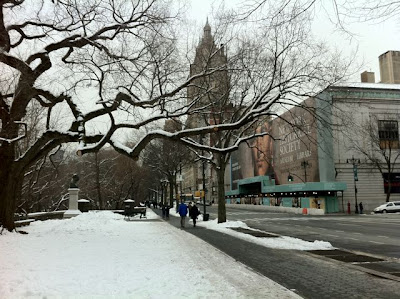
'gton Square Park, Greenwich Village.

Washington Square Park, looking north toward Fifth Avenue

Wednesday, January 26, 2011

At the Morgan Library and Museum: The Kasper Collection and The Diary

Mannerism and Modernism: The Kasper Collection of Drawings and Photographs
Through May 1, 2011

The New York-born fashion designer Kasper (Herbert Kasper, b. 1926) may be best known for his collection of feminine dresses for Joan Leslie, but his private collection of drawings and photographs, a selection of which is currently on display at The Morgan Library and Museum, celebrates his keen eye for art. In building the impressive collection, Kasper did not acquire works indiscriminately but focused on three primary areas - Old Master drawings, mostly in the sixteenth century Mannerist period; twentieth-century drawings of the likes of Picasso, Degas, Matisse, and Dubuffet; and works of contemporary photography by emerging artists, many of whom became established art world names.

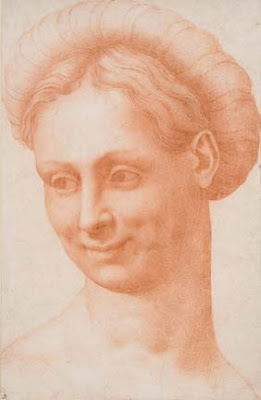
Baccio Bandinelli (1493–1560)
Head of a Woman Wearing a Ghirlanda
Red chalk
11 1/4 x 7 1/8 inches (28.6 x 18.1 cm)
Kasper Collection
Photography by Brad Dickson

The latter collection of contemporary photographs is quite stunning in context. While we would expect to see a fine drawing from a student of Raphael or of Caravaggio at the Morgan, a museum with a deep collection in Old Master drawings, it's a pleasant jolt to walk into the West Gallery at Mr. Morgan's place to see works by Ed Ruscha, Vera Lutter, William Eggleston, Jenny Holzer, Adam Fuss, and Robert Mapplethorpe. Furthermore, they've mixed it up in the East Gallery, so an Italian drawing of an angel circa 1598 by Andrea Lilio shares wall space with a 1997 Vik Muniz chromogenic print of a work made with chocolate syrup. Why not? Splendid, too, are the cubist drawings, grouped together, by Picasso, Gris, and Léger.


William Eggleston (b. 1939)
Stage 14, Parking Lot, Hollywood, 1999–2000
Iris print
24 x 30 inches (61 x 76.2 cm)
Kasper Collection
© Eggleston Artistic Trust
Courtesy Cheim & Read, New York

Monday, January 24, 2011

Befriending Mr. Chickadee: Winter Birding in Central Park, circa 1900

"New York is the metropolis of sparrowdom." 
- from "New York's Winter Birds," The Osprey, 1900.

Looking back to 1900 to see how New Yorkers spent their winter, a few dozen people, maybe many more, were trying to tame chickadees in Central Park. New York City is known as one of the best birding spots in North America, and a search for winter birding activity in Central Park, a favorite spot, turns up several entertaining items from 1900, give or take a few years. What makes the following reading fascinating is that the bird observers of 1900 displayed an eagerness to prove a likeness between the feathered friends and their fellow New Yorkers.

from American bird magazine; ornithology, Volume 3 by Chester Albert Reed, 1903

1. "Winter Birds in a City Park" by James B. Carrington, Popular Science Monthly, Jan. 1900, p. 366

According to writer Carrington, a winter walk in Central Park is made pleasant by observing winter birds, among them, a hardy robin "who perhaps prefers the dangers of a northern winter to those of the long journey southward" and "the rugged and noisy English sparrows." The writer confesses a sympathy for the sparrows - "for they appeal to my sympathies much as the plucky little gamin newsboys of the streets do." Particularly thrilling for him is the sight of "Mr. Chickadee himself, with his jet-black head, throat, and chin, and gray cheeks."

A woman takes time to befriend a squirrel, from "Winter Birds in a City Park, "
Popular Science Monthly, January 1900.

Saturday, January 22, 2011

Pictures from 70 Days of Walks: Days 15 - 21

"Polar high pressure." This is the phrase I read this morning in the National Weather Service's discussion of upcoming weather conditions in New York. This past week may feel somewhat balmy in comparison.

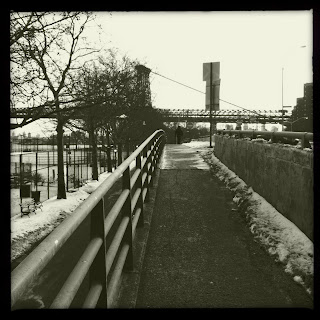
Day 15. A walk along the East River Park Promenade.
Described in Wednesday's post. The weather was fairly calm, a little chilly,
but manageable. You don't want to be near water in the wind.

"The average city dweller regards snow as a nuisance. It interrupts transportation, and interferes with wire communication; it makes automobiling impossible, so that we are reduced to the necessity, so humiliating to some of us, - of walking, and of wearing cumbersome rubbers or boots."- from the essay "Snow, An Asset or Liability?," The Mentor, Volume 8. (New York: Mentor Association, 1921)

Day 16. This is New York, after all, and a little jaunt to the Theatre District
serves as a reminder of place. Lunt-Fontanne Theatre, 205 W 46th St.

The rain or snow or blowing wind this week made walking at times difficult. I fantasized that I would later be found, like Per Hansa in the novel Giants of The Earth, as a frozen figure in a snow storm. Growing up in Texas, reading the story about Norwegian immigrants struggling to build a life on the Dakota prairie scared me. My school made us read it in seventh grade.

Friday, January 21, 2011

Taking a Constitutional Walk

A long time ago individuals going out for a walk, especially to get fresh air and exercise, often referred to the activity as "taking a constitutional walk." The word "constitutional" refers to one's constitution or physical makeup, so a constitutional walk was considered beneficial to one's overall wellbeing. (Or, as some would prefer to call it, "wellness.") The phrase is more common in British literature than in American letters.

As early as the mid-nineteenth century, many American commentators expressed concern that their countrymen were falling into lazy and unhealthy habits. Newspaper columnists and editorial writers urged their readers to take up the practice of the "constitutional" walk.


One such essay, "Walking as an Exercise," originally printed in the Philadelphia Gazette and reprinted in New England Farmer, Volume 11, 1859, urges the people of farm areas to take up walking. City dwellers seemed to have the advantage, according to the writer, especially "the city dames."

City ladies walk more than country ladies

"Ladies in the country hesitate about venturing abroad on foot; and they remain within doors, or in quiet inaction, while the city dames, who are presumed to be "delicate," and unable to endure fatigue, walk miles over the pavements, without thinking of the exertion."

Walking is better than the gym

"We have no objection to dumb bells, and other paraphernalia of the gymnasium. But none of these contrivances are half so beneficial as the use of our natural means of locomotion."


Wednesday, January 19, 2011

Tentative Steps along the East River Park Promenade

With a blustery weather week of ice and snow, it's probably not the most opportune time to discuss the merits of a constitutional walk along the East River. Yet, while on a recent walk to a revamped section of the East River Park Promenade, a stretch north of the Williamsburg Bridge from E. Houston St. to E. 10th St., a few joggers and walkers didn't seem to mind the chilly excursion. The sky was mostly clear, with a few clouds adding visual interest. And never mind the fact that that the Parks web page on East River Park, at the time of this adventure, stated that this particular section of the waterfront promenade was closed for renovations. The more accurate statement could be found on the Parks sign for the John V. Lindsay East River Park Promenade, as it is so named, near the water's edge: "Sections of the new promenade will be open to the public as they become ready." This section seems ready enough.

While the river is historically important, serving as a major shipping lane for centuries, teeming with sailors, markets, tenements, wharves, and industrial sites, the fast-flowing East River still carries a lot of baggage. Deep associations with the rough-and-tumble world of the Dead End Kids or gritty crime dramas - bodies tossed in the East River, don't you know - may keep some away. The glamorous Hudson River often gets the good press, upstaging its eastern counterpart. Brooklyn, over yonder, may have established better relations with the East River than Manhattan, as their creative new Brooklyn Bridge Park, with its repurposed piers, has already afforded new close-up views and access to the waterway. (Their view of Manhattan is kind of nice, too.) Yet venturing out on the new refurbished promenade of the East River Park on the Manhattan side should appeal to those best suited to strolling among the basic elements of river, bridge, sky, and smokestacks.

Getting there is half the fun. One way is to walk east on E. Houston Street to where it dead-ends, run fast across FDR Drive, and then locate the ramp down to the park. Walk south along the promenade to the Williamsburg Bridge and then turn around and walk north to E. 10th Street (there’s an access ramp there) and return, or keep walking north. One walker I met indicated he had just walked south from near the United Nations and recommended a longer stroll. Maybe another day, but soon.

Some Pictures


Monday, January 17, 2011

New Adventures in Street iPhoneography: Imagining New York in Camera Apps

With the increasing popularity of phone cameras, thousands of apps have hit the market in the last year or so. At the time of this writing, the iTunes app store features nearly 3500 apps in the category of photography. While the built-in camera on the iPhone 4 shows vast improvement over the earlier version, many developers have found ways to improve on Apple's camera by offering apps that incorporate vintage filters, panoramic stitching, the looks of Lomography, editing, cartoon and other special effects, and much more. Two new sensations include Instagram, an app that includes several filters for vintage effects and instant sharing, and 8mm Vintage Camera, an app for the movie mode that simulates the look of old home movies or experimental film.

A page on Walking Off the Big Apple's iPhone 4.
Getting carried away with the camera apps.
For the purposes of this website, I've taken to the world of iPhoneography in a big way. I don't need a big camera anyway. I consider myself more a writer than a photographer, and the kind of images I take of New York scenes, especially the ones that slightly alter "reality," appeal to my sense of creative nonfiction. As we often imagine New York City through the lenses of novels, plays, photographs, and films, we're always engaging in a dialogue between the representations of the city and our own lived experiences. While walking the streets, we may encounter a variety of representations of New York whether it's a DC Comic version of Gotham City, Holly Golightly's Fifth Avenue, New York as the white witch as perceived by James Weldon Johnson, or Piet Mondrian's abstract painting, Broadway Boogie Woogie (1942-1943), just to cite a few examples. The ability of the iPhone apps to create or recreate fictional representations of the city or the vibe of certain neighborhoods appeals to me as a writer.

For today, let's just look at three apps.

Pro HDR

The iPhone 4 camera has an optional setting for HDR, or High Dynamic Range, meaning the ability to combine a wide range of light and dark in one image. The process often involves merging an underexposed image (dark) and an overexposed image (light), or even many more images along the range, so that what is usually perceived by the human eye - a starry night or a cloudy sky above dark city streets - might be better rendered in a photographic image. Just because you can see it doesn't mean your camera can.

Before the last snowfall arrived, the clouds rolled in from the south. Here - a moment on Broadway near the intersection with Bond Street. Made with Pro HDR. It was important to capture the clouds and sky. 

Saturday, January 15, 2011

Pictures from 70 Days of Walks: Days 8 - 14

While setting out on daily walks this week, part of the ongoing project Pictures from 70 Days of Walks, the harsh weather made me seriously reconsider my commitment. It was literally freezing outside, with a cruel wind blowing down the urban canyons. For the first half mile or so, my thoughts often focused inward, stuck on the monotonous thoughts of the brutal wind. I can take the cold. I just can't take the wind.

Day 8. From a stroll along Central Park West.
See more at the post Central Park West: The Theater of Architecture.

Around the one-mile mark of these 2.5-mile daily walks, I'm warmed up sufficiently to shift my focus outward and to begin noticing the winter lights and colors dancing on the architecture. By the second mile I've hit my stride, and if I stay in the moment I can shift into a higher state of awareness and observance.

Day 9. In front of the New Museum on the Bowery.
See more at the post Economy Eye Candy: An Eclectic Walk on the Lower East Side
and A Rose for the New Museum.

Thursday, January 13, 2011

Economy Eye Candy: An Eclectic Walk on the Lower East Side

The idea for the previous post about Isa Genzken's Rose II sculpture on the facade of the New Museum came about as the culmination of a colorful stroll through the East Village and Lower East Side, and here I'll sketch out some of the features that made it full of color. The walk takes in this area's characteristic visual funkiness and bright splashes of eclecticism, qualities that distinguish it from many other more uniform parts of the city. The images here are from the second part of the walk, primarily from Clinton and Rivington Streets.

A vintage purple metal glider sits in a lot on the southeast corner of Clinton and Stanton Streets.
The image is a little out of focus.

Technically, the East Village was for a long time considered part of the Lower East Side, but most people over the last few decades have agreed to set the southern boundary of the East Village and the northern boundary of the Lower East Side at E. Houston Street. Similarly, Houston St. divides SoHo from NoHo. It's not like crossing Houston Street implies a gateway into a radically different neighborhood, but the street is wide enough to establish some distinctions of place on either side. Yet, the presence of street art, murals, graffiti, and vernacular ornamentation makes parts of the East Village and Lower East Side seem more together than not. The visuals make this area often more entertaining to walk than the more visually cohesive neighborhoods like the West Village. I suppose it depends upon one's mood and personal tastes.

Alias Restaurant, 76 Clinton Street, at the intersection with Rivington Street.

Wednesday, January 12, 2011

A Rose for the New Museum

Man may be the measure of all things, as Protagoras would claim, but for the next ten months or so, somewhere in the vicinity of the Bowery and Prince Street, a rose may provide the measuring stick. The New Museum's second presentation of their Façade Sculpture Program, a work titled Rose II (2007) by Berlin-based artist Isa Genzken, offers the strolling public the spectacle of a twenty-eight-foot tall long-stemmed blushing rose. The rose, made of stainless steel, aluminum and lacquer, stands upright and rigid, perched on an outdoor ledge of the museum (235 Bowery), quite graceful and nimble considering there's no vase to set it up so straight.  


Scaling up people and objects for the purposes of public art is nothing new. The examples in New York include hundreds of larger-than-life statues of famous historical figures, some with their horses, as well as many lions, a charging bull, and several bears. The most famous of all public art sculptures would be that statue of a very impressive woman in New York Harbor, a gift from France. Examples of simple objects made big come to mind, including the Fashion District's giant needle and thread (1995) by Pentagram Architectural Services on Seventh Avenue and Jeff Koons’s Balloon Flower (1995-2000) downtown at 7 WTC Park. Manipulating objects with respect to scale makes us take them less for granted, leading to a heightened sense of observation about its other physical properties and its intangibles, including symbolism and meaning. In the case of a giant rose, we can start with stems, leaves, and petals, but we will no doubt leap to many other spiritual and emotional associations, among them, peace, love, and beauty.  

Monday, January 10, 2011

Central Park West: The Theater of Architecture

A stroll along Central Park West works well for those who like their walks straight and uncomplicated, their architecture on the theatrical Art Deco side, and their nature decorated with seasonal beauty and well-designed artifice.

Central Park West, looking south. Central Park is on the left (east),
with the New York Historical Society (under wraps for renovation) on the right (west), near W. 77th St.

This walk, from the northwest corner of the park at 110th Street straight down to W. 59th Street - the entire west side of Central Park - emphasizes the theatrics of the architecture. (Images below shows sites from north to south in sequence.) Many of the apartment buildings along the way share a resemblance to the theatrical Art Deco movie palaces of the 1930s, especially the twin-towered apartment buildings of the Century and the Majestic (by architect Irwin Chanin), the San Remo (Emery Roth), and Eldorado (Roth and the firm of Margon and Holder). It's not surprising that several entertainers live in these buildings, but the well-reported incident from a few years ago of one apartment building turning down Madonna as a resident underscores the presence of old-school and publicity-shy New Yorkers.

Now 455 Central Park West Condominiums, at W. 106th St. Formerly New-York Cancer Hospital, and later Towers Nursing Home. built 1884-1886. French architectural influence, like castles of the Loire Valley.

The Eldorado. 1929-1930 by Emery Roth, consultant
and the firm of Margon and Holder. Fanciful Art Deco touches

Saturday, January 8, 2011

Pictures from 70 Days of Walks: Days 1 - 7

The first post of the new year on this website, A Winter Walk in Hudson River Park, suggested a new way to think about diet and exercise resolutions. This post is the first follow-up, offering clarifications and more ideas, illustrated with images from the first daily walks of 2011.

Day 1. A winter walk along the shoreline on New Year's Day
revealed the beauty in shades of winter blues.


In place of weight loss as a primary goal, another mission - seeing new things and living a larger life - is substituted, so that the experience becomes the primary goal and losing extra pounds become the ulterior, or underlying, motive.

Day 2. I discovered many charming places during a walk
to Stuyvesant Square and beyond, enough to write about it.  

Thursday, January 6, 2011

A Roundtrip Walk to Stuyvesant Square and Vicinity

A walk north to Stuyvesant Square, a park situated between E. 15th St. and E 17th St. and named in honor of Peter "Old Peg-Leg" Stuyvesant (c. 1612-1672), Director General of New Netherland, could begin on Stuyvesant Street and 3rd Avenue in the East Village and then proceed to St. Mark's Church in-the-Bowery at the street's intersection with 2nd Avenue. It would be a relevant starting place. "Pieter" or "Petrus" Stuyvesant is interned here. The current church, built by his great-grandson, is on the corner where the Stuyvesant family chapel once stood during the Dutch period. The church and its grounds are worth exploring, but there will be other remarkable sites along the way ahead, including many more references to Petrus, Pieter, Peters, and Pete's.

Peter Stuyvesant in Stuyvesant Square. Peg-legged.

Between E. 15th Street and E. 17th Street, Second Avenue bisects Stuyvesant Square. On the west side, several houses of worship dominate the park - the modernist St. Mary's Catholic Church on the south, and the Religious Society of Friends (Quakers) and St. George's Episcopal Church along Rutherford Place on the west, and East End Temple Congregation El Emet on the north side. In the park, a statue of Peter Stuyvesant, jaunty peg-leg and all, serves as a focal point, a rather ironic situation as Peter persecuted many of the religious groups that now surround him. Many New Yorkers are familiar with this area, as they make doctor visits to the Beth Israel Medical Center to the east. (The staff on this side of the park could have helped with that peg-leg.) Farther to the east is the large residential complex of Stuyvesant Town.

Wednesday, January 5, 2011

A Walk to a Mews and Alley, Unplowed

Even as the snow started to come down, and the snow was blowing hard by that Sunday night, one wondered when the plows would come. As the night fell into day, the city awoke under a great canopy of powdery snow, the kind more typical of Aspen or Vail than Uptown or Downtown, and the snow had arranged itself in artistically creative drifts. As the snow fell from the sky, it turned cars into white abstract sculptures, burying the hoods and roofs and settling around the tires, demobilizing even many in motion and abandoned in the middle of the street.

The scene on Monday morning presented a pretty sight, but still the plows, for many, especially in the outer boroughs and on side streets throughout the city, were nowhere in sight. The plow trucks, as expected, took care of the big avenues first, and then the smaller side streets, although hours and days would go by before many of these were cleared. Emergency vehicles could not find their way to rescue the suffering. The city is currently investigating why the plows did not come.

MacDougal Alley, Wednesday, December 29, 2010 at 1:37 p.m.

Forget the alleys. A few days after the storm, I decided to peek in on two of the most famous small alleys in Greenwich Village - MacDougal Alley and Washington Mews - to see how they fared during the blizzard. These little places, nestled on either side of Fifth Avenue between Washington Square North and 8th Street, with MacDougal Alley on the west and Washington Mews on the east, seemed removed in place and time from the modern politics of snowplows, winter postcards from the past.

Sunday, January 2, 2011

A Winter Walk in Hudson River Park, with a Plan for New Year's Diet and Exercise Resolutions

The first day of a new year typically brings with it the common resolutions to exercise more and eat less. Plans are made to stick to an exercise schedule and to cut back on calories, both designed in tandem to undo some of the damage of the holidays - the gluttony and the sloth, the multiple sins of one more cookie and another hour of sitting and watching TV on the couch. The season of penance begins.

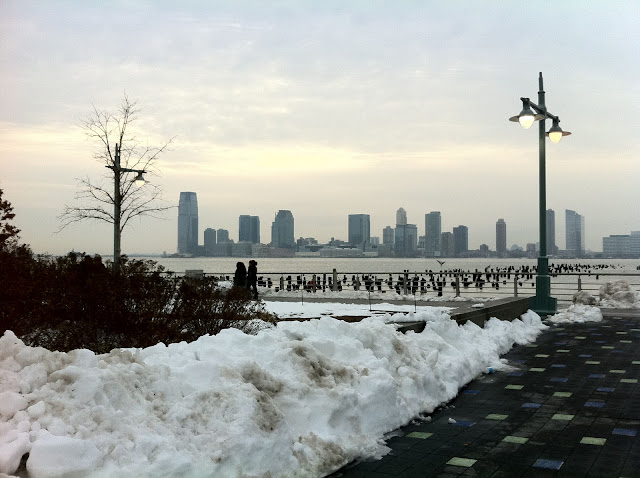
Hudson River Park, Tribeca section, looking across the Hudson River to New Jersey.


It's a relief the holidays are over. One more week of such indulgences, and the clothes in the closet would not fit. Come January 1, many who make New Year's resolutions visualize a healthier and leaner self in the near future, some 6 to 10 weeks from now. Visualizing oneself as a movie star - ha, ha, ha - is nevertheless a good beginning.

Walking south to Battery Park City.

As many well know, it's easy to slip on these goals. The weather takes a turn for the worse, and the natural inclination is to stay home. A winter cold or flu arrives, thwarting our dreams of running through the park. A thrilling jog along the trail is sabotaged by a sudden twisted ankle. A diet of yogurt and grapefruit grows tiresome, losing out to a giant red box of Valentine's Day candy.

Related Posts Plugin for WordPress, Blogger...