I've become so familiar with President Barack Obama's frequent trips to my neighborhood, such as his appearance last night at a fundraiser at Vogue Editor Anna Wintour's townhouse on Sullivan Street, that I know the routine by heart. It goes this way. In the morning, the Command and Control Center, a big white NYPD van, sets up shop nearby, followed by the arrival of hundreds of NYPD policeman, some in patrol cars, others on motorcycles or plain bikes, as well as the blue-shirted community affairs specialists. After the policeman gather to hear their instructions or check their equipment, they fan out to their designated positions. Street barriers begin to appear along the route. A policeman takes a stroll through our apartment's laundry room. For the many of us Village types of a certain age, we have flashbacks to the Vietnam War.
The neighbors go about their business, passing one another on the streets or in shops, but they will talk about the events. Shopkeepers vent worries that no one will be able to get to the stores or restaurants. Typical comments address the enormous taxpayer expense or personal hassle involved with these high security visitations by the President of the United States. Helicopters are involved. There are a lot of sirens and the towing of cars. At every single one of these visits, a poor delivery person on a bike, oblivious to what's happening, ends up casually cruising past a police barricade and into the arms of a nearby patrol officer. Bystanders enjoy these occurrences. Several neighbors panic that they cannot reach their homes.
Then there's a lot of waiting. Knowing the routine, I stayed in my apartment until the arrival of helicopters started shaking the building. Then I knew that the POTUS motorcade was on the scene. Even then, I had no real motivation to leave the house, especially as I was not invited to the affair.
a walking guide to New York City and self-guided walking tours by Teri Tynes
Pages
- Home
- New York City Self-Guided Walks (by Area)
- New York Literary Walks
- NYC Art Exhibitions
- NYC Music, Movies, Theater
- Architecture and Urban Planning
- Greenwich Village
- U.S. History
- NYC Parks
- New York by Season
- NYC Photography
- Walking for Fitness
- Best New York Apps and Maps
- Walking Off Wall Street
- Walking Directions
- All About WOTBA
- Press
Thursday, July 29, 2010
Monday, July 26, 2010
Walking an Uncertain Wall Street: A Strolling Guide to Stops, Sleepovers, and Anxieties in the Financial District
![]() |
| Bank of New York Mellon at 1 Wall Street. |
![]() |
| Maiden Lane |
![]() |
| Walk where the streets lead |
Wall Street, the actual street in lower Manhattan, as opposed to the highly-charged symbol of high finance, can be coldly seductive. Beginning with the formidable Art Deco masterpiece at 1 Wall Street, Bank of New York Mellon, there's something alluring, dangerous even, in the way the narrow street moves down its shadowed canyons toward the East River. In their steely heights, the famous Stock Exchange on Broad Street, the Morgan building, the Federal Hall, the Trump Building, Tiffany's, the Bank of New York Building, and others, lure the visitor into the corridors of power. The fact that there's a heavy security presence at the Stock Exchange can create an aura of exciting danger. It's helpful to have Trinity Church at the head of the street, praying over the whole dark den of worldly greed.
Monday, July 19, 2010
Matisse at MoMA
A review of Matisse: Radical Invention: 1913-1917 at the Museum of Modern Art (July 18 - October 11, 2010)
The exhibition, Matisse: Radical Invention: 1913-1917, at the Museum of Modern Art (July 18 - October 11, 2010) offers a compelling case to reassess a famous painter too often and too easily taken for granted. Even the most casual of art lovers are in love with the paintings of Henri Matisse (1869–1954) - the sensual bright colors, the nudes encircled in a dance, the sumptuous French interiors, the Jazz cutouts, and his exotic decorative patterns. A good Matisse poster seems to always perk up a dull room. Looking at many Matisse can provide a quick escapist vacation whether it's a window opening to the southern coast of France or to the cliffs of Tangiers. Such a one-sided view of Matisse, however, shortchanges the artist. It's hard to remember that the artwork, so loved now, was once considered by critics to represent an affront to respectable art. The exhibit at MoMA brings the experimental and avant-garde Matisse back into proper perspective.
The exhibit begins several years after Matisse's solo debut at Ambroise Vollard's gallery and the group exhibit of the Fauves. The works from 1905, especially compared to the subdued palette on display in the MoMA exhibit, come across as insane with color, a garish infraction of the rules. You can see where critic Camille Mauclair was coming from when he pronounced, "A pot of paint has been flung in the face of the public." An exhibition at the 1910 Salon d'Automne of two murals, La Danse (Dance) and La Musique (Music), two works signifying a shift in emphasis and made for collector Sergei Shchukin, met with equally harsh critical reception. The artist flees to Spain and Morocco, absorbs new lessons of decorative art and color theory and returns to Paris. The MoMA exhibit includes this valuable prequel, establishing patterns (quite literally) and themes for the artist's developing visual language. He also returns to Paris life more of a Cubist, fixating on geometric forms, a more reserved palette, and a willingness to edit information down to the lowest linear denominator. Importantly, we see Matisse making decisions in his studio, the sort that involves the intellect more than the senses.
The exhibition, Matisse: Radical Invention: 1913-1917, at the Museum of Modern Art (July 18 - October 11, 2010) offers a compelling case to reassess a famous painter too often and too easily taken for granted. Even the most casual of art lovers are in love with the paintings of Henri Matisse (1869–1954) - the sensual bright colors, the nudes encircled in a dance, the sumptuous French interiors, the Jazz cutouts, and his exotic decorative patterns. A good Matisse poster seems to always perk up a dull room. Looking at many Matisse can provide a quick escapist vacation whether it's a window opening to the southern coast of France or to the cliffs of Tangiers. Such a one-sided view of Matisse, however, shortchanges the artist. It's hard to remember that the artwork, so loved now, was once considered by critics to represent an affront to respectable art. The exhibit at MoMA brings the experimental and avant-garde Matisse back into proper perspective.
The exhibit begins several years after Matisse's solo debut at Ambroise Vollard's gallery and the group exhibit of the Fauves. The works from 1905, especially compared to the subdued palette on display in the MoMA exhibit, come across as insane with color, a garish infraction of the rules. You can see where critic Camille Mauclair was coming from when he pronounced, "A pot of paint has been flung in the face of the public." An exhibition at the 1910 Salon d'Automne of two murals, La Danse (Dance) and La Musique (Music), two works signifying a shift in emphasis and made for collector Sergei Shchukin, met with equally harsh critical reception. The artist flees to Spain and Morocco, absorbs new lessons of decorative art and color theory and returns to Paris. The MoMA exhibit includes this valuable prequel, establishing patterns (quite literally) and themes for the artist's developing visual language. He also returns to Paris life more of a Cubist, fixating on geometric forms, a more reserved palette, and a willingness to edit information down to the lowest linear denominator. Importantly, we see Matisse making decisions in his studio, the sort that involves the intellect more than the senses.
Links to this post
Labels:
art review,
artists,
Matisse,
MoMA,
museums,
New York,
sculpture
2
comments
Thursday, July 15, 2010
Dinner & a Movie: A Guide to NYC Movie Theaters & Nearby Bars & Restaurants
Twenty-four movie theaters and over ninety bars and restaurants are included in this selected guide for good places to dine, drink, or get a cup of coffee before or after the movies. Click on a placemark for a New York movie house, and see Walking Off the Big Apple's suggestions for a nearby place within walking distance. Some are restaurants, others are bars, and several feature that nice middle ground called "bar food."
View Dinner & A Movie: A Guide to NYC Movie Theaters & Nearby Bars & Restaurants in a larger map
A New York friend who goes to the movies all the time recently asked me about new places to try near favorite movie theaters, so this map is my elaborated answer. She was particularly interested in places near many of the cinemas specializing in independent or classic cinema, theaters like the IFC, Film Forum, Landmark Sunshine, and Cinema Village. Many of these pioneering cinemas are located downtown, and they continue to play an important part of the area's creative heritage. Now, with the ever-changing dining and bar scene, it's possible to try many variations on the old standby date of dinner and a movie.
Images and map by Walking Off the Big Apple. Above: Three good pairings of movie theaters and nearby places to eat and drink - Angelika Film Center (Houston and Mercer), with Fanelli's Cafe (Prince and Mercer); IFC (6th Avenue and 3rd St.) with Home Restaurant (Cornelia St.); and Film Forum (E. Houston) with Cafe Henri (Bedford St.). Readers are most welcome to add their favorites in the comment section.
View Dinner & A Movie: A Guide to NYC Movie Theaters & Nearby Bars & Restaurants in a larger map
A New York friend who goes to the movies all the time recently asked me about new places to try near favorite movie theaters, so this map is my elaborated answer. She was particularly interested in places near many of the cinemas specializing in independent or classic cinema, theaters like the IFC, Film Forum, Landmark Sunshine, and Cinema Village. Many of these pioneering cinemas are located downtown, and they continue to play an important part of the area's creative heritage. Now, with the ever-changing dining and bar scene, it's possible to try many variations on the old standby date of dinner and a movie.
Images and map by Walking Off the Big Apple. Above: Three good pairings of movie theaters and nearby places to eat and drink - Angelika Film Center (Houston and Mercer), with Fanelli's Cafe (Prince and Mercer); IFC (6th Avenue and 3rd St.) with Home Restaurant (Cornelia St.); and Film Forum (E. Houston) with Cafe Henri (Bedford St.). Readers are most welcome to add their favorites in the comment section.
Links to this post
Labels:
cinema,
film,
guide,
movie,
moving image,
New York,
restaurant,
restaurants
2
comments
Tuesday, July 6, 2010
A Walk from The Plaza to The Waldorf: A Guide and a Map
![]() |
| The Plaza Hotel |
I've been curious of late to see if the Plaza Hotel has regained any of its older flair, being one of those people more than disappointed with its renovation. As a member of the shabby genteel, I can state with some assurance that the old hotel is lost, and a recent visit did not help allay my fears. A great hotel needs a great hustle and bustle in its lobbies and a rapid movement in and out of revolving doors - many people at the hotel desks, people sitting in the lobby chairs, families waiting on the late ones so they can go to the museum, a concierge explaining availability of tickets to a Broadway play, business people heading to the bar, and so on. The whole place should smell of old roses, a variety of perfumes, mildew, and cigar smoke from fifty years ago. The Plaza, which once had everything going for it, is lacking in these areas.
The hotel, though seriously gutted of its Old World ambiance, at least now has Todd English's Food Hall, a fairly interesting market that offers a variety of foods and counter service. The handsome Boston celebrity chef has brought us a wine bar, a place for charcuterie, a cheese and dessert bar, a pasta bar, and a nice three-quarter-sided dining counter for seafood. Even if some of the market items are available at any New York grocery store, the counter space is welcome, especially for light fare and a glass of wine. I can see the Food Hall working really well in the holiday season. For those who remember the old Plaza and miss the wonderful feeling of its lobby, I recommend revisiting the space through the cinematic magic of movie rentals.
![]() |
| Louis Vuitton |
We're looking for the smell of old hotel lobbies, the kind of thing that should be sprayed into new hotels to make them more authentic, so we'll press on with our walk. We'll walk south on Fifth Avenue to 57th Street and turn east, stopping to look at the charming window display at Louis Vuitton in honor of the great French photographer Jacques Henri Lartigue. This designer homage to the photographer, best known for his youthful images of Paris, celebrates the enduring whimsicality of the Eiffel Tower, especially the sort of luggage it takes to get there.
Links to this post
Labels:
architecture,
books,
cinema,
guide,
hotels,
Midtown,
movie,
New York,
restaurant
3
comments
Sunday, July 4, 2010
Scenes from a Morning Bike Ride: A Cruise Ship, Times Square, Sidewalk Catwalk, and Fifth Avenue
There's a strange emptiness on a city morning on the 4th of July. It's a perfect time for a bike ride, as the traffic is nonexistent and the streets are wide open. The emptiness will not last long, however, as millions of residents and visitors head over to the Hudson River later today to see the fireworks show.
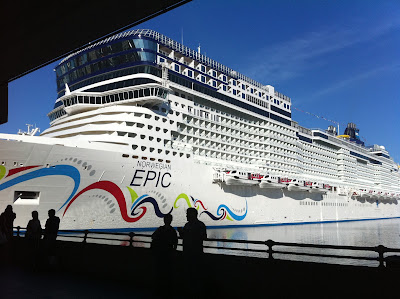
This morning I rode up the Hudson River Park to see the Norwegian Epic, the newly-christened cruise ship of truly epic proportions that has anchored in the Big Apple. The 4100-passenger boat, which barely cleared the Verrazano-Narrows Bridge as it made its way into New York Harbor, will serve as the main stage for the evening's entertainment.
From there, I rode east on W. 50th Street through a quiet Hell's Kitchen (you'd think Hell would be noisier) and then on to the Theatre District. On Broadway, I turned south. Riding a bike through Times Square is one of the great pleasures of the modern metropolis.
Though the streets were quiet, the billboards and neon lights still illuminated the avenues. Most people associate Times Square with late in the evening, but I recommend visiting at 8 o'clock on a holiday morning, especially if it's a Sunday.
This morning I rode up the Hudson River Park to see the Norwegian Epic, the newly-christened cruise ship of truly epic proportions that has anchored in the Big Apple. The 4100-passenger boat, which barely cleared the Verrazano-Narrows Bridge as it made its way into New York Harbor, will serve as the main stage for the evening's entertainment.
From there, I rode east on W. 50th Street through a quiet Hell's Kitchen (you'd think Hell would be noisier) and then on to the Theatre District. On Broadway, I turned south. Riding a bike through Times Square is one of the great pleasures of the modern metropolis.
Though the streets were quiet, the billboards and neon lights still illuminated the avenues. Most people associate Times Square with late in the evening, but I recommend visiting at 8 o'clock on a holiday morning, especially if it's a Sunday.
Thursday, July 1, 2010
New York's New Adolescence and the Play Impulse in the Contemporary Public Art
Sometimes I think New Yorkers have recovered their inner child. I'm not talking about the obsession with youth normally associated with the larger culture, of which the city is not exempt, but more about the signs of an emerging adolescent culture that manifest themselves in several aspects of contemporary urban life. A city inhabited by many young people who are prolonging their adolescence, as a recent article in The New York Times notes, (see essay by Patricia Cohen -"Long Road to Adulthood is Growing Ever Longer" ) will likely reflect a certain Peter Pan quality.
The idea of perpetual childhood seems especially pronounced in food trends, like the unceasing craze for cupcakes, those pretty confections for that special boy and girl (especially those SATC girls), as well as the appetite for fried chicken, gelato on a stick, ice cream of all sorts, chocolate cake, and gourmet hamburgers and hot dogs. Outside of food, many New Yorkers resemble children at play. We ride bikes, carry big backpacks, wear sneakers, and frolic with dogs. Because the Mayor insists we behave, we know we are not supposed to do bad things like smoke or eat too many sugary snacks. And if the development trend continues to replace older neighborhoods with a virtual facsimile of them, then we'll adopt behaviors more typical of an amusement park.
The city playground continues to expand. The conversion of once-working waterfront piers to recreational parks, the addition of hundreds of miles of bike lanes, the construction of new sports stadiums, and the repurposing of a railroad track into a park (the greatest kid fantasy of all) underscore the profound shift from a manufacturing to a consumer and recreational economy. In the realignment of the workforce to an information society, many New Yorkers find themselves in alternative work arrangements, often at home or with the laptop at the coffeehouse or working in a an open floor plan of an office, surrounded by toys, in a kind of Montessori school of the work world. Wherever we are, we seem to need to update others on our status or check in at our current location.
The way that members of the creative class interact with the city has also shifted from the manner previous generations interacted with the city. Growing up on virtual games, enveloped in personal entertainment systems (even while walking), the youthful city dweller conceives of the city as a virtual board game where places become check-in points. With the economy in crisis, many people in the city, even the most highly educated, find themselves underemployed or unemployed, improvising things to do in a summer recess without end. With opportunities for grownup work disappearing, some people start blogs or websites out of necessity or to do something constructive with all that learning they picked up in school. I predict the new LEGO store in Rockefeller Center will be very popular among all age groups.
The idea of perpetual childhood seems especially pronounced in food trends, like the unceasing craze for cupcakes, those pretty confections for that special boy and girl (especially those SATC girls), as well as the appetite for fried chicken, gelato on a stick, ice cream of all sorts, chocolate cake, and gourmet hamburgers and hot dogs. Outside of food, many New Yorkers resemble children at play. We ride bikes, carry big backpacks, wear sneakers, and frolic with dogs. Because the Mayor insists we behave, we know we are not supposed to do bad things like smoke or eat too many sugary snacks. And if the development trend continues to replace older neighborhoods with a virtual facsimile of them, then we'll adopt behaviors more typical of an amusement park.
The city playground continues to expand. The conversion of once-working waterfront piers to recreational parks, the addition of hundreds of miles of bike lanes, the construction of new sports stadiums, and the repurposing of a railroad track into a park (the greatest kid fantasy of all) underscore the profound shift from a manufacturing to a consumer and recreational economy. In the realignment of the workforce to an information society, many New Yorkers find themselves in alternative work arrangements, often at home or with the laptop at the coffeehouse or working in a an open floor plan of an office, surrounded by toys, in a kind of Montessori school of the work world. Wherever we are, we seem to need to update others on our status or check in at our current location.
The way that members of the creative class interact with the city has also shifted from the manner previous generations interacted with the city. Growing up on virtual games, enveloped in personal entertainment systems (even while walking), the youthful city dweller conceives of the city as a virtual board game where places become check-in points. With the economy in crisis, many people in the city, even the most highly educated, find themselves underemployed or unemployed, improvising things to do in a summer recess without end. With opportunities for grownup work disappearing, some people start blogs or websites out of necessity or to do something constructive with all that learning they picked up in school. I predict the new LEGO store in Rockefeller Center will be very popular among all age groups.
Subscribe to:
Posts (Atom)