Monday, June 28, 2010

New York Museum Exhibitions: Summer 2010

CLICK FOR THE UPDATED LIST OF FALL 2010 MUSEUM EXHIBITIONS.

One of the pleasures of this time of year is visiting the Roof Garden at the Metropolitan Museum, sipping a beverage, and taking in the sights of the current installation. This year's artwork of wonder is the impressive project, Big Bambú: You Can't, You Don't, and You Won't Stop by twin brothers Mike and Doug Starn (see image at left). The evolving bamboo structure is the perfect counterpoint to the formalities of the Beaux-Arts museum as well as the best match of an artwork to the summer season.

The following list includes exhibitions and openings for the remainder of the summer. A Fall 2010 list will be posted in early September.

In July, Matisse: Radical Intervention, 1913-1927 opens at MoMA (July 18, 2010 - October 11, 2010). At the Metropolitan Museum of Art, the Picasso exhibit continues through July. Look also for the Charles Burchfield paintings at the Whitney and Retro/Active: The Works of Rafael Ferrer at the El Museo del Barrio.

What follows is a list of selected museum and other art center exhibitions currently on view in New York City.

American Academy of Arts and Letters, 633 West 155th Street (Audubon Terrace):
For more on the must-see Audubon Terrace and neighborhood, see the post, A Visit to Audubon Terrace and Environs (one of Walking Off the Big Apple's 25 Great Things to Do in New York City. and see the nearby Hispanic Society, noted below.)

American Folk Art Museum, 45 W. 53rd St.:
• Approaching Abstraction
Through September 6, 2010
Women Only: Folk Art by Female Hands
Through September 12, 2010
The Private Collection of Henry Darger
Through September 19, 2010

American Museum of Natural History (Central Park West and 79th St.):
• exhibits include Race to the End of the Earth (tales of Antarctic exploration); Traveling the Silk Road; Mysteries of the Great Lakes, and more.

Brooklyn Museum, 200 Eastern Parkway, Brooklyn, New York:
Healing the Wounds of War: The Brooklyn Sanitary Fair of 1964
Elizabeth A. Sackler Center for Feminist Art, Herstory Gallery, 4th Floor
Through September 12, 2010
Kiki Smith: Sojourn
Elizabeth A. Sackler Center for Feminist Art, Herstory Gallery, 4th Floor
Through September 12, 2010
The Mummy Chamber
Long-term installation now open
• Andy Warhol: The Last Decade
Through September 12, 2010

Sunday, June 27, 2010

A Quiet Morning Spot in the West Village

It's easy to walk straight by James J. Walker Park in the West Village. On the west side fronting Hudson St., a large city ball field commands attention. On the east, the Tony Dapolito Recreational Center and the Hudson Park branch of the New York Public Library take up much of the real estate on 7th Avenue between Clarkson Street and Leroy Street. One the north side, this special block of Leroy Street is renamed St. Luke's Place, an elegant row of townhouses, nearly all with a celebrity past. One of the oddest of the most elegant homes, only odd because of the runaway greenery overwhelming the entrance, once belonged to the Jazz Age Mayor of New York, the young and handsome playboy reformer, Jimmy Walker, or "Beau James," for whom the park is named. Walking casually along St. Luke's Place, the tendency is to look at the pretty townhouse row and not at the gates to the park across the street.


Even a casual glance through the park's tall grated iron fence toward the benches in the shady seating area of the park does not reveal anything out of the ordinary there, though in many ways, the ordinariness of this park, with its pastiche of styles from the past, functions as its chief virtue. With the arrival of summer, the large parks like Washington Square Park are overwhelmed with visitors, so a bench in Walker Park seems right for locals in need of gathering thoughts before work or as an uneventful place to stop and sip coffee.


Sitting for a time in Walker Park and observing its details, however, begins to reveal that there's more than a few benches here. On the north side of the seating area, near a locked gate that opens to a small garden, full of blooming hydrangeas in the summer, sits a marble sarcophagus, graying peacefully in the shade, dedicated to three fallen firemen. A look at the NYC Parks & Rec website explains that the land here was once used by Trinity Church as a burial ground during the 19th century. In 1895 the Park department acquired the property, changed its name to Hudson Park, and hired the esteemed firm of Carrère and Hastings (New York Public Library, Henry Clay Frick House, Lunt-Fontanne Theatre) to design a new layout. In addition to a lagoon and a sunken garden, they installed a perimeter walkway, perfect for the perambulations of New York's flaneurs at the end of the century.

Tuesday, June 22, 2010

At Sotheby's for the Auction of the Polaroid Collection

At Sotheby's. Photo by WOTBA.
Over the past several days, visitors have been filing into Sotheby's New York on York Avenue and 72nd Street to look over the collection of stunning photographs of the former Polaroid Company, over a thousand images from the likes of Ansel Adams, Dorothea Lange, William Wegman, Chuck Close, Andy Warhol, Robert Frank, David Hockney, and others, artworks forced into auction by a bankruptcy judge in Minnesota so the company could pay its creditors. Visiting the works on display provided a rare chance to see some of the finest photographic work of the twentieth century and often at a rare scale, with the knowledge that as soon as the final auction gavel comes down later today, these works will likely be dispersed to far-flung locales. Many will disappear into private hands, and we may never see them again.

The sale at Sotheby's, an unusual bankruptcy proceeding for the auction house, has not been without controversy. Several artists and photo historians have expressed alarm over the breaking up of such a formidable collection, and efforts by several museums to acquire the collection broke down in negotiations. Second, and related, several artists who had participated in the company's Artist Support Program, one in which they received film, equipment, and technical support from the company over the years, have stated that they understood that the collection would remain together and stay accessible. (See A. D. Coleman's blog, Photocritic International, for details and updates on these matters. Coleman has been a leading critic.) In this video from The Deal Magazine, Sotheby's Denise Bethel, Head of Photographs, and Christopher Mahoney, Senior Specialist in the Photographs department, explain the circumstances of the auction and share their thoughts about the sale.

Lot 51
Andy Warhol
Farrah Fawcett    
Unique Polacolor Type 108 print
Est. $5/7,000
Sotheby’s New York
Photographs from The Polaroid Collection
June 21-22, 2010
Courtesy: Sotheby's New York.
Now underway at Sotheby's, with one session yesterday and three today, the Polaroid auction nearly achieved its estimated value on the first day. A rare work by Ansel Adams, "Clearing Winter Storm, Yosemite National Park," one of several monumental mural-sized prints by the photographer at the auction, sold for $722,000, much higher than the expected $500,000. Adams, a friend of Polaroid founder Edwin Land, helped develop the non-Polaroids for the company's Library Collection, buying works by Edward Weston, Dorothea Lange, Harry Callahan, and others. Also at auction are several works by Andy Warhol, a famous user of Polaroid cameras. According to Art Daily's story on the first session, the auction record for an Warhol photograph was broken twice, with the sale of the funny large close-up, "Self-portrait (Grimace)" and then "Self-Portrait (Eyes Closed)." According to same report, the latter Warhol served as the object of a fierce bidding war, with several bidders pushing up the final price to $254,500, considerably higher than Sotheby's high-end estimate of $15,000. So, in terms of money, these works are highly valued and will surely boost the market for the represented photographers.

Saturday, June 19, 2010

A Kind of Blue: A Walk Through Woodlawn Among the Blue Hydrangeas

Certain species of hydrangea feature opulent and puffy flowerheads, some in pink and some in blue, depending on the pH of the soil, but the ones in the blue-violet spectrum, seen in many city gardens in the summertime, look uncommonly unreal and ethereal. In context, the blue hydrangea that dot the eternal city of Woodlawn Cemetery in the Bronx seem to assume a celestial appearance under the varied canopy of a thousand different trees, ice blue floral memorials for New Yorkers alive to memory. Describing the exact shade of these flowers goes beyond my descriptive abilities and understanding, but it is a kind of blue, a color more common in landscape paintings than in real life. 

King's handbook of New York city, published in 1892, notes that the then-modern Woodlawn Cemetery "has become the fashionable burial-place of New York millionaire families," surpassing "every other place of burial in the country in the number, the beauty and the value of these imposing houses of the dead." (p. 473) One such millionaire, industrialist Jay Gould, who commissioned the first great mausoleum - a stunning classical temple of Parthenon proportions, may have started the trend. More than a hundred tombs of Classical, French Gothic and Egyptian styles eventually gathered around these pastoral streets.


Seeing the gorgeous old trees, the tombs in every style popular with the Beaux-Arts, and walking the winding avenues with suburban-sounding names like Laurel, Wintergreen, Hawthorne, Butternut, and Knollwood feels like visiting a wealthy neighborhood but with small temples instead of stately mansions. While peering through the front doors or windows of the houses, the inclination is to remain quiet, as the residents are asleep. Out beyond the wealthy districts of Woodlawn, conventional notions of the more crowded cemetery begin to appear - some in clusters on a hill or sprawled on the edges near the walls and gates. In other words, the cemetery mirrors the social structure and geographic arrangement of the city's history. Yet, the overall feeling is that of a city slightly shifted into another dimension, not necessarily a heavenly one but perhaps an ideal Roman city, something like the landscapes depicted in Thomas Cole's paintings in the series The Course of Empire. (Wikipedia entry).

Wednesday, June 16, 2010

Strolling Notes: The World Cup in New York, the Situationist Dog, and a Footbridge in Tribeca

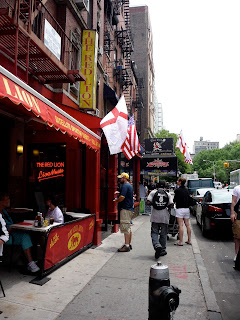
The Red Lion on Bleecker
• The World Cup in New York: An early day walk around New York neighborhoods these days brings the added surprise of seeing patrons in bars at 7:30 in the morning and hearing the not-so-subtle sounds of blowing musical instruments. Not every city bar has opened its doors for the first match of the day, but several venues have enthusiastically welcomed the early morning fans of the sport, including their matracas and vuvuzelas.

By the afternoon, many more bars and restaurants have opened, with fans sometimes spilling out into the street. Some venues cater to a particular team and feature special food and drink for the festivities. Outside of the bars, World Cup fever is in the air, with friends and acquaintances, especially those who have immigrated from countries represented in the competition, chatting wherever convenient to share news and friendly bantering.

It's hard to keep up with the expanding list of places to watch the World Cup in New York, but here are a few links to compilations of where to watch the matches in the big city:

"Germans Take World Cup of New York Bars, as England Loses Again" (Bloomberg.com)

"Watch the World Cup in New York at the bars and restaurants of the participating nations" The link is for Group G, with the article linking to other groups. (examiner.com)

"Where to Watch the World Cup in New York" (Zagat.com)

"Where to Watch the World Cup in New York City" (nytimes.com)

"Where to Watch the World Cup" (nbcnewyork.com)

You get the idea. Or simply find a bar-enhanced neighborhood like mine, the South Village, and come on down. If you're confused about what to drink in a bar that early in the morning, may I suggest the advice of a Tex-Mex restaurateur? He once said that it's OK to start drinking when MacDonald's stops serving breakfast.

• Amusing features of the Lower West Side/Tribeca: I often let my dog lead the way on walks, rather than the other way around, because she will lead me on fun, improvisational excursions. She doesn't pay attention to human conventions such as stop lights or intersections, so sometimes we get in trouble this way. She is a Situationist Dog, fighting the hegemony of city planners.

Monday, June 14, 2010

A Walking Guide to Sixth Avenue / The Avenue of the Americas

This is your brain on Sixth Avenue.


To prepare for a recent post on the Avenue of the Americas, the official name for Sixth Avenue, I walked the street's entire distance of 3.6 miles, from Central Park to Tribeca, in order to fully grasp Mayor La Guardia's original vision in renaming the avenue. While the remnants of the Pan-American avenue now seem somewhat tattered and confined to the extreme southern and northern ends, I still highly recommend a stroll down the avenue for a host of other reasons. The walk, in fact, is more like a hike after about three miles, requiring frequent stops and water, but the effort is worth it for those trying to walk off all sorts of problems and over-indulgences. The serious reason, however, rests in the usefulness of Sixth Avenue for studying the historical variations of New York commercial life as represented in its architecture and places of business. Walking all the way from the corporate blocks at the north end toward the south - through Midtown, Ladies Mile, Chelsea, the Village, the Charlton-King-Vandam Historic District, and Tribeca - encourages meditations on scale, public space, and the vestiges of New York history. It's a good way to see several historic areas of Manhattan in one walk. Wear comfortable shoes.

The walk starts on a few graceful notes. After the lofty equestrian sculptures of Latin American liberators on the plaza just to the north of Central Park South, turn south and walk past the Ritz Carlton (formerly the St. Moritz) Hotel and down the way, the Warwick Hotel, and later Radio City Music Hall, all on the east side, along with a few oddities on the west, such as the weird and grotesque Jekyll & Hyde Club on the west. Prominent features of the northern stretch of Sixth Avenue include a couple of significant public sculptures - Robert Indiana's famous and iconic "Love" and Jim Dine's set of twisted female torsos, variations on Venus de Milo, titled "Looking Toward the Avenue." (a joke, as the headless sculptures aren't looking anywhere.)

Without the humanizing art and the sleek, comforting public fountains out front, the imposing corporate presence of 1251 Avenue of the Americas (known also as the Exxon Building, though the oil giant took its headquarters to Texas in 1989) and its giant corporate siblings, technically part of Rockefeller Center, would constitute a dystopian future. As a grouping, the slabs come across like a giant piece of op-art (see image at top). Fans of architecture should also note the CBS Building, a black mammoth designed by Eero Saarinen & Associates in1965. Down the way, see Radio City Music Hall, and across the avenue, another corporate box. Don't forget to try out the rounded concrete tables and chairs in a so-called public space. (I'm joking. They look groovy, but they are uncomfortable.) Publishing and broadcasting maintains a strong hold on the avenue, with offices for McGraw-Hill, Simon & Schuster, and the Fox News Channel (the latter, a must for a right wing tour of the Big Apple).

Wednesday, June 9, 2010

The Rain on Prince Street


Some posts on this site advise people what to do when it rains in New York - things like go to a museum or visit Grand Central Terminal, etc., but actually, everyday life in New York can be lovely when it rains. Unlike days with sunny weather, when the sun bleaches out colors, a rainy day accentuates the bright colors of painted buildings, the yellowness of the yellow taxis, and the colors of those funny objects called umbrellas. (It's a mystery to me how New Yorkers can magically produce umbrellas at a moment's notice.) A walk in a busy neighborhood like Soho can offer a chance to look at the rain on the shiny street or visit an unfamiliar store or escape into a cafe. Walking along Prince Street today seemed to afford those kinds of pleasures.

Monday, June 7, 2010

A Beginner's Guide to Governors Island

Note for 2011: The island will open to the public on Friday, May 27, 2011.

• Governors Island in New York Harbor, now open to the public on a limited basis, was a military base for 200 years. The Coast Guard closed the island in 1996, and in 2003 the federal government sold much of the island to New York. The National Park Service continues to manage the two historic forts on the island. 

• Open every Friday through Sunday until October 10.

• The views from the island are stunning, and a trip affords a quick getaway from the urban canyons. 

• Visitors to Governors Island can walk the 2.2. promenade around the whole island and enjoy access to the northern part. The southern part is awaiting development.

• The Water Taxi Beach serves food and affordable drinks, including a few tasty beers on tap.

• In my opinion, drinking beer on a hot day on a sandy beach while looking at the skyline of Lower Manhattan as viewed between plastic palm trees is an experience both pleasant and surreal. Mostly surreal.


• Because of its strategic location, the island was mainly used for military defense. Now because of its proximity to Manhattan and Brooklyn, the island is seen as the perfect beachhead for sand volleyball, contemporary art projects, cocktails, concerts that will not upset the neighbors, and utopian visions for the urban future.


• Architects McKim, Mead & White designed a structure on Governors Island that once housed an entire regiment.

Friday, June 4, 2010

Studies in Blue and Green: The Hudson River Park, South of Houston, Morning

For our morning walk, my dog forcefully pulled me toward the new Tribeca section of the Hudson River Park, as if she really needed me to check it out.

along the Hudson River Park, looking south. Sometimes, but especially in the summertime, it feels like the old core of the city fades to the background, while the edges near the shoreline present new chances for exploration.
On our semi-regular walks, we usually wander toward the pier in the Greenwich Village section near Christopher Street, so I hadn't realized that this stretch of the park to the south was open for our recreational pleasure.

This newly renovated section sports some nice features —

a well-landscaped nature boardwalk,

different types of grasses are planted in the nature boardwalk. So many parks and waterfront areas are being developed, not just sections of the Hudson River Park, but the new Brooklyn Bridge Park, the East River, Governors Island, and more.

Thursday, June 3, 2010

What's Left of the Avenue of the Americas?

The change of name from Sixth Avenue to "Avenue of the Americas" became official October 2, 1945 when Mayor Fiorello La Guardia signed a bill passed by City Council. According to an article in The New York Times ("6th Avenue's Name Gone With the Wind," New York Times, Oct. 3, 1945), a few voiced opposition to the change, including the Citizen Union, arguing that the street contained so many "eyesores" that the new name would be "scarcely an honor to our sister nations." Others speaking on record at City Council included Mrs. Viola Warrin, who thought the new avenue name was "an awful mouthful;" Albert W. Ransom, who shared his observation that "Avenue of the Americas" was supported "by nobody 'but a group of people seeking propaganda';" and various Greenwich Village activists, including Marion Tanner (the aunt of writer Patrick Dennis, more on this website) of the Greenwich Village Association. The Mayor, on the other hand, said he found "general approval in this city, in this country and in the entire hemisphere." The Sixth Avenue Association, chief instigators of the "Avenue of the Americas," celebrated with a luncheon at the Rainbow Room.

northern block of the Avenue of the Americas (Sixth Ave.) with medallions for Argentina, Costa Rica, and Chile
On October 20, a formal parade and ceremony took place to officially rechristen Sixth Avenue as the Avenue of the Americas. Crowds cheered a parade of four thousand Navy veterans, newly returned from victory in the Pacific Theater of War, upstaging Mayor La Guardia and President Juan Antonio Rios of Chile. ("Navy Steals Show at Dedication of Avenue of Americas by Rios," New York Times, October 21, 1945). According to the Times, the Mayor said that the street name change reflected "the love and affection we have for our sister republics of Central and South America" and the realization of President Roosevelt's Good Neighbor Policy. At the ceremony, President Rios, who spent part of the previous day in Hyde Park to lay a wreath on the grave of the late President, placed a new Avenue of the Americas sign on a reachable street pole especially built for the occasion.
"With the ceremonies ended, the signal was given to dismiss the service men, and with a shout that startled the dignitaries the patient sailors, marines and midshipmen evacuated the Avenue of the Americas for simple Broadway." 
Simón Bolívar
With twenty-one countries signing the Charter of the Organization of American States in April of 1948, the idea of an Avenue of the Americas seemed promising. The city designed a new plaza at the intersection of Central Park South and the Avenue of the Americas in celebration, and an existing equestrian statue of Simón Bolívar (1783-1830) was moved from Bolivar Hill to a new granite pedestal on the east side and rededicated in 1951. According to the city's Parks & Recreation page on the statue, Bolivar was soon joined there by a statue of Argentine general José de San Martín. In 1965 the dedication of a statue in honor of Cuban leader José Martí completed the trio.

Related Posts Plugin for WordPress, Blogger...