Monday, May 31, 2010

The Sun's Fifteen Minutes of Fame: Manhattanhenge

(2011 Dates and Times for Manhattanhenge:

Half-sun on the grid: Monday, May 30 at 8:17 p.m.
Full-sun on the grid: Tuesday, May 31 at 8:17 p.m.
The phenomenon repeats Monday, July 11 at 8:25 p.m. and Tuesday, July 12 at 8:25 p.m.)


Many people left the city for the Memorial Day weekend, but several of us who belong to a particular tribe of neo-Druid photographers made sure we were back in town just to watch the sunset. Sounds peculiar, I know, but the weekend happened to correspond with "Manhattanhenge," a word coined by Hayden Planetarium Director Neil deGrasse Tyson to describe the phenomenon when the east-west crosstown streets of midtown Manhattan move into alignment with the setting sun.

On an evening when no clouds interrupt the view and the temperature hovers in a netherworld between not-warm and not-cool, the luminous experience is glorious and transcendental. The payoff comes in the last fifteen minutes of blow-out glory, when the Sun, saying its goodbyes, throws out a splash of gold and crimson along the manmade canyons. Several of the great crosstown streets show off the effects of this spectacular light show - 14th, 23rd, 34th, and 42nd, for example, as well as the streets in between. 

Last evening, I joined others on the bridge that overlooks 42nd Street at Tudor City, a well-known spot for the viewing, arriving around 7:35 p.m., just in time to watch and wait for the expected setting of the half-Sun at 8:17 p.m. The Chrysler Building was there. As the clock ticked down to the Sun's fifteen minutes of fame and the horizon grew ever more blazing, the gathered photo tribe, literally focused and dead set on the great shot, laid down a soundtrack of whooshing shutters. The Sun went out like a rock star, and we were its paparazzi. We applauded at the end.

Weather permitting, Manhattanhenge will repeat with the Full Sun on the grid at 8:17 p.m. on Monday, May 31, 2010. For dates in July and more on the phenomenon, see the Hayden Planetarium page on Manhattanhenge.


Images by Walking Off the Big Apple, in sequence, from approximately 7:35 p.m. to 8:17 p.m.

Friday, May 28, 2010

Cool Plans for a Hot New York Day - A Walk, a Matinee, a Dinner

This past Wednesday we saw the hottest day so far this year in the city, 94℉ in the shade, and the kind of heat that feels like standing next to an open oven door. Perhaps the arrival of a hot weather day promises that the upcoming summer, unlike last year's tepid affair, will live up to the season's potential. At any rate, we had plans that day to take a long walk in the morning, see a Broadway matinee in the afternoon, and go to a nice place for dinner at night, the sort of things appropriate for a birthday. As it turned out, the well-paced day of outdoor and indoor amusements proved a great way to beat the heat. In addition, I thought that a walk, a play, and a dinner, as general categories, would provide a winning combination for spending any sort of day in New York and wanted to pass the idea, though hardly novel, along to readers. The success of the day, however, would be highly dependent on the choice of walks, the play, and the restaurant.


A Walk
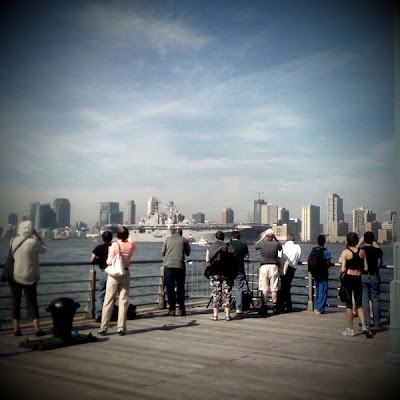
Walking along the waterfront in the morning, especially with a nice breeze in the air, is a great way to start the day in the city; that is, after sipping a good strong cup of coffee. From the Village I often make my way west over to the Hudson and to Pier 45, the long open pier with a green lawn and shady areas at the end of W. 10th St. From there, it's easy to walk north or south, depending on the mood, along Hudson River Park. My walk this past Wednesday happened to coincide with the exciting opening event of Fleet Week, the Parade of Ships, when members of the U.S. Navy and Marine Corps sail into port. The air on Wednesday morning was a little hazy, presaging the oven-like day, but it was a thrill to watch the big ships sailing by, with the sailors at parade rest in advance of the docking. My movie-fed imagination led quickly to singing and dancing sailor scenes from the 1949 musical film, On the Town.
   
Hudson River Park is only one choice for a morning promenade. The East River, Roosevelt Island, the Battery, the new Brooklyn Bridge Park, or Riverside Park, among many others, would be excellent choices for a morning walk on a hot day.

Tuesday, May 25, 2010

Three Guide Books to New York City: Online, but a Little Dusty

For fans of time travel, literary researchers investigating the mindset of a previous era, and for city residents who grow bored with the present metropolis, I have three books to recommend. The following guide books to New York City, originally published in the years 1857, 1901, and 1920, respectively, and now in the public domain, are available for online browsing. All three guides provide insight into the values and attitudes of their respective times, revealed in their choices of worthy points of interest, in words of caution to visitors, and in their often stereotypical attitudes about ethnicity and class. For present-day visitors, for example, visits to charitable institutions may not be a priority, but in the 19th century, a trip to New York City would not be complete without a visit to the Bloomingdale Insane Asylum. As for the attitudes, the Rand McNally guide from 1920, for example, directs visitors toward the crowded streets of "Judea," a word often used interchangeably with "ghetto" in reference to the streets of the Lower East Side.

One fascinating aspect of these guides rests in the contemporary accounts of the modern metropolis in progress. As examples, the first guide from 1857 points out the exciting plans for the new Central Park, the 1901 guide takes in the construction of St. John the Divine Cathedral, and the 1920 guide, as you will see, expresses confusion about the new subways. To help establish the cultural context for the guides, I have added a note with each title, indicating some notable novels published that same year. 

•  Phelps' strangers and citizens' guide to New York City by Humphrey Phelps. Published by Gaylord Watson, 16 Beekman Street, N. Y. 1857.

New books of 1857: Herman Melville - The Confidence-Man, Gustave Flaubert - Madame Bovary, Charles Dickens - Little Dorrit.

The book begins with a fascinating section, "Advice to Strangers," a collection of warnings to visitors about such dangers as cheap lodging houses, the operation of pickpockets, offers of fake merchandise, and "mock auctions." Best line in this section - "there are some places where the morals of strangers or citizens will not be particularly improved by visiting, to say nothing of the bodily danger one incurs, especially in the evening and unattended."

The author recommends visits to the spire of Trinity Church for the sweeping views of the surrounding landscape, to the charitable institutions such as the Home for the Friendless on E. 30th St., the House of Refuge on Randall's Island, the Bloomingdale Insane Asylum between 115th and 120th Streets, and to several of the dispensaries handing out medicine to the poor. He's excited about the libraries and parks, especially the new Central Park: "when its walks and drives are completed, and trees and shrubbery planted, it will be the most extensive and beautiful public park on the continent." (p. 50)

Friday, May 21, 2010

Scenes from a Walk Through Hell's Kitchen

On two consecutive nights in March of 1905, poet Vachel Lindsay tried to peddle his poems on the streets of New York City. A young and poor art student at the time, he possessed vaulted ideas about taking Beauty to the masses. On the first night, he began his door-to-door poetry crusade at 10th Avenue and 50th Street and then walked down the west side of 10th, stopping in stores, laundries, delis, and drugstores to talk the proprietors into buying his poems. He didn't do all that well, but he seemed to enjoy his efforts. In his diary, quoted at length by Edgar Lee Masters in his biography of Lindsay, the aspiring poet detailed his interactions with many of the shopkeepers he encountered, offering commentary about their various ethnic backgrounds - Greek, Chinese, African-American, and German. While his comments often take on offensive stereotyping, he does paint a fascinating, if naive, portrait of the multi-ethnic neighborhood known as Hell's Kitchen.

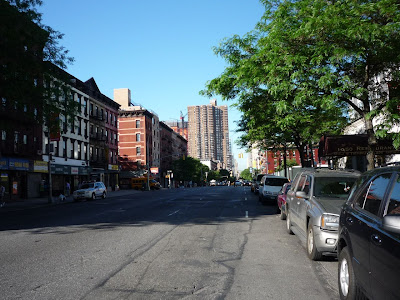
Tenth Avenue at W. 50th St. looking south
In the mid 19th century, Irish dockworkers settled along the banks of the Hudson in this area, soon to be joined after the Civil War by poor and working class immigrants from other countries. Poverty bred gang life and violence, so that by the 1880s this increasingly industrial section of the West Side had developed into one of the most dangerous neighborhoods. One theory about the origin of the name Hell's Kitchen stems from an anecdote in the 1880s. Responding to his rookie partner's observation that the block of W. 39th between 10th and 9th Ave. resembled Hell, Dutch Fred The Cop retorted, "Hell's a mild climate. This is Hell's Kitchen." (See the Wikipedia entry on Hell's Kitchen for alternative theories of the neighborhood name.) Walking this particular block today, nothing much is left to recall the looks of the old neighborhood, except for a handful of buildings near 9th Avenue. This block, however, is the site of the popular weekend market, the Hell's Kitchen Flea Market.

10th Avenue between W. 48th and W. 47th St. west side

Tuesday, May 18, 2010

A Jazz Weekend

With guests staying in town and tickets to the Village Vanguard to hear Bill Frisell's 858 Quartet on Sunday night, the weekend took on a jazz theme. In addition to also hearing snippets of free live jazz in Washington Square Park, we took a group excursion to the NYPL’s Performing Arts Library at Lincoln Center to see the exhibit, The Jazz Loft Project. On Sunday afternoon, I ventured a solo trip to revisit photographer W. Eugene Smith's loft on Sixth Avenue, the subject of the exhibit, to see what remained of this jazz-infused block near W. 28th Street. Within forty-eight hours, a few trips on the A train and the walks around Lincoln Plaza, the parks, the streets, and the avenues assumed varying syncopated tempos on their own. Like Vachel Lindsay picking up the tempo of the elevated trains for his poetry, the walking excursions to places in jazz history tapped into the alternating syncopations and meters of the language of jazz. Listening to the street, the visits seemed to inspire riffs on an altered image, down beats strong enough to forsake straight photography at times for alternative sources of visualization. Jazz was making me look anew at the city's visual rhythms.

The Jazz Loft Project, a multimedia exhibition focusing on photographer W. Eugene Smith's documentation of the city's jazz scene in the 1950s and 1960s, closes at NYPL's Performing Arts Library at Lincoln Center this week, and for serious jazz fans, it's not to be missed. The exhibit was organized by the Center for Documentary Studies at Duke University in cooperation with the Center for Creative Photography at the University of Arizona and the Smith estate.

The New York Public Library for the Performing Arts. 40 Lincoln Center Plaza.

A successful photographer for Life magazine, Smith quit the magazine in 1955 after arguing with the editors in order to pursue more creative freelance assignments. He joined the Magnum Photo Agency and soon headed to Pittsburgh for a documentary project. He managed to lengthen a short visit of a few weeks into an unmanageable project of thousands of photographs over a period of three years. Stressed and strung out, he moved away from his family and home up the Hudson and into a messed-up loft in New York at 821 Sixth Avenue near W. 28th Street. In the heart of the flower district, the five-story building had become a favorite late night hangout for some of the most celebrated jazz musicians in the history of the genre - Thelonius Monk, Zoot Sims, Charles Mingus, Bill Evans, Roland Kirk, and many more. According to the documentation by scholar and writer Sam Stephenson, nearly six hundred musicians, teachers or artists can be documented at one time or other visiting this mecca of jazz, creativity, and art during its heyday.

Thursday, May 13, 2010

Vachel Lindsay, Artist and Poet, Walking in New York

Vachel Lindsay (1879-1931), the peripatetic poet from Springfield, Illinois, came to New York City in 1905 to study art with William Merritt Chase and Robert Henri, but his famed teachers, especially Henri, quickly assessed the young man of twenty-five more talented in poetry than in drawing. Lindsay found himself so torn between his poetry writing and art that he often had trouble focusing. That opinion, at any rate, belongs to biographer Edgar Lee Masters who also observed that his fellow Illinois poet "had no faculty for the practical things." Lindsay spent much of his time after school walking through the galleries of the Metropolitan Museum of Art as well as through "the quaint and curious neighborhoods of the city, which had not yielded at that time to the innovation of the modern apartment building and the skyscraper." (Vachel Lindsay: A Poet in America by Edgar Lee Masters. Charles Scribner's Sons. New York, 1935) As it turns out, walking serves a purpose.

Vachel Lindsay studied art at the Art Institute of Chicago before moving to New York. This image is from a later period. [Hoboes sitting and sleeping outside Art Institute of Chicago]. Chicago Daily News, Inc., photographer. 1921. DN-0073421A, Chicago Daily News negatives collection, Chicago History Museum. Library of Congress.

Sunday, May 9, 2010

A Walk in the Ramble

A Walk in the Ramble in Central Park: A visit in May 2010 told mostly in pictures and published accounts from the nineteenth century

For those who enjoy a long walk in nature but who also like their creature comforts not far away, a visit to the Ramble in Central Park should fit the bill. This 38-acre site of wild woods, outcroppings of rock, man-made rustic features, and confusing trails, all set to the tune of birds and sometimes screaming children, sits roughly between 78th St. on the north and 73rd St. on the south. The Lake is to the south. A walk through this intentionally contrived wild northern shore affords great views of the water, its seasonal recreational boaters, and beyond, the formalities of Bethesda Terrace. New York Central Park's landscape designers, Frederick Law Olmsted and Calvert Vaux, designed the Ramble this way as a counterpoint to the nearby formal elements of the park.

Entering the Ramble from Bank Rock Bridge on the west side of the park
From the days of its construction in the late 1850s, when scores of workers moved the earth, constructed masonry, built artificial hills and streams, carved out paths, and planted a diversity of trees and plants, the Ramble has interested many visitors for its elaborate mimicry of nature.

View of boaters on the Lake from Bank Rock Bridge
From the 1869 book, A description of the New York Central park by Clarence Cook:
"Nature having done almost nothing, art had to do all. And yet art, trying to contradict nature in nothing, but only to follow her hints, improve her slight suggestions, and take advantage of her help, however stingily it may sometimes seem to have been proferred, has been able to produce a result, which, on the whole, so closely resembles nature, that it is no wonder if the superficial observer does not clearly see how vast is the amount of work that had to be performed before the Park could reach its present perfection." (A description of the New York Central park, Princeton University, 1869, p. 115)

Tuesday, May 4, 2010

New York Museum Exhibitions: Late Spring, Early Summer 2010

Note to readers: See UPDATED listings at the post, New York Museum Exhibitions: Summer 2010.

Of the current museum exhibitions in New York, two stand out and should not be missed - the Henri Cartier-Bresson retrospective at the Museum of Modern Art (MoMA) and the major Picasso exhibit at the Metropolitan Museum. In addition, several exhibitions of note conclude in May, so be sure to see William Kentridge: Five Themes and Marina Abramović: The Artist is Present, both at MoMA, and the Whitney Biennial (at the Whitney Museum, of course) before they close.

Of the openings in May and early June, look for Pictures by Women: A History of Modern Photography at MoMA (opens May 7), National Design Triennial: Why Design Now? at Cooper-Hewitt (opens May 14), and at the Metropolitan Museum, Hipsters, Hustlers, and Handball Players: Leon Levinstein's New York Photographs, 1950-1980 (opens June 8). The Rubin Museum will open an exhibit of contemporary Tibetan Art titled Tradition Transformed (opens June 11). Toward the end of June, Brooklyn Museum will exhibit work by Andy Warhol in his final decade, and the Whitney Museum will present Heat Waves in a Swamp: The Paintings of Charles Burchfield (opens June 24). The Burchfield exhibit is curated by the artist Robert Gober.

One of the pleasures of this time of year is the opening of the Roof Garden at the Metropolitan Museum. This year's installation is the impressive project, Big Bambú: You Can't, You Don't, and You Won't Stop by twin brothers Mike and Doug Starn.


What follows is a list of selected museum and other art center exhibitions currently on view in New York City along with dates of upcoming exhibits that are scheduled to open in May and June of 2010.

Temporary public art exhibitions:

Antony Gormley: Event Horizon
Madison Square Park area
Through August 15, 2010

Upcoming museum exhibitions are noted in bold type.

American Academy of Arts and Letters, 633 West 155th Street (Audubon Terrace):
For more on the must-see Audubon Terrace and neighborhood, see the post, A Visit to Audubon Terrace and Environs (one of Walking Off the Big Apple's 25 Great Things to Do in New York City. and see the nearby Hispanic Society, noted below.)

American Folk Art Museum, 45 W. 53rd St.:
• Approaching Abstraction
Through September 6, 2010
Women Only: Folk Art by Female Hands
Through September 12, 2010
The Private Collection of Henry Darger
Through September 19, 2010

Brooklyn Museum, 200 Eastern Parkway, Brooklyn, New York:
Healing the Wounds of War: The Brooklyn Sanitary Fair of 1964
Elizabeth A. Sackler Center for Feminist Art, Herstory Gallery, 4th Floor
Through September 12, 2010
Kiki Smith: Sojourn
Elizabeth A. Sackler Center for Feminist Art, Herstory Gallery, 4th Floor
Through September 12, 2010
The Mummy Chamber
Long-term installation now open
American High Style: Fashioning a National Collection
Through August 1, 2010
• Andy Warhol: The Last Decade
Through September 12, 2010

Related Posts Plugin for WordPress, Blogger...