a walking guide to New York City and self-guided walking tours by Teri Tynes
Pages
- Home
- New York City Self-Guided Walks (by Area)
- New York Literary Walks
- NYC Art Exhibitions
- NYC Music, Movies, Theater
- Architecture and Urban Planning
- Greenwich Village
- U.S. History
- NYC Parks
- New York by Season
- NYC Photography
- Walking for Fitness
- Best New York Apps and Maps
- Walking Off Wall Street
- Walking Directions
- All About WOTBA
- Press
Friday, April 30, 2010
Free Verse, Love and Greenwich Village - Where Poetry Burns At Both Ends
April is National Poetry Month, and before the month is over, I thought I would write a few words about some of the well-known poets who have lived or consumed alcohol or engaged in sexual encounters in Greenwich Village. I realize now that the entry would be too vast for one blog post. A tradition of poetry in the neighborhood extends back to the nineteenth century, with Edgar Allan Poe thinking dark thoughts on Amity St. (now W. 3rd.), but the poets really started the migration to these charming streets around 1910, the time when the bohemian self-awareness and identity associated with the neighborhood begins to blossom. It proved to be a large flower.
One of the poets who resided in the Village in the early twentieth century was Edwin Arlington Robinson, the son of a wealthy lumber merchant in Maine. He moved to New York in 1896, having decided on a life of poetry, taking jobs just to get him by. At one point he worked on the IRT subway line. Often in the doldrums, he took to drink. His fortunes began to look up when President Theodore Roosevelt learned of his poems and helped him secure a job in the New York Custom House. From 1909 to 1912 Robinson lived on Washington Place, at least from time to time, and it was here he wrote this third book of poems, The Town Down By the River, dedicating the work to Roosevelt. He lost the government position, however, when President William Howard Taft took office. The book includes "Miniver Cheevy," a portrait of a man who fancies he belongs to the age of chivalry rather than to the modern world. As a way to cope with being "born too late," Robinson writes, he "kept on drinking. Readers may also be familiar with Robinson's earlier "Richard Cory," the poem about the wealthy man about appears successful but who goes home and commits suicide. The poem served as the point of inspiration for a 1965 song by Paul Simon.
Tuesday, April 27, 2010
At the Tribeca Film Festival: "My Trip to Al-Qaeda" (It's Like a Movie)
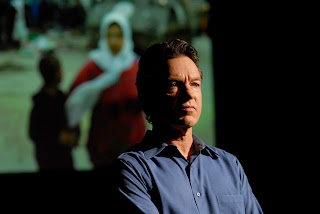
After writing his 2006 book about the origins of Islamic fundamentalism, The Looming Tower: Al-Qaeda and the Road to 9/11, journalist Lawrence Wright penned a one-man stage play, "My Trip to Al-Qaeda," to explore questions and moral dilemmas he encountered in the process. The film directed by Alex Gibney, and which is receiving its world premiere at this year’s Tribeca Film Festival, is adapted from the play that opened off-Broadway in March of 2007. The stage action, now translated to the motion picture, is properly opened up to include film interviews, news footage, and location shots from many places important to the story – degrading Egyptian prisons, the stunningly beautiful Afghanistan, Saudi Arabian streets, and of course, and horrifically, New York City, with footage of the bombing of the World Trade Center. At the center of the documentary is Wright, a journalist who adheres to the traditions and tenets of objective journalism but who is not always comfortable with them.
At the beginning of the film, Wright confesses to a feeling of guilt as the co-author of "The Siege" (1998), an eerily prophetic action picture about a terrorist attack on New York, the subsequent declaration of martial law, and the restraints on the U.S. Constitution. Before that film's release, terrorists targeted a Planet Hollywood in Cape Town, South Africa, killing two tourists and causing one child to lose a leg. Speculation surfaced that the bombers had targeted Wright’s film for its portrayal of Islamic fundamentalists. While he knows he was not to blame, the writer, taking personally the way people often compared the images of violence to those they had seen in the movies, undertakes a long and difficult journey to understand the origins of extremism. He finds those roots in the demeaning and dehumanizing prison conditions in Egypt and in other situations of degradation and humiliation, urging the audience to understand the Middle Eastern point of view for the presence of American forces in Saudi Arabia during the Persian Gulf War.
Saturday, April 24, 2010
Respite: On the Grounds of St. Mark's Church in-the-Bowery
Strolling along Stuyvesant Street to the grounds of St. Mark's Church in-the-Bowery at its intersection with E. 10th Street and 2nd Avenue connects the walker in the city to those who passed this way a long time ago, the inhabitants of Dutch New York. This land once belonged to Pieter Stuyvesant, the Governor of New Amsterdam, who purchased the farm (or bowery) from the Dutch East India Company in 1661. The Second Dutch Reformed Church stood once here where the current church stands. The 17th century Dutch would not have been familiar with the term for the present neighborhood - the "East Village," that name only coming into prominence in the 1960s.
Pieter's great grandson, Petrus Stuyvesant, donated the land to the Episcopal Church in 1793, with the stipulation that a new chapel should be erected here. Daniel Tompkins, the fourth Governor of New York and U.S. Vice-President under James Monroe, is interred on the grounds along with other members of the church. The street itself once functioned as the pathway to the farm, and though it was subsequently lined with trees and lovely townhouses from a later era, its irregular movement within a surrounding grid serves as a reminder that sometimes it's nice to keep with older geometries.
![]() |
| in the west garden. back of the statue of Daniel Tompkins |
![]() |
| dappled sunlight at the gate to the grounds |
Tuesday, April 20, 2010
New York, New York Films at the 9th Tribeca Film Festival
(Note - For information about the films of the 10th Tribeca Film Festival in 2011, read this post.)
The 9th Tribeca Film Festival begins Wednesday, April 21, and while no doubt the scope of the festival now reaches around the world, highlighting creative filmmaking everywhere, several festival selections this year maintain the Tribeca Fest's original ties to the neighborhood and to the city. As always, the city can provide compelling subject matter. A disgraced governor, creative avant-garde filmmakers, the designer Halston, salsa dancers, a writer in search of Al-Qaeda, and Joan Rivers are just a few of the subjects of documentaries in this year's festival selections. Narrative New York-centered feature films include several comedies, dramas, or a combination of both, many set against the backdrop of contemporary Greenwich Village, Brooklyn, lower Manhattan, and other locations in the city. The programs of short films at Tribeca also feature vivid portraits of New York life, highlighting the diversity of cultural landscapes that are too rarely portrayed in the mass media.
What follows is a selection of films in this year's Tribeca Film Festival that prominently feature the city. For information about schedule and tickets, please consult the official website. The festival, which offers a wealth of films and programming beyond the local fare mentioned here, continues through May 2. Look for upcoming reviews of some of the following films on Walking Off the Big Apple.
FEATURES
• Arias with a Twist: The Docufantasy (2009). Feature Documentary. 86 min. The downtown art scene of New York as seen through the collaboration between cabaret and drag artist Joey Arias and master puppeteer Basil Twist, with rare footage of Andy Warhol, Jim Henson, Keith Haring, Grace Jones, Divine and others.
• Every Day (2009). Feature Narrative. 90 min. Family comedy drama about a New York couple, played by Live Schreiber and Helen Hunt, having to deal with a sick father-in-law (Brian Dennehy) and surprising developments with their children and co-workers.
• Joan Rivers: A Piece of Work (2010). Feature Documentary. 84 min. Brassy, funny lady Rivers pretty much owns a style of high New York humor. Filmmakers follow the irascible 76-year-old over the course of a year.
• Last Play at Shea (2009) Feature Documentary. 95 min. All-star concert headlined by Billy Joel closes out the life of the legendary Shea Stadium, providing a soundtrack for historical footage and memories of the former home of the New York Mets.
The 9th Tribeca Film Festival begins Wednesday, April 21, and while no doubt the scope of the festival now reaches around the world, highlighting creative filmmaking everywhere, several festival selections this year maintain the Tribeca Fest's original ties to the neighborhood and to the city. As always, the city can provide compelling subject matter. A disgraced governor, creative avant-garde filmmakers, the designer Halston, salsa dancers, a writer in search of Al-Qaeda, and Joan Rivers are just a few of the subjects of documentaries in this year's festival selections. Narrative New York-centered feature films include several comedies, dramas, or a combination of both, many set against the backdrop of contemporary Greenwich Village, Brooklyn, lower Manhattan, and other locations in the city. The programs of short films at Tribeca also feature vivid portraits of New York life, highlighting the diversity of cultural landscapes that are too rarely portrayed in the mass media.
What follows is a selection of films in this year's Tribeca Film Festival that prominently feature the city. For information about schedule and tickets, please consult the official website. The festival, which offers a wealth of films and programming beyond the local fare mentioned here, continues through May 2. Look for upcoming reviews of some of the following films on Walking Off the Big Apple.
FEATURES
• Arias with a Twist: The Docufantasy (2009). Feature Documentary. 86 min. The downtown art scene of New York as seen through the collaboration between cabaret and drag artist Joey Arias and master puppeteer Basil Twist, with rare footage of Andy Warhol, Jim Henson, Keith Haring, Grace Jones, Divine and others.
• Every Day (2009). Feature Narrative. 90 min. Family comedy drama about a New York couple, played by Live Schreiber and Helen Hunt, having to deal with a sick father-in-law (Brian Dennehy) and surprising developments with their children and co-workers.
![]() |
| Helen Hunt (Jeannie) and Ezra Miller (Jonah) in a scene from Richard Levine's EVERY DAY. Courtesy of Ambush Entertainment. |
• Last Play at Shea (2009) Feature Documentary. 95 min. All-star concert headlined by Billy Joel closes out the life of the legendary Shea Stadium, providing a soundtrack for historical footage and memories of the former home of the New York Mets.
![]() |
| Billy Joel, in concert at the "Last Play at Shea" concert, where he was the last artist to perform at Shea Stadium. Directed by Paul Crowder and Jon Small (concert footage). Image: Kevin Mazur |
Thursday, April 15, 2010
Strolling Notes: Restaurants, Cafes, and Walk-Ups (With Dog-Friendly Advice)
• While drive-in windows are standard in the car culture beyond New York, more walk-up windows would be welcome for food-friendly and dog-friendly pedestrian New Yorkers. According to NYC offleash, there are 1.4 million dogs living in New York City.
For those walking dogs in the Villages, NoHo, SoHo, and NoLita, I am scouting all the good hangouts where we can take our dogs and drink coffee at the same time. A truly civilized society should accommodate people with their dogs, especially when al fresco dining or drinking coffee is concerned. In a recent post on Petrosino Square, I mentioned the convenient walk-up window at La Esquina, a Mexican restaurant near Lafayette and Kenmare, as a good place to order quality tacos and then sit down in the newly-renovated square. My dog seems more than happy with this excursion, but she has also become a fan of Little Veselka, an outdoor kiosk in First Park at the convergence of E. 1st St., E. Houston, and 1st Avenue run by the parent restaurant on Second Ave. at 9th St. They sell good dog biscuits at the kiosk. So, one of those for her, please, and a coffee and regular human biscotti for me.
• Chelsea has some nice restaurants, but don't try to take a dog into any of these places. There are rules. For the recent Orphan Film Symposium, a gathering of film archivists, scholars, filmmakers, and preservationists organized through NYU by the professor spouse of WOTBA, I assembled a map of dining places near the SVA Theater. Word has come that the information was useful to people, so I am now passing it along to you.
For those walking dogs in the Villages, NoHo, SoHo, and NoLita, I am scouting all the good hangouts where we can take our dogs and drink coffee at the same time. A truly civilized society should accommodate people with their dogs, especially when al fresco dining or drinking coffee is concerned. In a recent post on Petrosino Square, I mentioned the convenient walk-up window at La Esquina, a Mexican restaurant near Lafayette and Kenmare, as a good place to order quality tacos and then sit down in the newly-renovated square. My dog seems more than happy with this excursion, but she has also become a fan of Little Veselka, an outdoor kiosk in First Park at the convergence of E. 1st St., E. Houston, and 1st Avenue run by the parent restaurant on Second Ave. at 9th St. They sell good dog biscuits at the kiosk. So, one of those for her, please, and a coffee and regular human biscotti for me.
• Chelsea has some nice restaurants, but don't try to take a dog into any of these places. There are rules. For the recent Orphan Film Symposium, a gathering of film archivists, scholars, filmmakers, and preservationists organized through NYU by the professor spouse of WOTBA, I assembled a map of dining places near the SVA Theater. Word has come that the information was useful to people, so I am now passing it along to you.
Links to this post
Labels:
cuisine,
dogs,
East Village,
film,
Lower East Side,
New York,
restaurant,
walking
3
comments
Tuesday, April 13, 2010
Under the High Line: A Guide to Art, Food, Cars, and Theology
![]() |
| The south entrance of the High Line. Just to the left of this image is the site planned for the Whitney Museum's second home. |
![]() |
| The entrance to the Standard Hotel |
![]() |
| Looking south, with the High Line above and curving in the distance |
Links to this post
Labels:
architecture,
art,
Chelsea,
galleries,
guide,
New York,
restaurant,
weather
6
comments
Wednesday, April 7, 2010
Playing With the City: Antony Gormley's EVENT HORIZON
The lone figures stand up there along the rooftops and crevices of buildings that you've never quite seen before, until now - MetLife, the Flatiron, and lesser-known structures now new and suddenly fascinating, carving out their universal figures in space against the sky. These thirty-one life-size men fluctuate in meaning, like passing thoughts - as witnesses, sentinels, guardian angels (a little Wings of Desire, without the wings and trench coats), naked dudes (the artist's own body as model), or mute sightseeing guides to hint at famous architecture. The ones on the ground invite closer inspection. When I was checking out one of them yesterday, the one that stands facing south toward the Flatiron's famous curve, several people stopped to take a picture with him. Others drew closer, unafraid of how an inanimate and immovable man might react, and gave him - and it's most definitely a him, a gentle pat on the rear.
British sculptor Antony Gormley (1950- ), a figurative artist who uses his own body as the basis of much of his art, originally created this work, titled Event Horizon, in 2007 for sites in London. Now, they've come to inhabit the Flatiron District. Even for fans of architecture or others accustomed to looking above the normal visual field, the presence of the figures in relationship to the buildings heightens an awareness of their scale and proportion. It's amazing how large some look, even that high up, or how powerful. At a social level, the figures provoke questions about the everyday life of seeing and being seen. For those of us who sometimes frequent rooftop terraces, window offices in skyscrapers, or our own balconies up in the air, exploring Event Horizon can trigger a new consciousness, or rather, a self-consciousness, about privacy and transparency. Gormley, in talking about the work for Mad. Sq. Art (official site), says “I don’t know what is going to happen, what it will look and feel like, but I want to play with the city and people’s perceptions."Saturday, April 3, 2010
A Walk in the Village: 15 Captions for 15 Pictures of Trees
![]() |
| Many people outside of New York don't think of New York this way. There's so much nature. It's so pretty. And even for New Yorkers, the advent of these trees in blossom come as a miraculous surprise. |
![]() |
| Even a mundane walk on 6th Avenue takes on a new aspect under a canopy of blossoming trees. Most all the trees shown in these pictures are callery pears. |
![]() |
| Cars look more offensive in the city in bloom. Stop. Do not enter. |
Subscribe to:
Posts (Atom)