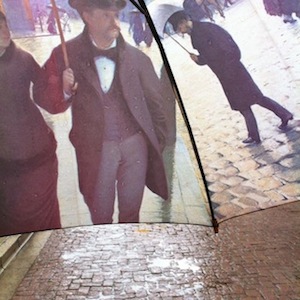
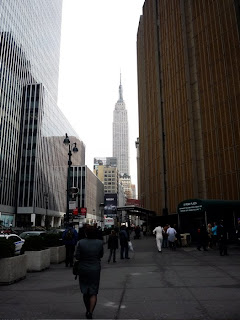
(updated October 2011) Let's face the music. Walking in bad weather is no fun. But for those desiring to see the city anyway, no matter what the weather, other means of transportation are, of course, available - hailing a taxi or hiring a car service, for example. The subway, depending upon one's proximity to a station, may be the best and most convenient means of maneuvering New York City in awful weather. Locate a subway stop near a favorite shopping destination, landmark, or a museum, and you are good to go.
Here is a list of recommended subway stops in or near a major NYC attraction.
• Eastern Parkway-Brooklyn Museum 2, 3: Just outside the Brooklyn Museum.
• Bowling Green Station, 4, 5: Near the main steps of the National Museum of the American Indian (the former Custom House).
• W. 4th St., A, B, C, D, E, F, V: There's always a movie. The IFC Center on 6th Avenue shows the best of independent film.
• 34th Street-Herald Square, N, Q, R, W: You can go straight to the Manhattan Mall and shop. JCPenney (901 Avenue of the Americas) is now the anchor of this indoor mall, an unusual feature of Manhattan retail. Macy's, via the subway outdoor exit, is very close.
• 34 Street-Penn Station, 1, 2 , 3, A, C, E: Penn Station isn't beautiful, but you'll at least find shopping and food.
• World Financial Center (left), near E, N, R: With indoor shops and restaurants, views of the World Trade Center site on the east, and scenes of the Hudson River on the west, the World Financial Center is a good place to wait out a rainy day.
• 42nd Street-Bryant Park, B, D, F, V, 7: Just steps from the famous lions gracing the steps of the New York Public Library. Visit the reading room, check out the special exhibits, or bring your laptop to the wi-fi-enabled Edna Barnes Solomon Reading Room. Just to the north, see the ICP (International Center of Photography) a block away at 43rd St. and 6th Ave.
• 42nd Street- Port Authority Bus Terminal, A, C, E: Stores, restaurants, and the Leisure Time Bowling Center and Cocktail Lounge. Yes, hipsters, the Port Authority is your place to be.
• Times Square-42nd Street. The busiest station of all. Artwork by several artists, including Roy Lichtenstein, Jane Dickson, Jacob Lawrence, and others make this subway stop a destination underground. A good place to listen to free live music.
a walking guide to New York City and self-guided walking tours by Teri Tynes
Pages
- Home
- New York City Self-Guided Walks (by Area)
- New York Literary Walks
- NYC Art Exhibitions
- NYC Music, Movies, Theater
- Architecture and Urban Planning
- Greenwich Village
- U.S. History
- NYC Parks
- New York by Season
- NYC Photography
- Walking for Fitness
- Best New York Apps and Maps
- Walking Off Wall Street
- Walking Directions
- All About WOTBA
- Press
Saturday, January 30, 2010
Wednesday, January 27, 2010
Breakfast at the Breslin, Then a Walk
The streets near Madison Square Park and north to Greeley Square represent an aging section of the city, replete with great dowager buildings of glory years past and the fading songs of a hundred years ago. The streets serve up their own specialties - Tin Pan Alley itself on W. 28th between Fifth and Sixth Avenues, Korea Way on W. 32nd Street, and Broadway functioning as a wild wholesale district selling every whatnot imaginable. Streetside views take in the splendors of the Flatiron Building from all angles and the ubiquitous over-the-shoulder shadows of the Empire State Building from above. NoMad, the name often given to this section of Manhattan north of Madison Park, managed to hide from the wrecking balls of mid-century, so several ornate buildings dating from the 1860s give the streets a slightly French air. Grizabella, the aging feline, and the Madwoman of Chaillot would be comfortable wandering the streets. As with Jean Giraudoux's play, I wouldn't be surprised if NoMad had its own aging Countess.
View Between Greeley and Madison Squares in a larger map
This eclectic hotel-centric neighborhood features accommodations of every sort, from high-end glamour to funky efficiency. Chain hotels normally associated with bland roadside architecture are dressed up here in elegant Beaux Arts exteriors. The NoMad name is particularly suitable for a place frequented by temporary residents. The restaurants here are varied, and many are amazing.
Nothing warms the hearts of old New Yorkers more than a great big fixed-up hotel lobby and accompanying restaurant, especially the kind that pays homage to history rather than erasing it; hence, the pleasures of the new Ace Hotel on W. 29th Street and its much-hyped restaurant, The Breslin. The husband and wife team of the design firm Roman and Williams have wisely allowed the former interior of the 1904 building to breathe a little, its ceilings and walls open here and there for admiration. Essentially, the designers playfully inserted a new box in an old box, with the new box feeling like a dark and sexy private boy's club that has recently voted to let in the girls. When you think "hotel lobby," I know your mind instantly wanders to library tables, antique file cabinets of curiosity, taxidermies of skunks and specimens of dead birds, n'est-ce pas? A lobby bar, comfortable sofas and chairs, artwork, a photo booth (!), hi-tech-looking side tables on wheels, and more curious objects are set amidst oversize round columns and a traditionally-patterned tile floor. Giving your guests a variety of things to do, the chance to be social or to sit and read quietly, is a great gift. The hotel is welcoming and comfortable.
View Between Greeley and Madison Squares in a larger map
This eclectic hotel-centric neighborhood features accommodations of every sort, from high-end glamour to funky efficiency. Chain hotels normally associated with bland roadside architecture are dressed up here in elegant Beaux Arts exteriors. The NoMad name is particularly suitable for a place frequented by temporary residents. The restaurants here are varied, and many are amazing.
Nothing warms the hearts of old New Yorkers more than a great big fixed-up hotel lobby and accompanying restaurant, especially the kind that pays homage to history rather than erasing it; hence, the pleasures of the new Ace Hotel on W. 29th Street and its much-hyped restaurant, The Breslin. The husband and wife team of the design firm Roman and Williams have wisely allowed the former interior of the 1904 building to breathe a little, its ceilings and walls open here and there for admiration. Essentially, the designers playfully inserted a new box in an old box, with the new box feeling like a dark and sexy private boy's club that has recently voted to let in the girls. When you think "hotel lobby," I know your mind instantly wanders to library tables, antique file cabinets of curiosity, taxidermies of skunks and specimens of dead birds, n'est-ce pas? A lobby bar, comfortable sofas and chairs, artwork, a photo booth (!), hi-tech-looking side tables on wheels, and more curious objects are set amidst oversize round columns and a traditionally-patterned tile floor. Giving your guests a variety of things to do, the chance to be social or to sit and read quietly, is a great gift. The hotel is welcoming and comfortable.
Links to this post
Labels:
architecture,
cuisine,
hotels,
maps,
New York,
restaurants,
sculpture,
Slideshow,
walking
3
comments
Monday, January 25, 2010
At the Morgan: The Master of Catherine of Cleves
A Review of Demons and Devotion: The Hours of Catherine of Cleves at The Morgan Library and Museum. January 22 through May 2, 2010
Bigger than an iPhone but smaller than whatever reading device Apple is expected to roll out this week, The Hours of Catherine of Cleves, a pre-digital 15th century hand painted illuminated manuscript of devotional miniatures, attracted the attention of many visitors to the Morgan Library and Museum this past Sunday afternoon. Created for a wealthy woman with some serious marital problems, the precious volume of richly colorful images is the work of the gifted anonymous craftsman known as the Master of Catherine of Cleves. The books of this common type of medieval manuscript vary in composition and style, but as the Morgan made the good move to also display several others for comparison, the viewer can appreciate hands-down their claim that the disassembled pages constitute "the greatest Dutch illuminated manuscript in the world." While we grow increasingly accustomed to the marvelous reading machines of our own era, nothing beats a beautiful medieval book of Hours. Catherine's book, curiously enough, is almost the exact same size (7 1/2 x 5 1/8 inches) as a Kindle, but in color of course. On some pages the artist even thoughtfully added text tags in the margins to help Catherine understand the scene. Even the most conscientious bloggers forget to do that!
Bigger than an iPhone but smaller than whatever reading device Apple is expected to roll out this week, The Hours of Catherine of Cleves, a pre-digital 15th century hand painted illuminated manuscript of devotional miniatures, attracted the attention of many visitors to the Morgan Library and Museum this past Sunday afternoon. Created for a wealthy woman with some serious marital problems, the precious volume of richly colorful images is the work of the gifted anonymous craftsman known as the Master of Catherine of Cleves. The books of this common type of medieval manuscript vary in composition and style, but as the Morgan made the good move to also display several others for comparison, the viewer can appreciate hands-down their claim that the disassembled pages constitute "the greatest Dutch illuminated manuscript in the world." While we grow increasingly accustomed to the marvelous reading machines of our own era, nothing beats a beautiful medieval book of Hours. Catherine's book, curiously enough, is almost the exact same size (7 1/2 x 5 1/8 inches) as a Kindle, but in color of course. On some pages the artist even thoughtfully added text tags in the margins to help Catherine understand the scene. Even the most conscientious bloggers forget to do that!Friday, January 22, 2010
Postcards from a Walk on St. Mark's Place and W. 8th Street
A walk along the colorful streets of St. Mark's Place in the East Village and west on 8th Street in Greenwich Village offers an overdose of visual pleasures but also a sense of the ephemeral nature of the contemporary urban experience. Like many other streets of the city, favorite places come and go so quickly here that repeating the walk at regular intervals teases with the memory. Where was that Mexican restaurant I visited last year? Where has it gone? Many New York residents and visitors with a strong sense of place must surely share this sense of confusion and displacement; yet, technological changes in how we relate to the city make me wonder. On a recent walk here I also noticed several people walking slowly along the street, heads down, eyes
on the cell phone in their hand in front of them. Oblivious to the sights of the street, except maybe for the sidewalk, they seemed to occupy a separate reality.If the walking residents of cyberspace would look up and observe, they might notice that St. Marks Place, just to the west of Tompkins Square Park, is lined with tenement buildings, intimate shops, and small restaurants that often sport splashy hues of color. A bright rose-colored brick building sits over a storefront cafe trimmed in electric neon green. A little farther down the street, the green restaurant awnings mix it up with storefronts painted turquoise or mustard color and lovely stoops set into arched doorways crowned with carved faces. Mosaics,
painted metal storefront grates, round sidewalk tables, a bright blue door, and a street level apartment painted in an intense purple eggplant color, all elements in what could be called an East Village style, give way to a restrained and subtle stretch of buildings with facades in the Italianate style.After crossing Second Avenue, St. Mark's Place becomes an amusement park. Suddenly, it's all wild hats for sale on the street, Asian and Middle Eastern food, pizza booths, tattoo parlors, yogurt-gelato in all its forms, a chain bourgeois Mexican food place, stores that sell ironic gifts, body therapy and karate studios, an upscale grocery, and yet more Asian fusion restaurants. The block is packed.
Wednesday, January 20, 2010
From Penn Station to New York Landmarks: Measuring Walking Distance and Time in Manhattan
How long does it take to walk from Penn Station to well-known destinations in Manhattan? What are the best walking routes ? What if I don't want to see anything in particular but just want to walk around? In addition to the thousands of working commuters from the surrounding area, especially from New Jersey and Long Island who arrive at Penn Station via New Jersey Transit or the Long Island Rail Road, many people arrive at the station just to spend time in The City. Some have questions.This map should help these visitors measure walking distances and times from the station to well-known destinations in Manhattan - Bryant Park, the Metropolitan Museum of Art, the Empire State Building, Times Square, Rockefeller Center, Washington Square Park, the High Line, SoHo, Central Park, Dag Hammarskjold Plaza, and more. The map should also help anyone else who would like to get a rough idea of how long it takes to walk from NYC Point A to NYC Point B.
One line on the embedded map illustrates the example of walking 20 streets uptown/downtown in Midtown, a distance of approximately one mile. Ten numbered streets generally measures a 1/2 mile, so walking twenty streets uptown/downtown equals one mile. Walking from W. 33rd St. north to W. 53rd Street along 8th Avenue, for example, a distance of 20 blocks, measures one mile. Another line on the map, from 11th Avenue to 5th Avenue, illustrates walking the long crosstown streets, especially on the west side. Walking these crosstown blocks seems endless in comparison to walking uptown or downtown. But none of these measurements will help with measuring distances in the off-grid circular world of Greenwich Village and in other older areas of Manhattan.
Monday, January 18, 2010
When Walking Becomes Marching: A Post for Martin Luther King, Jr. Day
On March 12, 1930, when Mohandas Karamchand Gandhi (1869-1948) set out on his 240-mile march to the seaside town of Dandi to protest the British tax on salt, he was joined by 78 followers. As the walk continued and the word spread of his unconventional means of protest, thousands more joined in the nonviolent protest against the injustices of colonialism. By the time he arrived on April 5, Gandhi had attracted the attention of the whole world.
Marches and walks as a form of demonstration were not new, finding precedents in cities in the 19th century. Years before the March on Washington in 1963, civil rights and labor leader A. Philip Randolph and others had proposed a march on Washington in 1941 to protest discrimination in the war industries. The march was called off after President Franklin D. Roosevelt signed legislation pledging fairness. Randolph, Bayard Rustin, and Martin Luther King, Jr. organized the March on Washington for Jobs and Freedom, the historic event of August 28, 1963 when an estimated quarter of a million people took part in the walk from the Washington Monument to the Lincoln Memorial. That walk, in terms of distance, was not long. It was the symbolism that mattered. The 54 miles from Selma to Montgomery in March of 1965 proved to be more physically difficult.
Friday, January 15, 2010
Now Another Thing to Do in Times Square: Catch Criminals
| From 2010 |
Today, according to media reports, the FBI announced plans to display mugshots of the nation's most wanted criminals on a massive billboard near the TKTS booth in Times Square. The media advertising firm, Clear Channel Outdoor, is providing the agency use of the 40-foot digital display at no cost. The idea is that placing these images in a spot where thousands of people congregate will result in arrests.
Thursday, January 14, 2010
The Many Lives of Second Avenue (A Walk)
Judging just by the looks of its current commercial occupants, the stretch of Second Avenue between Houston on the south and 14th Street to the north appears primarily as a food destination. Dozens of restaurants and bars crowd both sides of the eclectic-looking avenue, offering an impressive array of world cuisine - Thai, Ukrainian, North African, Belgian, New American, French, and more. Several celebrated restaurants, such as Momofuku Ssäm Bar on the southwest corner of Second Avenue and E. 13th Street, have been gravitating to this part of the East Village for the past few years. Beyond its culinary moment in the sun, however, Second Avenue's famous past is increasingly hard to discern. The street served as the nerve center for many important cultural moments, but two periods
of its history stand out - first, as a major center for Yiddish theatre in the early part of the 20th century, and second, as a major thoroughfare in the downtown art scene from the 1960s to 1990.I was reminded of the avenue's theater history this week by reading the New York Times obituary of Mina Bern, 98, described there as "a plucky and versatile actress and singer who was one of the last links to the scrappy world of Yiddish theater in New York." Second Avenue was once home to over a dozen Yiddish-language theaters that catered to the nearby tenement dwellers in the Lower East Side. A couple of these old theater buildings remain, though used in a different capacity - the Village East Cinemas, formerly the Yiddish Art Theatre, and the Orpheum, a smaller theatre originally built for vaudeville but later for Yiddish theater. At the southeast corner of Second Avenue and E. 10th Street, in front of what is now a Chase bank location, look down at the sidewalk. For many years, the Second Avenue Deli (162 E 33rd St.) was at this location, and its
owner, Abe Lebewohl, installed this Yiddish
Walk of Fame here in front of his restaurant to celebrate the stars of the era. Presenting often innovative plays such as The Dybbuk (1919) and The Golem (1921) during its heyday, a few of the theaters continued operations into the 1960s. By then, the surrounding neighborhood, a place people considered to be the northern section of the Lower East Side, began to establish a separate identity as the East Village.
Links to this post
Labels:
artists,
cinema,
cuisine,
East Village,
film,
Lower East Side,
movie,
New York,
theater
2
comments
Sunday, January 10, 2010
Point and Shoot Nostalgia: iPhone Photo Apps for the Contemporary Retro Traveler
In the history of contemporary art photography, the transition from film to digital in the 1990s inspired a creative counter wave of explorations in increasingly archaic photographic equipment and techniques - daguerreotypes, tintypes, the wet collodion process, cyanotypes, the camera obscura, and so forth. Even in amateur photography, as digital cameras produced clean and perfect shots, allowing untrained photographers to mimic the work of professionals, some people longed for the look of imperfect analog photographs - images blurred around the edges, scratched, off-color, or odd.Early in the 1990s, a visionary group of Austrian students devoted themselves to saving a mass-produced Soviet camera from the 1980s, the Lomo LC-A, that made such images. The subsequent Lomography craze, along with its playful set of instructions to disobey conventional rules, introduced the values of art photography to a larger public. The resulting film prints, still requiring lab development, often looked much cooler and less predictable than the best stuff from an expensive digital SLR camera. And what about those old Polaroid and Instamatic cameras from the past? Yes, they, too, have their fans.
The look, and in some cases even the feel, of popular lo-tech analog cameras, is now available for the iPhone, thanks to several clever, fun and useful apps. Many of the best apps greatly improve the iPhone's built-in camera, automatically improving the clarity or available light even without adding special filters or lenses. Some specialize in a particular look while others feature a range of styles.

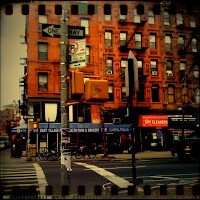
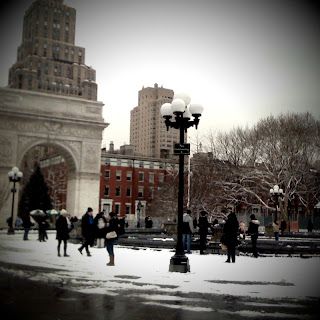
How do these iPhone apps apply to the streets of New York? While I haven't yet jettisoned my point and shoot Panasonic Lumix, I'm enjoying the playfulness of the iPhone apps while out on my strolls through the city. I enjoy the ease of taking an image, the accessibility of creative choices on the spot and the convenience of sharing the image on Twitter or Facebook. Beyond these qualities, however, I'm enjoying the results of this odd mashup of new technology and vintage aesthetics. Depending on my mood and the choice of filters, I can make a moment on the New York street look like it's from 1885 or 1962. With the ability to make a subject more blue or more red, more sharp or more faded in the iPhone, I must look harder with my own nearsighted vision, corrected through blue-tinted solarized progressive lenses, to understand what image is inscribed on my retina for later memories. Just lately, however, Washington Square Park has looked a little more romantic to me, Broadway a bit more Parisian, and the East Village just a little bit green.
Links to this post
Labels:
apps,
art,
artists,
cinema,
film,
iPhone,
New York,
photography
2
comments
Friday, January 8, 2010
The Educated Artist: A Guide to Continuing Education Classes and Workshops in the Fine Arts in New York City (Updated)
Living in a city with so much art, it's not surprising that so many people who are not professional artists occasionally like to draw, paint, sculpt, and take pictures. Many area art schools, colleges, and other institutions offer a range of art courses and workshops for all levels of artistic skill - beginning, intermediate, and advanced. A few of these programs offer a drawing course, or at least a class session, at the Metropolitan Museum of Art, a classic way to improve artistic vision.In addition to improving artistic skills and learning new techniques, participating in an art class is a fun way to meet others in the city who share the same interests. Classmates come from all areas of the city, with different backgrounds and experience that shape their individual visions. You'll be amazed at what kind of work is out there among the amateur art population. Do not worry about your own level of talent. Someone will be worse than you. Others will blow you away.
Most of these institutions listed below offer daytime, evening, and weekend classes, plus intensive workshops. Many multi-week courses fall in the $425-$475 range. Some include model fees. Particularly popular courses with well-known artist instructors can fill up, so register early. A few of the schools listed below hold information sessions prior to the beginning of the semester courses. Be sure to attend, because it's always helpful to find a good match between your inner artist and its new instructor.
• School of Visual Arts Continuing Education, 209 East 23 Street, New York, NY 10010
Painting, drawing, figure drawing, anatomy, drawing at the Met, drawing New York City, sculpture, printmaking, jewelry. Also many courses in photography, animation, illustration and cartooning, etc.• New York Studio School of Painting, Drawing and Sculpture, 8 W 8th St, New York, NY 10011
Evening and Saturday classes are open to members of the public. Drawing, painting, and sculpture courses last 11 weeks.
• Cooper Union Continuing Education, Cooper Square, New York, NY 10003
Several courses in the fine arts including book arts, photography, painting, drawing for all levels (including absolute beginners), collage, color theory, drawing nature, drawing on location, watercolor and abstraction, drawing at the Metropolitan Museum of Art.
• Parsons The New School for Design, 66 Fifth Avenue, 2nd floor. New York, NY 10011
Courses in drawing, painting, watercolor, Drawing at the Met, printmaking, mixed media, collage, and more. Non-credit students pay tuition and fees as listed along with the course description, and a $7 university services fee each term.
Thursday, January 7, 2010
Long Live the Bauhaus
Bauhaus 1919–1933: Workshops for Modernity, an exhibition at the Museum of Modern Art, presents a straightforward but elaborate visual chronology of the school from its beginnings in Weimar to its new building in Dessau and finally to its end in Berlin. Advancing the story through a sequence of gallery spaces, the exhibit explores the intellectual and creative struggle among its leaders as they thought through the basic principles of design in a machine age. While the school's direction shifted under the consecutive administrations of architects Walter Gropius, Hannes Meyer, and Mies van der Rohe, the institution's endeavors to create a sort of unified field theory in every medium of communication never ceased. The comprehensive exhibition of some four hundred objects gives a strong sense of an engaged community of artists and designers creating work of great functional beauty, having some fun, yet at the same time grappling with what to do with the increasingly disturbing economic, cultural and political events around them. Every organization goes through a similar familiar pattern - the excitement and creativity of its beginnings under a strong leader (Gropius), the attempt to impose formal rules through a period of growth, a phase devoted to outreach (as in Hannes Meyer's emphasis on designing for the working class), and a period of professionalization (Mies). But this school, with its inherent values of cosmopolitanism (with the involvement of several Russian artists) couldn't escape the pressures of national socialism.This exhibition, the first serious accounting of the Bauhaus at MoMA since 1938 (and the earlier one, just five years after the school's demise, did not consider developments after 1928) goes far in complicating any simplistic understanding of the Bauhaus. The inclusion here of objects of vibrant colors and tactile qualities, many created by the little publicized women artists of the school, upsets notions of the school as dominated by masculine geometries. The exhibit turns what was previously remembered through a series of textbook black and white drawings and still photos (with a Leica, as it turns out) into something like CinemaScope. The craft roots of the school are wholly restored. For example, even toward the final years of the Bauhaus, faced with financial instability, the school kept its weaving department. In showing us the products of the cabinet workshops and textile workshops, among others, the exhibition seems fully in sync with our own back-to-basics artistic moment. The "New Typography," too, looks relevant for any contemporary course in design.
Even if we still come to understand the school's main personalities through monochromatic film stock, we're nevertheless presented in the MoMA Bauhaus exhibition with a geometric rainbow of works by Paul Klee, Johannes Itten, Vasily Kandinsky, Benita Koch-Otte, and of course, the highly color conscious works of Joseph and Anni Albers. Objects such as fiber wall hangings, puppets, lights fixtures, carpets, ceramic pots and examples of famous chairs (perhaps the Bauhaus's best known export) aid in imagining the various iterations of the school's interior school rooms and workshops. In other words, if you were expecting mainly pictures of boxy buildings and geometric fonts on posters, you're in for a surprise. The exhibition's online interactive chronological presentation of objects by each year gives a good sense of the richness and variety of the school's creativity, especially within the dictates of overarching design principles. While the latter days of the Bauhaus may have been guided by strict architectural directions under the strong personality of Mies van der Rohe, you can nevertheless see in Mies's own career designs and in those by his students the long-lasting emphasis on materials and texture.
While only a few more weeks are left to see the MoMA exhibition, the architectural influence of the Bauhaus, in contrast to its craft beginnings, remains for viewing in the urban landscape of New York. The Bauhaus school may have shuttered in
Germany in 1933, but twenty or so years later, it arrived, after a fashion, in the city. Walter Gropius, Mies van der Rohe and Gropius protégé Marcel Breuer played roles in designing high-profile buildings for post-war New York. Unfortunately, as with other International Style gurus like Le Corbusier, some of their design spirit became woefully lost in translation overseas, often succumbing to the different demands of the American corporation.
Links to this post
Labels:
architecture,
Bauhaus,
Bronx,
cinema,
film,
guide,
Midtown,
MoMA,
New York,
Seagram Building,
Tribeca,
weather,
Whitney Museum
1 comments
Monday, January 4, 2010
Tim Burton at MoMA
In the midst of the crowded galleries devoted to filmmaker and artist Tim Burton, surrounded by adults still stuffed inside their winter coats and besieged by their young children, I inadvertently became another object of curiosity. Not that I resemble any of Burton's creatures. No, when the guards kept shouting "No pictures!" to those who thought they could sneak in a cellphone picture of a Batman cap or a drawing of a Ghost Dog or a statue of Johnny Depp as Edward Scissorhands, I simply pulled out a small notebook and started sketching. This act of a lady sketching the small models of Burton's balloon-headed, big-eyed creatures seem to excite the youngest museum attendees, and one or two offered favorable remarks for my efforts. Their parents, on the other hand, seemed less engaged with my activity, perhaps thinking the medium a form of juvenilia or a province of weirdo artists. Kids totally get it.And then looking up from my drawing, I realized Tim Burton was just like a kid who always loved to draw but managed somehow to defy the unimaginative school system's kill-joy insistence on putting down the pencil. He kept doing it anyway. (Creative writers fare much better in keeping the flame alive, with only graduate school killing off their natural talents.) Drawing and painting as a bored adolescent in Burbank, California, Burton continued in adulthood to make drawings as an aide to mental development and simply as a way to amuse himself. Sketching became a private means to communicate with a larger public, a way to wave off the demands of the larger culture to make him "normal." This is a man, after all, who says in MoMA's online exhibition video that wearing striped socks makes him feel better and that he totally identifies with Charlton Heston's character in The Omega Man (1971). Subsequently attending CalArts and then working as an unhappy
apprentice at Disney goes far in explaining everything.Most know Burton, of course, as the director of imaginative movies such as Pee-wee's Big Adventure, Beetlejuice, Batman, Edward Scissorhands, Ed Wood, Sleepy Hollow, Charlie and
the Chocolate Factory, Sweeney Todd, and more. His work is a dark whimsy, often colorful, hysterical and macabre at the same time. MoMA is screening the films in the theaters downstairs as well as showing in the galleries little-known off-beat efforts like Hansel and Gretel (1983), a project supported by Disney. His upcoming film, Alice in Wonderland, due to be released in March and produced by Walt Disney Pictures, takes place years after the novel and revolves around the heroine reconnecting with the place she has forgotten. The theme is perfectly suited to someone who managed not only to remember but sustain a long childhood. Furthermore, living in London with companion Helena Bonham Carter, the grown Burton may continue to enjoy more culturally sanctioned eccentricity. Despite being a Burbank native, he just doesn't seem like a Hollywood guy.The works on display at MoMA, especially the drawings, look like a lifelong uninterrupted desire to escape the confines of normality. Dark creatures are your friends. The maturity displayed in later works, however, does not necessarily reflect a more refined talent but perhaps more the professionalization of the artist. Burton, like many successful professional artists, has the command of people to help him realize his ideas. The exhibition makes some effort to group Burton with the West Coast school of painters, given his interest in popular culture, but that seems a little forced. Surveying the many charming monsters and freaks sprung from his imagination, Burton seems more kin to gothic illustrators like Charles Addams and Edward Gorey or to German Expressionist stage designers of the 1920s than he does to surfing artist dudes of the West Coast.
Tim Burton continues at MoMA (11 W. 53rd St.) through April 26, 2010. The exhibit is popular and space is limited so the museum suggests the purchase of timed tickets on weekdays. Timed tickets are required on the weekends. Members of the museum can breeze on in. No photography. But bring a sketchbook. MoMA's interactive site here.
Image and sketches by Walking Off the Big Apple.
Subscribe to:
Posts (Atom)