Tuesday, November 30, 2010

Flagships of New York: A Self-Guided Holiday Walk to New York's Department Stores

Somewhere the other day in a New York department store - where was I? - stopping to chat with a cosmetic representative and to try a whiff of perfume, riding the escalator to the store's main restaurant, examining the selection of leather wallets, asking directions from an elegant worker in black, searching for the holiday decorations on whatever floor, locating the women's room, trying on a trench coat, gazing upward at the vaulted main floor lit up in bright white lights - can't remember - the exterior world dissolved. Suddenly there was only the world of the store, a certain kind of place with its own life and culture. Without a view of the outside, the inner world of the artificially lit universe collapsed on itself. Time and place were suspended.

walking by a window at Bergdorf Goodman

While recalling some of the department stores of New York holidays past - Gimbels, Bonwit Teller or B. Altman, there's the realization that the stores operate within a larger economy and could vanish. Owners can sell off the failing stores or shutter them. That's happened many times. But what's striking about the remaining department stores in New York, especially the historic ones that grew with the city, is their resilience, their ability to emerge stronger after refinancing, acquisition, or rebranding.

strolling Fifth Avenue
Importantly, department stores represent an ideal of cosmopolitanism, and for those who grew up in less than cosmopolitan places, the large department store can provide a way of learning about the world and a path to a larger universe. The fantasies presented in some of the great department stores invites those with wanderlust to connect to the great cities - New York, Paris, Milan, even if it's only through window shopping. On the other hand, there's nothing more depressing and alienating than strolling through the aisles of a department store that is failing, doesn't care, or is situated as an anchor in a forgotten mall in a struggling town in a collapsing economy.

For New York, its historic stores and specialty stores such as Tiffany and Co. and FAO Schwartz have functioned as an important part of the society and economy, generating income from tourists and locals. The successful stores have exported the idea of the city itself, an alluring beacon or a chimera of opulence and wealth. Truman Capote's Holly Golightly, a poor Texas child of the Great Depression, feels better at Tiffany's.

Monday, November 29, 2010

Flagships of New York: Bergdorf Goodman and Henri Bendel

The series Flagships of New York: The Great Department Stores continues with a look at Bergdorf Goodman and Henri Bendel.

• Bergdorf Goodman
754 Fifth Avenue, 58th

The one and only Bergdorf Goodman remains an exception among the great New York department stores, because the company chose to limit its business to the pair of stores on Fifth Avenue and 58th Street (and online now, of course). Its main store sits on the west side of 58th Street and the men's store on the east side of the avenue. Bergdorf Goodman's exclusivity is accentuated by its geographical proximity to its posh neighbor - The Plaza, directly to the north, as well as the sight of the horse-drawn carriages lining up at the southeast corner of the park nearby. If you want to shop at BG, you have to come to one of the most important intersections in Manhattan.  

At the end of the 19th century, Herman Bergdorf, a French immigrant to New York City, owned a tailoring shop on Fifth Avenue and 19th Street, specializing in fine tailored suits for women. In 1899, a 23-year-old tailor by the name of Edwin Goodman came to work with him. Two years later, in 1901, Edwin became a partner, creating the business known as Bergdorf Goodman. Later, while Goodman traveled to Europe on his honeymoon, Bergdorf decided to move the business to a cheap address on W. 32nd. St. Goodman did not care for this decision. According to the company story on fundinguniverse.com, "The two men did not remain partners much longer: Goodman bought out Bergdorf, who then retired and enjoyed his remaining years in Paris." 

With Bergdorf out of the way, Goodman concentrated on building an affluent clientele. He moved the store up Fifth Avenue to where Rockefeller Center now stands. Business boomed, and he quickly outgrew the space. With rumors of the future Rock Center circulating, Goodman relocated his store to the current site on Fifth Avenue and W. 58th St. After his death in 1953, Goodman's son, Andrew, assumed leadership of the company and further expanded the store. Bergdorf Goodman was sold in 1972 to a company that also acquired the historic Dallas retailer, Neiman Marcus. The latter currently operates the two Bergdorf Goodman stores in New York City in addition to its own stores.

"Wish You Were Here," a window of fantasy travels at Bergdorf Goodman

Sunday, November 28, 2010

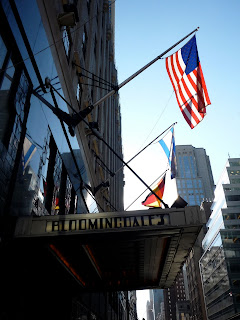
Flagships of New York: Bloomie's and Barneys

The series Flagships of New York: The Great Department Stores continues with a look at Bloomingdale's and Barneys New York.

Bloomingdale's
1000 Third Avenue, 59th St.

In 1861, the sons of entrepreneur Benjamin Bloomingdale, Joseph and Lyman, opened Bloomingdale's Hoopskirt and Ladies' Notions Shop on the Lower East Side. Ten years later, with the hoopskirt going out of style, they opened their East Side Bazaar, expanding the business to offer a wider variety of women's fashions. In 1886 the brothers moved uptown to 59th Street and Third avenue. In 1930 Bloomingdale's built the grand Art Deco building that houses the current store, an ambitious presence that commanded a full city block. The opening of the Lexington Avenue subway line in 1915 took shoppers directly to the store, and the company capitalized on this convenience with the advertising campaign "All Cars Transfer to Bloomingdales."

Bloomingdale's flagship store. 1000 Third Avenue (pictured on Lexington side)

Bloomingdale's currently operates forty stores nationwide, including a store in the SoHo neighborhood of New York (504 Broadway). The store's parent company is Macy's Inc. (founded as Federated; R. H. Macy & Co. had merged with Federated in 1994). In 2006 the parent company, under the old Federated name (the change to Macy's Inc took effect in 2007), sold another famous New York department store, Lord & Taylor, to NRDC Equity Partners. (See Wikipedia entry on Macy's for the details. It's OK to be slightly confused following the storyline of New York department store ownership.)

Bloomingdale's features several places for hungry shoppers including Le Train Bleu, a fun dining experience in a replica of a French train car, on the 6th floor, 40 Carrots on the 7th floor (with a great frozen yogurt counter for a quick treat), and David Burke at Bloomingdale's on the 1st floor.

Check out the store's in-store display of holiday decorations. A "We Love New York" Christmas tree is decorated with elaborate ornaments representing the city, including taxis, the subway, tourist busses, the skyline,and the New York Yankees logo.

For this year's holiday window displays facing the street, Bloomingdale's went digital, moving away from the traditional mechanical and artisan windows of traditional displays. The windows are filled with flat screen displays showing images of winter landscapes.

As a personal recommendation, the winter coat sale at Bloomingdale's is worth checking out for bargains on quality coats. The Lexington Avenue line (4,5.6) makes getting in and out of Bloomindale's very easy, especially convenient during rough weather conditions.

Below, listen to a little of the sights and sounds of New York as pedestrians stroll past a window at Bloomingdale's during the holiday season. (Walking Off the Big Apple TV)

Friday, November 26, 2010

Flagships of New York: Macy's on the Home Front, Photographs by Marjory Collins for the FSA/OWI

The week before Christmas in December of 1942, photographer Marjory Collins (1912-1985), working on assignment for Roy Stryker's Farm Security Administration/ Office of War Information photographic division, took her camera to the R. H. Macy and Company department store on 34th Street in New York and shot several pictures of the busy holiday scene. It was also wartime, clearly telegraphed in some of the scenes. Her photographs served the mission of the government agency to show that domestic life continued as normal during the war, and they also relayed the importance of thrift and morale-boosting on the homefront.

Portrait of Marjory Collins, photographer
for the Farm Security Administration (FSA)
and the United States Office of War Information (OWI)
Though Collins is not as well known as Dorothea Lange, Walker Evans, Gordon Parks, and other FSA/OWI photographers, her story should interest New Yorkers. According to the biographical essay from the Library of Congress, she was a native New Yorker, born into a prominent family. As a young woman, she made her social debut, followed by a proper marriage to a Yale graduate of her own class. But they divorced after two years. She made a turn toward rebellion, not unlike many of her peers in the 1930s. And where would a rebellious young woman in 1935 live in order to establish a new identity? The answer is not surprising. "Determined to reject her patrician roots," the Library of Congress notes, "Collins moved to Greenwich Village and a Bohemian life style." (Biographical portraits of Greenwich Village life always go there.) Selling her wedding silver to buy a camera, she began studying photography with an avant-garde photographer. Soon she would be accepting many assignments for magazines. In 1941 she landed a job in the New York office of the Foreign Service's Office of War Information. In January 1942 she moved to Washington, DC to join Stryker's photo team.

Throughout the war, Collins pursued many assignments that involved ethnic and racial diversity, photographing upbeat portraits of Americans from all backgrounds. Working as an editor and professional photographer, she continued to pursue her interests in social activism and racial justice all her life. Her professional work would take her to many new places. According to the Library of Congress, "From her home in Vermont, she participated in social and political causes including the civil rights, Vietnam War protest, and women's movements. She founded and edited the vanguard publication Peace Concerns (began 1962) and was associated with the Center for the Study of Democratic Institutions." In her later years, after not finding work on account of her sex and age, she rallied support for the plight of older women. While in her late sixties, she went back to school to study the subject of older women in American society and earned an M.A. in American Studies. She died in 1985.

Collins took these holiday images of Macy's five years before the release of the popular postwar classic, MIRACLE ON 34th STREET (1947), the movie that centrally featured the department store. Where the latter movie spins a fictional story, Collins's pictures document everyday life in the famous department store during wartime. A sample is included here. Look for more in the American Memory project at the Library of Congress.

Wednesday, November 24, 2010

Flagships of New York: Lord & Taylor and Saks Fifth Avenue

the former Lord & Taylor Dry Goods Store,
Ladies' Mile, Broadway and 20th St. southwest corner
In 1826, after emigrating to the United States, Englishman Samuel Lord and his cousin-in-law George Washington Taylor opened a store on Catherine Street in New York City to sell women's clothing. Later, at the outset of the Civil War, Lord & Taylor moved the location to Broadway and Grand. In 1870 they outdid themselves. A new cast-iron store opened at the southwest corner of Broadway and 20th Street in what would be known as Ladies' Mile, a shopping district catering to fashionable women living nearby.

The Lord & Taylor Dry Goods Store on Ladies' Mile, so European and fanciful in its presentation to the street, would have fit in perfectly in the upper class social world of Edith Wharton's novel The Age of Innocence (1920), her portrait of New York society of the 1870s. With its distinctive mansard roof, the building is one of many architectural jewels that still dot the area. The AIA Guide to New York City (revised edition, 2010) comments about the building, "Windows explode everywhere, a time when merchandisers sought natural light. Now, the opposite is true; Lord &Taylor and its peers want a sealed box, with controlled artificial lighting." The company would soon need more room, and another move was underway.

Lord & Taylor's flagship store on Fifth Avenue opened on February 24, 1914. Designed by Starrett & Van Vleck, the building presents an impressive massive facade but without the Renaissance particulars that characterized many buildings in the preceding decades. The location between W. 38th and W. 39th Streets followed the fashionable clientele as they moved in greater numbers up the avenue. Similarly, Benjamin Altman opened his grand new store (now CUNY Graduate Center) on Fifth Avenue between 34th and 35th Streets in 1906. While many of the other established stores moved farther north on the avenue, L & T (as it's often called) continues to anchor this part of the avenue between the New York Public Library on 42nd Street and the Empire State Building on 34th., in proximity to the Garment District and to Macy's in nearby Herald Square.

Lord & Taylor, 424 Fifth Avenue

Monday, November 22, 2010

Flagships of New York: The Great Department Stores

Bloomingdale's, 59th St. and Lexington Ave.
While shopping in the Bloomingdale's flagship store on 59th Street the other day, I took a break from browsing to sit down and enjoy a little dessert at the store's 40 Carrots restaurant. I was sitting at a counter that runs underneath a large mirror and observing the comings and goings of the many well-dressed women behind me. I also fleetingly glanced at the reflections of several women of a certain age sitting at the counter. With their well-coiffed hair and careful makeup, donning artfully arranged scarves, perfume, and earrings, I thought of the song "Ladies Who Lunch," a satire of leisure class women from Stephen Sondheim's musical Company. Instead of the mocking tone of the song and memorable delivery by Elaine Stritch, however, I found myself sympathetically connecting to these women and to a tradition. This scene was frozen in time, maybe in the 1940s or 1950s, and I could remember my mother at such a place in years past. This could be me in 2030, I thought, and then as an afterthought, if department stores still exist then.

A similar timeless scene may have been unfolding at the other stores nearby - at Henri Bendel, Barney's New York, Bergdorf Goodman, or Saks, or farther south at Lord & Taylor on Fifth Avenue, or in Herald Square at Macy's. With Bloomingdale's and Barney's as important exceptions, Fifth Avenue has long been a preferred site for department stores, long ago known as dry goods stores, and they now seem entrenched and full established after their long migration from downtown and Ladies' Mile.

former B. Altman store, Fifth Avenue,
 between E. 34th and E. 35th,
now CUNY Graduate Center
It's really hard to imagine New York City without them, but several important ones have vanished. These sorts of enormous stores, with specialized departments featuring a range of merchandise from many brands, have difficulty competing with the discount stores of similar organization, and increasingly, their competition comes from online shopping. Most all the stores we associate with Fifth Avenue have suffered some sort of financial crisis. But for many New Yorkers of a certain age, just recalling the names of the long departed stores of times past conjures their worlds again - Bonwit Teller, B. Altman, Gimbels, or Brooklyn's Abraham & Strauss, to cite a few important ones. Suddenly, the mind recalls the heady mix of the perfumes of the cosmetic department, the many voices of clerks and customers in a holiday rush, working girls making their careers in the big city, the glamorous tones of the elevators as they stop for each floor. These were magic kingdoms for New York shoppers during the holidays. We saw them in the movies.

Wednesday, November 17, 2010

The Village Street: Hipstamatic Images of Greenwich Village, a Map, and a Walk

The Village has its share of green spots, but the downtown equivalent of the village green - the shared communal space that traditional villagers used for grazing and celebrations - would probably be its famously intricate web of streets. The off-grid narrow alleys and cobblestoned streets make the neighborhood, especially in its western sections, one of the most entertaining to explore on foot. The scale of the buildings, residences and shops encourages intermingling and stopping for a chat, the kind of interactions neighborhood activist Jane Jacobs noted in her books on the city. When developers propose a gargantuan project for the Village, the natives, not surprisingly, grow alarmed.

While exploring the streets to research the previous post, 25 Radical Things to Do in Greenwich Village, I took many images of Village scenes using the Hipstamatic app for the iPhone. A popular app for camera phones (see related post), the Hipstamatic's filters, limited field of vision, and square frames create a kind of heightened or altered reality. This sort of illusion seems suitable to the traditions and myth of the New York neighborhood.

I have selected several of the images here to discuss briefly, but I've put fifty of them on Flickr WOTBA (a place for supplemental images). I've also documented the sites represented by the images on a Google map and suggested a walk. The 1.7-mile walk follows a path I've followed several times over the last month, one I've enjoyed, and the images I selected tend to be grouped along this walk. I've written about other parts of the Village on this site, so streets like Bleecker may be better represented in other posts.

Waverly Restaurant, 6th Avenue and Waverly Place

(above) Waverly Restaurant, 6th Avenue and Waverly Place. Fans of the TV series Mad Men will recall that our favorite handsome ad man, Don Draper, moved to this area of the Village following his divorce. I like to think he lives above the restaurant. The place is actually a pretty nice diner, with comforting plates of food. Part of the decor consists of framed photographs of celebrities of years past who have since lost some of their distinction.

Sunday, November 14, 2010

25 Radical Things to Do in Greenwich Village

Hipstamatic iPhone images of contemporary Greenwich Village
by Walking Off the Big Apple


Flipping through a book like Greenwich Village: A Photographic Guide by Edmund T. Delaney and Charles Lockwood with photographs by George Roos, a second, revised edition published in 1976, it’s easy to compare the black and white images with the look of today’s neighborhood and see how much the Village has changed. A long shot photograph of Washington Square taken up high from an apartment north of the park, and with the looming two towers of the World Trade Center off to the distant south in the background, reveals a different landscape than what we would encounter today. On the north side of the park, an empty lot and two small buildings have since given way to NYU’s Kimmel Center and a new NYU Center for Academic and Spiritual Center Life, now under construction. The Judson Memorial Church is still there, but buildings housing the law school have replaced adjacent older buildings. The park itself is recognizable only if memory presents images of what the place looked like two years ago before the advent of the ongoing renovations. The trees are much bigger now.

8th Avenue and Jane Street
Many of the older residents are gone, of course, and with them, many of the old places that gave the Village its character. Turning to the 1976 book, here are pictures of Circle in the Square (in its theater on Bleecker St.), Sullivan Street Playhouse (with The Fantasticks still playing), the Conca D’Oro bakery, the Bleecker Street Cinema (now a stationary shop and a Duane Reade), the Bitter End, Granados Restaurant on MacDougal, the Coach House (once a famous posh restaurant on Waverly), Dauber & Pine bookshop on Fifth Avenue, Trude Heller’s nightclub, the Village Gate, and the Gaslight. 

By the late 1970s, two decades before TV's Carrie Bradshaw arrived with her ambitions, shoes and tiny cakes, the gentrification of the Village was well underway. Stories of the old Village began to circulate, and perhaps many stretched credulity. A writer for New York Magazine, reviewing three new restaurants for the April 24, 1978 issue, argued that many locals remembered “a variety and abundance of eating places” in the Village, when in fact, the author says, they were mostly uninteresting spaghetti joints. He writes, “These days, when the Village is just another high-rent district (its vestigial bohemians the well-fed sort), money has lured what eccentrics never did.” Money is a good thing, he implied, bringing quality French restaurants to the poor Villagers. 

Saturday, November 6, 2010

Required City Reading: 25 New Books for New York, New York

What follows is a list of exciting books published in 2010 that involve New York City as a prominent setting. In various manifestations, the city appears as the culmination of creative success, a troubled dystopia, the place of theatrical dreams, a crime scene, a sports venue, or in the case of the last five books, a really good place to start a restaurant.

Literary Fiction:

By Nightfall: A Novel
• Michael Cunningham, By Nightfall: A Novel (Farrar, Straus and Giroux, 2010). 256 pages. The author of The Hours has set his new novel in contemporary New York - SoHo, to be exact, with a story of an art dealer and an editor whose lives are interrupted by a beautiful nephew.

• Paul Auster. Sunset Park. (Henry Holt and Co., 2010), 320 pages. One of the mainstays of New York fiction brings us a new tale of twenty-something artists searching for connection in Brooklyn's Sunset Park neighborhood.

An Object of Beauty: A Novel• Steve Martin, An Object of Beauty (Grand Central Publishing, November 23, 2010), 304 pages. The talented funnyman and writer takes on the insanity of the New York art world, with a novel relishing in unflattering portraits of its protagonists. (Note to reviewers: Detecting a theme here, the first three books in this list could be appraised together.)

• Gary Shteyngart, Super Sad True Love Story: A Novel (Random House, 2010), 352 pages. This satire of middle aged angst and love is set in a dytopic New York future. The novel, published in July, has already made several "best of" lists.

• Adam Langer, The Thieves of Manhattan: A Novel (Spiegel & Grau, 2010). 272 pages. If it's not the art world, another easy target of contemporary satire is the publishing industry. The protagonist in this intriguing novel works as an employee of a New York diner who becomes embroiled in his own literary fictions.

A Curtain Falls• Stefanie Pintoff, A Curtain Falls (Minotaur Books, 2010), 400 pages. A talent in historical detective fiction, Pintoff has been compared to Caleb Carr (The Alienist). Her new book finds a serial killer amidst the Broadway world of the early twentieth century.

• Reggie Nadelson, Blood Count: An Artie Cohen Mystery ( Walker, 2010), 352 pages. Nadelson's mystery, featuring her Russian emigré NYPD detective, unfolds within the walls of a Harlem apartment building. Contemporary Harlem is represented by its tenants who may, or may not, have something to do with the crime.

• Cyrus R. K. Patell and Bryan Waterman, editors, The Cambridge Companion to the Literature of New York (Cambridge University Press, 2010), 282 pages. NYU professors Patell and Waterman teach a popular course on New York, and they have a smart blog, too. Here, they've edited a collection of insightful essays on themes of the city's literature, including Dutch New York, poets of the East Village, the voice of Brooklyn, and more.

Monday, November 1, 2010

Wish You Were Here: Pictures from an Autumn Walk in Central Park

For many people it's simply known as the Park. And for many New Yorkers we know the wonders of the Park simply as the Great Lawn, the Lake, the Ramble, Turtle Pond (to distinguish it from The Pond), the Sheep Meadow, the Boathouse, the Conservatory, the Reservoir, the Mall and so forth. Each place has its own look and personal associations. We often use these names to explain to our friends where we are.

Trees between the Great Lawn and the Museum.


And where we are here, with these images, is Central Park in autumn, a glorious temporary world unto itself. It's a fleeting sight, these autumn umbers and reds that light up the trees, and it's an ephemeral sound, too, the whoosh of falling leaves settling around the paths and lawn and water and hills. We know we have to catch it in just the right weeks, from late October to early November, and in just the right amount of light, not too sunny and not too many clouds. 


Contemplating Turtle Pond


The following pictures capture some of the feeling of a breezy afternoon on an autumn day in Central Park. All that's missing is a soundtrack, a mixed tape by park musicians - among them, a saxophonist in a tunnel, a family of singers known as the Boyd Family signing hymns in the Bethesda Terrace Arcade, and an accordionist on the Mall billowing out songs of Paris. To fully convey the atmosphere, I would also toss in the smell of roasted nuts. This day happened to be Sunday, October 31, 2010, All Hallow's Eve, or simply, Halloween. I felt lucky to be there.

Related Posts Plugin for WordPress, Blogger...