Saturday, October 30, 2010

The Guided Tour: A Visit to the World Trade Center Site and the Statue of Liberty

For someone who has spent the better part of the last three years designing self-guided tours around New York City, and indeed content to pursue urban adventures in a solitary way, you may be surprised to learn that I went on an actual guided tour this past Monday. The occasion was an invitation from NYCTrip.com, a vacation company started in 1983, to follow along on one of their tours, specifically a guided trip to the World Trade Center site and then to the Statue of Liberty. I’m not opposed to group tours, and for reasons I will explain, visiting some sites in New York may be better suited for the organized tour than venturing alone.


The Statue of Liberty, as seen from a ferry to Liberty Island, October 25, 2010.


Our guide was Georgienne Millen, a native New Yorker, trained actress, licensed city guide, and a storyteller of the first order. With an authoritative brassy voice and apparent comfort in speaking to large groups of people, she had what it took to corral the fourteen of us, a group that included domestic and overseas visitors as well as children, through the mazes of lower Manhattan and the ferries. More importantly, she mastered guiding us through the complicated and often difficult landscape that the first subject of the tour presented - the attacks on the World Trade Center and its aftermath.


The site of the World Trade Center, under construction, as seen from the World Financial Center

Tuesday, October 26, 2010

The Newcomer on Spruce Street: Frank Gehry's Contribution to the New York Skyline

While walking the Brooklyn Esplanade or strolling downtown these days it's easy to notice the glimmering newcomer in the lower Manhattan skyline. That shimmering steel tower below the Brooklyn Bridge is a skyscraper previously known as "Beekman Tower" or "The Beekman," designed by Gehry Partners, and at 876 feet and 76 floors, it's now the tallest residential building in New York. According to a recent article on the building and interview with the architect in The Wall Street Journal, the builders, Forest City Ratner Companies, plan to market the tower by the name of "New York by Gehry at Eight Spruce Street." Okay. Hey man, whatever works. I think they, the builders and marketing people, want to get out the notion that the proud and soaring thing, to borrow Louis Sullivan's phrase, isn't just a Frank Gehry building anywhere, but an artistic statement about the city, the architect's interpretation of New York's visual identity. It also signals, in a practical way, that the building's more important front faces Spruce Street, as opposed to the "back" side on Beekman Street.


Architecture fans may recognize a signature Gehry style in the tower's waves of undulating stainless steel (his Guggenheim Bilbao is cloaked in titanium), but the architect specifically addresses the New York context in his design for the building. In the WSJ interview, he explained that the most noticeable features of the classic New York skyline are the step-backs. When passage of the city's 1916 Zoning Resolution put a stop to the construction of massive buildings that plunged the streets in darkness, the resulting step-backed skyscrapers, especially of the Art Deco era, helped define the metropolis. Gehry says, "So I decided to work with that. I also saw a lot of modernist mistakes like putting glass at the corner of towers. It sort of weakens the form of the building. In the best buildings the corners are solid." In terms of its neighbors, Gehry says, "I think it talks to the Woolworth Building." See "Gehry on New Gehry Building" by Peter Grant in the WSJ, Oct. 5, 2010. Link

Wednesday, October 20, 2010

An Autumn Walk in Upper Manhattan: From The Cloisters to Audubon Park

With the arrival of cool autumn temperatures, a trek to upper Manhattan is in order, specifically a vigorous hike around Fort Tryon Park followed by a meditative walk in The Cloisters. That will get you going. It's lofty up here, away from the secular masses and their petty bourgeois pursuits and their traffic fumes and discordant notes. The terrain is literally higher, elevation-wise, and the combination of a hike through a heather garden and sounds of Gregorian chants wafting through the museum's gift shop can shift the mortal soul into a higher state of being. Plus the views of the Hudson River and the George Washington Bridge are drop dead gorgeous.

From an Autumn Walk in Upper Manhattan
The George Washington Bridge as seen through the Heather Garden at Fort Tryon Park
Getting here: Take the A train up to 190th Street and either wait for a bus to pick you up and drop you off at the front of The Cloisters, or walk through Fort Tryon Park and up to the museum. The park's Heather Garden is beautiful this time of year. Walk the Promenade to Linden Terrace for the lofty views, including one of the tower of The Cloisters to the north.

From an Autumn Walk in Upper Manhattan
View of The Cloisters from Linden Terrace in Fort Tryon Park.
Fort Tryon Park, opened in 1935, was designed by Frederick Law Olmsted Jr., the son of the Central Park landscape architect, on land donated by John D. Rockefeller Jr. The park offers regular walking tours and a fitness program, and rightly so, because its many paths offer several degrees of fitness challenges. Rockefeller bought and donated land across from the river from the Cloisters, along the steep cliffs known as the New Jersey Palisades (and now Palisades State Park), so the views from the Manhattan side would be unobstructed and pastoral.

Thursday, October 14, 2010

Reading for Pleasure: Recommended Stops Along Library Way

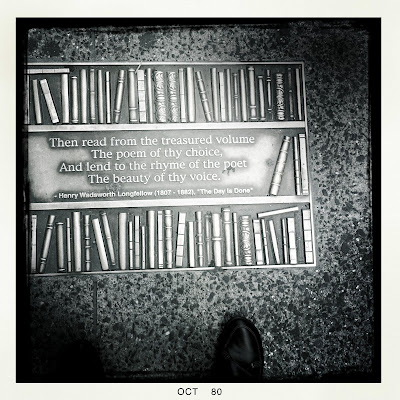
For bibliophiles visiting the city, a trip to the main branch of the New York Public Library on Fifth Avenue in midtown is a required stop. But what's also enjoyable is a stroll of book-related points of interest nearby. On E. 41st Street, on the two blocks just to the east of the main entrance of the library in a stretch known as Literary Way, look down to the sidewalk for the bronze plaques depicting literary quotations. After visiting the great marble halls and rooms of the library, walk to the west side of the building to Bryant Park. While there, borrow a book from its outdoor Reading Room or take a look at one of the statues commemorating a notable figure in arts and letters. For a coffee break, stroll east on 42nd Street to Madison Avenue and look for the new branch of D'Espresso with its mind-bending design of a book-lined study turned on its side. Or for a longer break late in the day or night, wander over to the Library Hotel's rooftop bar, Bookmarks, and sip a glass of wine while contemplating literary matters against the backdrop of the New York skyline. It's a great way to spend the day. In New York, we take our book matters seriously.

Also of literary note nearby - the Algonquin Hotel, the home of the famous literary Round Table, and the Yale Club, frequented by Nick Caraway in The Great Gatsby. If traveling by subway here, take note of the literary-themed artwork lining the underground passageways near Fifth Avenue.

Created by Grand Central Partnership and dedicated in 2004, the two-block corridor on E. 41st Street between Park Avenue/Pershing Square and Fifth Avenue is known as Library Way. Along the sidewalk, look for bronze plaques with quotations from world literature. The plaques are the creation of sculptor Gregg Lefevre.

Tuesday, October 12, 2010

The Advantages of a New Perspective: A Literary Walk in Brooklyn Heights

Brooklyn Heights still retains a sense of dignity and quiet, the legacy of a residential neighborhood that was famous in the nineteenth century for its churches and for its elegant homes built by merchants and sea captains in the shipping trades. The neighborhood remained relatively secluded until 1908, ten years after the incorporation of Greater New York, when the IRT subway connected the two boroughs. According to the Federal Writers' Project guide to the city, the prospects of the lesser sort visiting the bucolic suburb of the aristocracy frightened the residents: "Many of the patrician inhabitants fled; the old Victorian mansions were partitioned into studios and apartments; and writers and artists were attracted to the region." (p. 442)

the view from Brooklyn Heights
Despite the subsequent twentieth century invasion by artists, poets, painters, and playwrights, Brooklyn Heights has managed to retain much of its seclusion and exclusivity, largely as a result of its landmark status, high property values, and success in confining commercial enterprises to a couple of streets. These days, a well-compensated actor or popular novelist would be just as likely as a successful merchant to snap up a desirable brownstone in the Heights. A sea captain today would probably be priced out of a home built for a sea captain of the 1800s.

Looking down Middagh Street toward the East River. The old Brooklyn Heights street has several houses built in the 1820s-1840s.

Tuesday, October 5, 2010

Abstract Expressionism at The Museum of Modern Art (MoMA) and Beyond

REVIEW. Abstract Expressionist New York, a sprawling exhibition at MoMA that is drawn entirely from the museum's collection and fills the entire fourth floor plus two additional focus exhibits on the second and third floors, presents the opportunity to be surprised and see the world new again. Shifted to center stage, the paintings that once rocked the art world sixty years ago become important once more, not just another chapter, albeit an important one, in art history textbooks. Much time has ticked away since those boozy, smoky and chatty New York days that gave rise to the drips and the zips, and as most of the artists departed the big scene, a mythology about their lives and work overshadowed their real stories. But even as they became myths, new art movements and artists took their place. MoMA's exhibition includes a section about these pop upstarts - Johns, Oldenburg, Lichtenstein, Ruscha, Rosenquist, and above all, Warhol, waiting in the wings.

Jackson Pollock (American, 1912-1956)
One: Number 31, 1950. 1950
Oil and enamel paint on canvas
8' 10" x 17' 5 5/8" (269.5 x 530.8 cm)
Sidney and Harriet Janis Collection Fund (by exchange)
© 2010 The Pollock-Krasner Foundation / Artists Rights Society (ARS), New York
Jackson Pollock (1912-1956) is highly conducive for mythmaking because of his physicality, roots in the American West, and untimely tragic death, yet other biographies are equally fascinating. The mythologizing is an ongoing practice. Look at Mark Stevens and Annalyn Swan's popular 2004 biography of Willem de Kooning or the recent Broadway hit, Red, by playwright John Logan and starring Alfred Molina as the fierce Mark Rothko. While the vast MoMA exhibition, organized by curator Ann Temkin, invites a new look at the work through group displays, solo artist rooms, and thematic presentations, it's still difficult sometimes to see the work through the haze of hagiography.

Franz Kline (American, 1910–1962)
Chief. 1950
Oil on canvas, 58 3/8" x 6' 1 1/2" (148.3 x 186.7 cm)
The Museum of Modern Art, New York. Gift of Mr. and Mrs. David M. Solinger
© 2010 The Franz Kline Estate / Artists Rights Society (ARS), New York
In such an ambitious exhibit, one stretched almost to the breaking point, abstract expressionism becomes a rather slippery catchall term in light of its varieties on display. While Pollock might fit well under most meanings of the phrase, an artist like Barnett Newman points to minimalism, a rather different project. Still, by assembling the works close together, it's possible to see more unifying marks and themes than differences and even to feel the camaraderie that characterized the cultural moment in New York City in the 1940s, 1950s, and early 1960s. In galleries that showcase works by several artists, especially a strong room that gathers paintings by Willem de Kooning, Alfred Leslie, Joan Mitchell, Grace Hartigan, Larry Rivers, Sam Francis, Lee Krasner, and Jack Tworkov, the shared excitement of yet different artistic directions becomes most apparent.

Friday, October 1, 2010

New York City as the Stage for the World: Walks Through the City's International Cultural Centers

New York City is home to many international cultural centers that serve to highlight, advocate, or otherwise educate a larger public about a particular country, cultural group, or language. The city's international culture extends back to its earliest days, but New York firmly established itself as a world financial and cultural center in the latter half of the twentieth century. Certainly, the waves of immigration over the centuries have made New York one of the most diverse cities in the world. One of the city's most well-known institutions, the United Nations, brings thousands of people from around the world to live and work. The headquarters of the UN, built in the Turtle Bay neighborhood in the years 1949-1952, is designated international territory.

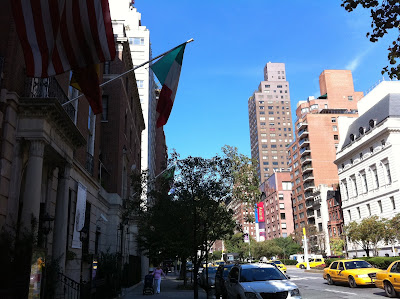
 Park Avenue. The Italian Cultural Institute of New York is on the left. In the distance, the Asia Society.
This walk serves as an introduction to several international societies, groups, and institutes, primarily located in a convenient swath of land from the Upper East Side, specifically the area known as the Gold Coast, to Midtown Manhattan. Some of the institutions are homegrown, like the Asia Society, founded by John D. Rockefeller III. Other organizations are sponsored by a country, such as the Austrian Cultural Forum, an agency of the Republic of Austria.


View International Cultural Centers in New York in a larger map

Start at the Asia Society and walk south to the Onassis Cultural Center in the Olympic Tower, stopping in at several of the centers. The distance is a little over one mile. Or, find some of the other cultural centers located on the map (and this list in not complete) and make your own international walk. The only reason these centers are grouped together for a self-guided walk is their geographical proximity. This particular walk, however, has the added benefit of several historical points of interest, architectural gems and retail attractions between the stops. A few of these places are noted below and on the accompanying map. 

Asia Society
Asia Society (725 Park Ave. at 70th St.)
The society's building in New York, just one of many Asia Society centers around the world, is housed in a large building on Park and E. 70th Street. The society hosts a full range of exhibitions and programs, all centered on developing a better understanding of the nations of Asia. Stop for lunch at the Garden Court Cafe, a highly-regarded culinary favorite for the surrounding neighborhood. 

Exhibit of note:
Yoshitomo Nara: Nobody's Fool 
Through January 2, 2011
The main attraction at Asia Society these days is a sublimely engaging and imaginative presentation of the work of Japanese artist Yoshitomo Nara. Raised as a latchkey child to older parents and with much older siblings, Nara was left to invent his own amusements. Finding solace in drawing and pop music, Nara developed a healthy amount of resentment and artistic revenge for being left alone for too long. The result is that the artist became a master of the cute and creepy strains in Japanese art, infusing manga and anime with an irate rocker's wicked sensibility. The installation rooms - paths winding through a child's playhouses - are a tour de force. Yoshitomo Nara: Nobody's Fool is WOTBA's favorite exhibition of the year so far.  Look for the two large public sculptures by Nara on Park Avenue (one is noted below).   

Italian Cultural Institute of New York (686 Park Ave)
A small room just inside the main doors of the institute hosts art exhibitions.

Exhibit of note:
Interior Costume, artworks by Enzo Cucchi.
Through October 15, 2010

Related Posts Plugin for WordPress, Blogger...