Tuesday, September 28, 2010

The Spanish Civil War in the Lost & Found: The Mexican Suitcase at the ICP

The Mexican Suitcase has come to describe the contents of three boxes, once considered lost, containing 4,500 negatives of photographs of the Spanish Civil War. After resurfacing and then delivered, in somewhat mysterious fashion, to the International Center of Photography in 2007, these images by Robert Capa, Chim (David Seymour) and Gerda Taro are now seeing the light of day in an exhibition at the center's galleries. Displayed as contact sheets along with enlargements of selected images, and with some images blown up to wall size for visual effect, the photographs once again open the wounds of a war that tore Spain apart. If anyone is in need of a reminder about the lengths people will go in the service of their ideology, then look no further than the events in Spain from July 1936 to April 1939.

Robert Capa 
[Exiled Republicans being marched down the beach to an internment camp, Le Barcarès, France], March 1939 
Negative 
© International Center of Photography / Magnum 
International Center of Photography 
The conflicts between the members of the democratically-elected Republican government and the Nationalist forces seeking to overthrow them engaged the full spectrum of heated political opinions, pitting socialists and liberals against one another even as they worked to combat the rising tide of fascism and its tense coalition of militarists, monarchists, and many members of the clergy. The cause of the besieged Republican government inspired many writers and artists overseas to join their cause, becoming fighting members of the International Brigades, or like Ernest Hemingway, reporting on the story for the American press, or like Capa, Chim, and Taro, as photojournalist witnesses shooting with their cameras. The larger world would follow the stories of the war through the publication of their photographs in the leading magazines and journals.  

Chim (David Seymour) 
[Outdoor mass for Republican soldiers, near Lekeitio, Basque region, Spain], January–February 1937 
Negative 
© Estate of David Seymour / Magnum 
International Center of Photography 

Tuesday, September 21, 2010

When the Bowery was Skid Row: Lionel Rogosin’s On the Bowery (1957)

The stunningly beautiful new 35 mm restoration of Lionel Rogosin’s On the Bowery (1957), playing now at Film Forum, harkens back to an infamous time along the downtown thoroughfare. A skid row for alcoholics, mostly men of the laboring trades, the Bowery was also in a slump, in eclipse from its better days as an important farm lane in New Amsterdam and later as a downtown Broadway. The Bowery had even slipped from its raunchy vaudeville existence under the darkness of the Third Avenue El. By the 1950s, even as much of the city shined in the boom of the postwar years, the Bowery attracted few people, except for artists seeking lower rents. The street's cheap bars and flop houses lured the down-and-out hopeless cases, men whose weathered faces erased any signs of a happier former life or a hopeful future. The Bowery Mission offered one way off the street, but for the man addicted to the heady combination of freedom and Muscatel, the promise of room and board in exchange for sobriety did not seem as fun as a night of drinking, even if that meant sleeping in the streets.

From Lionel Rogosin's On the Bowery (1957). Courtesy Milestone Films.
Many New Yorkers would have known the filmmaker as the eccentric founder of the Bleecker Street Cinema (1960-1990), but this film should help many recognize Lionel Rogosin (1924-2000) as an important documentary filmmaker. Trained as an engineer, a veteran of the Navy, and a worker in his father's successful rayon business, Rogosin suddenly decided he wanted to make a film. Leaving the family business, he started exploring why the society left some people in dire poverty. As he explained in a filmed interview, On the Bowery served as his school for filmmaking. He spent the next six months just observing the life there, getting to know his subject before he even picked up the camera. He got to know five or six of the men and invited them over to his place in the Village at 96 Perry Street. His comfortable world, although proximate in geography, seemed far away from the sidewalks of the Bowery.

Wednesday, September 15, 2010

From the East Village to Chelsea Market: A Zigzag Walk by Intersections

Pretend it's a nice day in New York City, and you're sitting on a park bench in First Park at the corner of E. 1st St. and 1st Avenue and drinking a good cup of coffee from Little Veselka, and then someone calls you on the phone and says they want to meet you in an hour at the Chelsea Market. Well, that's not exactly close. The market is on the west side near 9th Avenue and W. 15th Street, and it's going to take some thought about how to get there. You could take the subway - the F to W. 4th and then transfer to a C to 14th Street, but it's a nice day for a walk. You'll tell the person that you will be there.

So, if you're near E. 1st and 1st Ave., then why not proceed uptown and westward, block by block? From 1st and 1st, go to 2nd Avenue and 2nd Street, then up to 3rd Street and over to the Bowery, and then up to E 4th and Lafayette, and so forth? This will work. A meandering walk in Manhattan from the intersection of 1st Ave. and 1st St. to the intersection of 9th Ave. and 15th St. takes its course through several downtown neighborhoods - the East Village, Noho, Greenwich Village, West Village, Meatpacking, and Chelsea - with plenty of notable buildings, cultural institutions, and restaurants to enjoy along the way. It's a pleasant way to learn city geography.


View A Zigzag Walk from the East Village to Chelsea in a larger map

The walk is made up of intriguing intersections, most of which visually represent their respective neighborhoods. New Yorkers are big on intersections, as these mark the way we understand the city. When we tell another New Yorker where we live, we usually give them the intersection so that they can start mentally processing the location. We then watch the person on the receiving end of the information fall into a trance-like state as they recover their memories, if any, of visiting that intersection. If they have, they will always come back with something like "Oh, I know that corner. I had a friend down there, and we would always hang out at that ice cream place." This type of conversation takes place a thousand times every day.

Friday, September 10, 2010

A Walk Among the Brownstones of Brooklyn

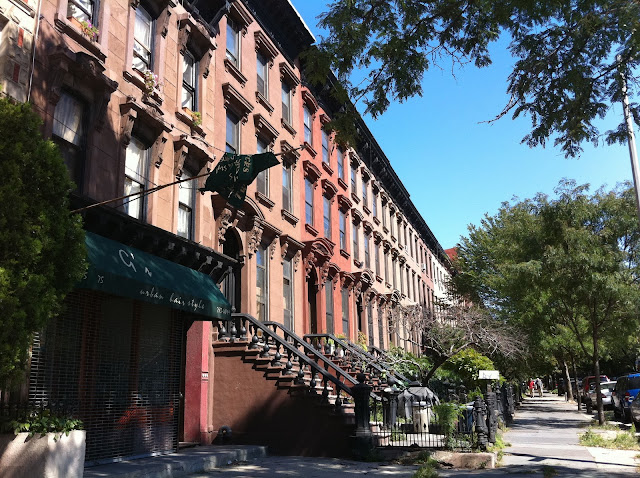
As many readers know well, Brooklyn hosts the largest concentration of nineteenth century buildings made with the building material known as brownstone. Members of the aspiring upper middle classes of the day, especially from the 1860s through the 1880s, sought out the dark-hued sandstone to lend their houses a distinguished appearance, and the rush to join the fashion of decorating one's home in the versatile material often created a shortage. Rich with red iron oxide, creating deep brownish to red colors, the stone came from nearby quarries in New Jersey, Connecticut, and Pennsylvania and then shipped into Brooklyn by barges.

Along St. Mark's Avenue, near the intersection with Flatbush Avenue.
A brownstone mason working on site would affix a thick veneer of the stone to the exterior brick wall of the constructed house. Individual houses were often designed in Greek Revival, Neo Greco, Romanesque, or Italianate styles, or as row houses with one consistent style. Many of these houses featured stoops, wrought iron gratings, and detailed carved decorations, many of which still remain. Obviously, over subsequent decades, other styles of architecture would come into favor.

For example - on the left, Richard Meier On Prospect Park.
1 Grand Army Plaza. Completed 2008. On the right, Brooklyn Public Library. 1941.
By the 1890s, many architecture critics worried that the material was overused, part of a fad that had carried on much too long.

From The building materials of Pennsylvania:
I.--Brownstones by Thomas Cramer Hopkins of Pennsylvania State College (Busch, State Printer, 1896).
Novelist Edith Wharton famously detested the indulgence in brownstone. In her memoir A Backward Glance, she refers to the New York of her youth as "cursed with its universal chocolate-coloured coating of the most hideous stone ever quarried."

Tuesday, September 7, 2010

14 Useful Mobile Apps for Walking New York City

Texting and walking at the same time is wrong. Talking on the phone while strolling down the street is wrong. Leaving the sidewalk to stop and consult the information on a cellphone, preferably while alone, is OK.

What's on Walking Off the Big Apple's iPhone: A List

Walkmeter GPS Walking Stopwatch for Fitness and Weight Loss. While out walking, Walkmeter tracks routes, time, speed, and elevation. This is an excellent app for recording improvised or impromptu strolls, especially with many unplanned detours. The GPS function maps out the actual route. The app keeps a running tally of calories burned while walking, useful for weight loss goals. Another welcome feature is the ability to switch over to other modes of activity, including cycling. An indispensable app for city walkers. $4.99 

New York City Compass, designed by Francesco Bertelli, is an elegant compass calibrated for Manhattan, with indications for Uptown, East Side, Downtown, and West Side. While facing a certain direction, the letters will turn blue. This comes in handy when stepping out into an unfamiliar neighborhood from the subway. Back in the day, all you ever needed to know about New York City could be summed in the words Uptown, East Side, Downtown, and West Side. We should go back to this way again. No more contrived names for neighborhoods. When you're watching Mad Men, for example, and someone says they're going downtown, you know exactly what that means.* Free.

NYCMate, with subway and bus maps for all the boroughs, is easier to read and use than many of the other transit maps. Free.

NYC Way could be described as an app of apps, because it contains multiple applications - everything from a list of nearby restaurants to nearby public restrooms to Wifi locations to street food. Some of the restaurant information is out of date, but it's hard to keep up a current data base with new restaurants opening and old ones closing. Favorites here include the list of free things and nearby art galleries. Free.

Urbanspoon, a longtime popular iPhone app, still comes in handy when deciding upon a restaurant. With variables for type of cuisine, neighborhood, and price, Urbanspoon spins its magic and comes up with a suggested place. Don't care for the selection? Spin again, or just shake the whole phone. Sometimes, the list of restaurants is not extensive or selected eateries are squeezed into the wrong category, but at least the app helps expand a list of options for dining out.

NYC Tip, another simple app from Francesco Bertelli. Easy way to calculate 15%, 18%, or 20% tips on a meal and split the bill by up to five people. Free.

Open Table, the website that allows diners to search and place reservations for restaurants, eventually accumulating redeemable points, has an attractive app with thumbnail pix of restaurants, availability for tables by time slot, distance, pricing information, diner reviews, and sometimes the actual menu. Click on an available opening, and you're set for dinner. Free.

Monday, September 6, 2010

Scenes from a Walk on a Windswept Afternoon

The passing of Hurricane Earl, thankfully far away in the Atlantic Ocean, kicked up powerful breezes in New York City earlier in the weekend but left a brilliant sky in its wake. The previous stretch of humid days had come to an end, just in time for the first day of a long Labor Day weekend.

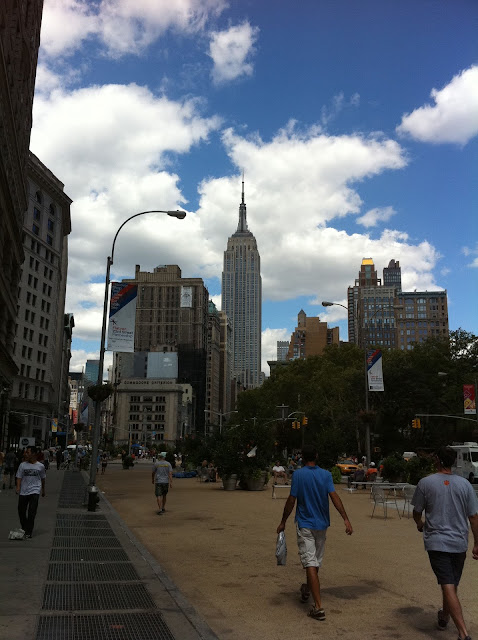
The sky was crystalline, giving the the skyline's favorite star, the Empire State Building, the look of a cinematic matte shot. Approaching the building from the block of Broadway south of Madison Square Park, the scene seemed at times like a surreal photo-collage, as if the buildings were cutouts and pasted on another photograph of the sky.

1. the Empire State Building
On Saturday, I set upon a walk uptown to complete a couple of errands, but the brilliance of the day encouraged a longer excursion with additional stops.

2. Eataly. 23rd St. and Fifth Avenue.
Hundreds of people lined the corner of 23rd St. and Fifth Avenue in order to visit Eataly, the new market featuring the foods of Italy, and like a fool New Yorker, I stood in line with them. The wait was not exceedingly long. After strolling through the mega-eatery, not easy with such a crowd, I came away with first impressions - appetizing, frantic, too crowded, expensive, a little disorganized, and not all that reminiscent of Italy. As a resident of the Village, with its remaining echoes of Italian heritage, all I ever want or need is Raffetto's (144 West Houston), a small grocery store with homemade food and a big heart.

Related Posts Plugin for WordPress, Blogger...