Tuesday, August 31, 2010

New York Museum Exhibitions, Fall 2010: A Selected List, With Openings in September, October, and November

International Center of Photography
For updated museum listings for winter 2010-2011, please follow this link to the most current post.

Surveying the upcoming exhibitions scheduled to open at New York museums and art centers this fall, a few stellar exhibitions stand out from the pack. First and foremost, in late September the International Center of Photography unveils the contents of The Mexican Suitcase, the legendary boxes of images of the Spanish Civil War made by Robert Capa, Gerda Taro, and Chim (David Seymour). Thought lost since 1939, the center acquired the suitcase in December 2007, and the unveiling will present images from the recovered negatives along with a display of magazines that first published the works. Photography historians have been waiting decades to take a look at these images. (Read WOTBA review.) The center will also present a concurrent exhibition on the Cuban Revolution, including rare prints of Alberto Korda's iconic portrait of Che.

Among other promising exhibits, the recently renovated El Museo del Barrio, in collaboration with the New-York Historical Society, will present Nueva York (1613-1945), an examination of how Latinos and Spanish-speaking countries have historically shaped the cultural life of New York City. Beginning in October, the Frick Collection will present a significant selection of drawings from Spain, The Spanish Manner: Drawings from Ribera to Goya. At the Guggenheim, the exhibition Chaos and Classicism: Art in France, Italy, and Germany, 1918-1936 will show how artists began to once again represent the body after abandoning figurative work during World War I. At the Drawing Center on Wooster St., fans of Gerhard Richter will want to see an exhibition of fifty drawings made over five decades. The Jewish Museum presents a significant exhibition on the feminist encounter with the canvas, Shifting the Gaze: Painting and Feminism.

At the Metropolitan Museum of Art, the big John Baldessari exhibit, Pure Beauty, opens October 20, the first significant survey in twenty years. The exhibit will present the conceptual artist's work over five decades. Beginning in November, the Met's photography department will exhibit selections from the museum's collection of three major photographers - Alfred Stieglitz, Edward Steichen, and Paul Strand. At MoMA, the museum will show its selections of the New York School with Abstract Expressionist New York.

Finally, look for the Morgan Library and Museum's exhibitions on Mark Twain, Roy Lichtenstein's black-and-white drawings, and drawings and sketchbooks by Degas. The New Museum will present The Last Newspaper, an exhibition inspired by the ways artists respond to the news media. And in late October, the Whitney Museum will present an exhibition it knows how to do best - Modern Life: Edward Hopper and His Time.

What follows is a list of selected museum and other art center exhibitions currently on view in New York City along with dates of upcoming exhibits (listed in bold) that are scheduled to open in the fall.

Upcoming museum exhibitions are noted in bold type.

bears in Audubon Terrace
American Academy of Arts and Letters, 633 West 155th Street (Audubon Terrace):
Annual exhibitions are held in the spring. See the nearby Hispanic Society, noted below.

American Folk Art Museum, 45 W. 53rd St.:
Eugene Von Bruenchenhein
Through October 9, 2011

Monday, August 30, 2010

Day Trip: Up the River to Hudson, New York and a Visit to Frederic Church's Olana

Summer in the city has been long and hot, and for those of us who never managed to get away, the season has felt even longer and hotter than usual. Worried that the summer was drawing to a close, I vowed to go somewhere or anywhere, even if overnight, preferably to a small city at a northern latitude with some visual architectural interest, surrounding views of nature, and a sense of history. I also wanted to escape the perpetual sounds of jackhammering, street shouting, car honking, fire engine clanging, and the myriad other noises that characterize my overly-long summer days.

View of the Hudson River from Parade Hill.
I selected Hudson, New York for my escape largely because of its proximity to Olana, the fanciful residence of Hudson River School painter Frederic Edwin Church (1826-1900). Having heard of the marvelous estate he designed, one with Persian-style influences and of a grand scale befitting one of the most successful painters of the latter half of the 19th century, I decided to board Amtrak's Ethan Allen Express and check it out for myself.

Warren Street. Hudson, New York.

Friday, August 27, 2010

How to Walk Off a Pastrami Sandwich in New York City

Walker Street. Chinatown, New York.
Some people can eat a lot and not gain much weight, but many others will simply gain weight if they eat too much and not exercise. Most of us fit in the latter category. Walking is a simple and common way to get some exercise, and if we're out and about in New York City, it's easy to think that we can walk off whatever fun New York foods we've consumed along the strolls - the hot dogs, the cupcakes, the cafe lattes, the precious fusion fried chickens, the three-course lunches, the gelato on a stick, the three sauvignon blancs, etc. We may be correct about the benefits of walking, but we would be completely delusional to think that we can easily walk off all of our favorite New York foods and drinks. Don't forget the drinks.

New Yorkers themselves became more aware of the caloric value of favorite foods starting back in 2007 when chain restaurants were required to post calories. It came as something of a shock to see how many calories a so-called low-fat blueberry muffin contained. And I think New Yorkers are increasingly aware, like others, of the health benefits of walking. Walking is often cited as a solution for a variety of issues - as a healthy alternative to smoking (pertinent as many city dwellers had to give up the habit when it became too expensive), as a way to beat stress, and as a low-impact form of exercise. On the other hand, strolling, the kind often practiced on this website, is rather distinct from walking as exercise. Strolling is a slow balletic gesture of putting one foot in front of another. It's hardly an effort. In the golden age of the flâneur in the nineteenth century, taking a turtle for a walk down a Paris street helped set the pace.

To enjoy the health benefits of walking, it's necessary to pick up the pace, to walk with some deliberation, as if rushing to meet a person for an appointment or to catch the next train. A person weighing 150 pounds walking a moderate pace of 2.5 mph on a flat urban sidewalk burns approximately 204 calories an hour. Smaller people tend to burn less calories, and big people burn more. Other factors must be considered such as age, shape, overall body composition, etc., but we can use calculators to get a rough idea. A caramel frappuccino with skim milk from the coffee place has about 167 calories in it, so for a trim person of 125 pounds, it would take nearly an hour to walk that off.

As cooler weather and hearty appetites return for the fall and winter, it's time to get a grip on food, walking, and calories. Brace yourselves. As Margo Channing says in All About Eve (1950), "It's going to be a bumpy night!"

New York Food, Calories, and Distance Between New York Sites to Walk It Off

Using www.gmap-pedometer.com, I've calculated the necessary distance to walk off various New York favorite foods by connecting a walk between two New York sites or landmarks. 

• slice of good New York pizza (350 cal) = Morgan Library & Museum (Madison Ave. & 36th Street) to Cooper-Hewitt Museum (5th Ave. and E. 91st St.)

• cafe latte grande (260 cal) =  Walk once around the perimeter of Governors Island (2.1 miles)

• bagel (320 cal) = Sheridan Square (Village) to Lincoln Center

Tuesday, August 24, 2010

A Walk Along Hudson Street on an August Afternoon

A walk along Hudson Street from its northern tip near the intersection of 14th Street and 9th Avenue and south all the way down its end in Tribeca, a pleasant but hardy distance of about two miles, affords the opportunity to visit a variety of historical sites and to indulge in epicurean pleasures. For area residents, however, Hudson Street is their everyday street, a place of schools, nursing homes, gyms, community organizations, houses of worship, parks and many businesses that support the life of the neighborhood. The neighborly aspect is most notable in the prime West Village blocks from Horatio St. south to W. Houston.

Once the home street of Jane Jacobs, the revered urban activist and writer who passionately championed multi-use street life, Hudson Street is still marked by its easygoing and casual character. The area is a nice place to linger over a casual French dinner or to sit quietly in the serene gardens of the Church of St. Luke in the Fields. The street is home to one of the city's most famous watering holes - the White Horse Tavern, the place where poet Dylan Thomas fatally drank too much. During the school year, just be sure to schedule your serene moments for any time other than the moment classes are dismissed at the middle school.


Sunday, August 15, 2010

The Reagan-Bush-Gorbachev Meeting on Governors Island: A Debriefing and a Walk

On December 7, 1988, President Ronald Reagan and Vice President George H. W. Bush met with Soviet leader Mikhail Gorbachev on Governors Island, then the headquarters for the Coast Guard. Documentation of the events that day remained secret for twenty years, but the release of both Soviet and American materials, analyzed and posted by the National Security Archive (see sources at end of post), provides a vivid picture of the dramatic events that unfolded around the meeting. Furthermore, now that Governors Island is open to the public, including the Commanders House where the leaders met for lunch, it is now possible to reconstruct the historic events by matching the words of a declassified memorandum describing the lunch with images of the interiors of the house today. The small talk that characterized the lunch, however, does not betray the extraordinary surprise that the Soviet leader unveiled earlier that morning in a speech to the United Nations.


Standing in front of the 43rd U.N. General Assembly, Mikhail Gorbachev began his speech by describing the sweeping changes of revolutionary history, acknowledging the surge of recent change sweeping the Soviet republics. He tells the members of "the profound democratic reform of the entire system of power and government," including the end to state control over public associations, an end to political imprisonment, the end of travel restrictions, and a firmer commitment to the notion of human rights.

"Gorbachev said each time they met the weather got better. The President replied jovially that we arranged that."

"Turning to substance, Gorbachev said he hoped what he had said at the UN had not contained surprises."

Wednesday, August 11, 2010

Charles Burchfield at the Whitney

An exhibit at the Whitney Museum of American Art, Heat Waves in a Swamp: The Paintings of Charles Burchfield (1893-1967), features a chronological overview of the watercolors, drawings, and paintings of an important 20th century American artist perhaps more well known among artists than with the general public. While it's become common to label the painter a "visionary artist," with his exaggerated circular forms and frightening distortions of nature, sometimes bordering on fantasy illustration (but never boiling over that far), Burchfield nevertheless worked prolifically and well within the confines, at least outwardly, of a fairly conventional American life.

Charles Burchfield, Sun and Rocks, 1918–50. Watercolor and gouache on paper, 40 x 56 in. (101.6 x 142.2 cm). Albright-Knox Art Gallery, Buffalo, New York. Room of Contemporary Art Fund, 1953.

Curated by artist Robert Gober and organized and first presented by the Hammer Museum in Los Angeles, the presentation of work over a fifty-year period describes the continuities, creative development, and intriguing backtrack of an artist both "visionary" and yet deeply akin to artists of his own generation. The point of the exhibit is to bring Burchfield up a few pegs in the art canon, perhaps within range of his friend Edward Hopper, though the latter will still be difficult to topple as the art god of the Whitney. The exhibit's supplemental printed material from earlier decades, including exhibit catalogues of Burchfield's work, interviews with the artist in popular magazines, Hopper's 1928 essay, etc., helps advance the case for the artist.

Charles Burchfield, Two Ravines, 1934–43. Watercolor on paper, 361⁄2 x 611⁄8 in. (92.7 x 155.3 cm). Hunter Museum of American Art, Chattanooga, Tennessee. Gift of the Benwood Foundation.

A native of Ohio, Burchfield lived most of his life near Buffalo New York, staying close to the study of the natural world around him, especially the teeming spaces of bogs and swamps. Preferring watercolor as his medium, he developed a highly individuated style of expressionist interpretations of nature. Early in his artistic life, he sketched out abstract forms that symbolized emotions, and these bare and elegant sketches from 1916, a year that marks his graduation from the Cleveland School of Art, to 1918 would earn him the distinction of having the first solo show at MoMA in 1930. His abstractions actually invite some comparison to Georgia O'Keeffe's charcoal drawings from the same period, a generational attraction of budding modernists to the geometries of nature.

Tuesday, August 10, 2010

Hot Days in New York City: An Ennui Advisory is in Effect

URGENT - WEATHER MESSAGE...
WALKING OFF THE BIG APPLE GREENWICH VILLAGE NEW YORK NY US A


...VERY BORING WEATHER THROUGH TUESDAY...

 AN ENNUI ADVISORY REMAINS IN EFFECT UNTIL 9 PM EDT THIS EVENING ACROSS ALL THE BOROUGHS OF NEW YORK CITY AND NEARBY LESSER TOWNS OF WHICH WE ARE UNFAMILIAR.

ENNUI ADVISORY INDICES THIS AFTERNOON WILL REACH THE MID-90S ACROSS NEW YORK CITY, MAKING IT COMPARABLE TO HOUSTON, TEXAS ON A REALLY BAD DAY. INDICES ARE MEASURED BY NORMAL CLIMATE AND HUMIDITY LEVELS COMBINED WITH THE PERSONAL BREAKING POINTS FOR HEATED CONVERSATIONS WITH SIGNIFICANT OTHERS, THE SLOW SPEED OF YOUR DOG WHILE WALKING, THE GENERAL ENNUI OF COWORKERS AND FRIENDS, THE HIGH PERCENTAGE OF CONVERSATIONS STUCK ON THE TOPIC OF THE HEAT AND HUMIDITY, AND THE MALAISE THAT ACCOMPANIES A FEELING THAT THE DAY WILL NEVER END.

COPING/DENIAL ACTIONS...

AN ENNUI ADVISORY IS ISSUED FOR NEW YORK CITY WHEN CONDITIONS ARE EXPECTED TO LIMIT WARDROBE CHOICES AND THE ABILITY TO REMAIN ON A SUBWAY PLATFORM WITHOUT PASSING OUT. DRINK PLENTY OF WATER, ESPECIALLY FROM ONE OF THE 10 OR MORE PLASTIC BOTTLES OF POLAND SPRING WATER UNNECESSARILY ACCUMULATING IN THE REFRIGERATOR…STAY IN AN AIR-CONDITIONED MUSEUM. MUSEUMS IN NEW YORK OPEN ON TUESDAY INCLUDE AMERICAN FOLK ART MUSEUM, GUGGENHEIM MUSEUM, INTERNATIONAL CENTER OF PHOTOGRAPHY, THE METROPOLITAN MUSEUM OF ART, THE MORGAN LIBRARY & MUSEUM, THE MUSEUM OF THE CITY OF NEW YORK…FORGET MOMA ON TUESDAYS, THEY WERE OPEN YESTERDAY AND YOU BLEW IT…

FIND A PLACE TO GO NEAR A SUBWAY STOP (SEE FOOTNOTE) OR STAY NEAR A SOHO BOUTIQUE THAT KEEPS ITS DOORS OPEN AND WASTES ENERGY…ANOTHER GOOD IDEA IS TO VISIT THE MAIN BRANCH OF THE NEW YORK PUBLIC LIBRARY, THE ONE WITH THE LIONS OUT FRONT, BECAUSE IT IS AIR-CONDITIONED AND RIGHT THERE WITH SEVERAL SUBWAY STOPS. HOURS ON TUESDAY ARE 10 A.M. UNTIL 9 P.M. AND SINCE IT'S NEXT TO BRYANT PARK AND FOOD PLACES, IT WOULD BE A GOOD PLACE TO SPEND THE DAY…OR THAT PLACE AT LINCOLN CENTER DESCRIBED IN YESTERDAY'S POST.

NEW YORKERS SHOULD PLAN TO CALL IN BORED TODAY.

…AND CHECK UP ON BORED RELATIVES, DOGS AND NEIGHBORS.

NEW YORK CITY RESIDENTS SHOULD IDENTIFY CAFES AND BARS THAT LEAVE THEM ALONE.

%%

##

WALKING OFF THE BIG APPLE KNOWS WHICH WAY THE WIND BLOWS.
ADDITIONAL RESOURCES:

GOOD SUBWAY STOPS FOR BAD WEATHER DAYS: A LIST OF STATIONS NEAR MAJOR NYC ATTRACTIONS

Monday, August 9, 2010

Great Public Spaces: David Rubenstein Atrium at Lincoln Center

Longtime New Yorkers walking near Lincoln Center may inadvertently breeze past one of the city's best new public spaces on Broadway between 62nd and 63rd Street. A light-infused and music-filled airy space, the David Rubenstein Atrium at Lincoln Center, as it's officially named, is now the starting point for the center's guided tours and ticket office for day-of discount tickets for Lincoln Center performances. But it's an extremely well-designed public space that not just fulfills the city guidelines for such spaces but reaches for a higher design standard.

As I've discussed in other posts on the topic, usually in reference to outdoor spaces such as Greenacre Park, elements that create great public spaces have been well-defined and codified over the years - movable chairs, a water feature, natural elements, the presence of food, a variety of things to do, and so forth. The idea is that people will more likely gravitate to places that humanize them and allow freedom of choice in the way they socially react in those spaces. At the basic level, the atrium, named in honor of the philanthropist and Lincoln Center Vice Chair, provides all the features - many places to sit, a 'witchcraft cafe for light meals, a comfortable climate-controlled environment (much appreciated in this most humid summer), restrooms, Wifi access, and a variety of things to do, including checking out the schedule for Lincoln Center. Target Free Thursdays sponsors free performances every Thursday at 8:30 p.m. But it goes beyond that.

The Atrium design by Tod Williams and Billie Tsien features many visual delights, including a tall ceiling with oval-shaped skylights, two vertical gardens with real plants, a ceiling-to-ground water fountain, and artwork by Dutch textile artist Claudy Jongstra. The multitude of textures on the walls and floor, including natural light and materials, wraps the visitor in a sensual, inviting space. And it's green. A recent visit at noon, depicted in these images, demonstrate the success of providing an innovative space that works equally well for tour groups or smaller meetings or the solo traveler. What's most impressive, however, is the acoustics. In spite of many people gathered in the atrium to talk and dine and ask questions at the information desk, you can hear what your friend is saying or actually hear yourself think. And, on top of that, when there's a lull in the conversation, you may actually hear the sound of an orchestra or other music. When I was there, it was Beethoven's 3rd Symphony, the Eroica. How sublime. This is Lincoln Center, after all. And someone was thinking.

David Rubenstein Atrium at Lincoln Center
Broadway between 62nd and 63rd Streets

Hours: Mon-Fr 8 a.m. -10 p.m.
Sat-Sun 9 a.m. - 10 p.m.

Day of Discount Tickets/Zucker Box Office Hours:
Tues-Sat 12 p.m.-7:45 p.m, Sun 12 p.m.-5:45 p.m.
Box Office is closed on Mondays. 

Consult the website for the David Rubenstein Atrium at Lincoln Center for current happenings.

Images by Walking Off the Big Apple from August 5, 2010.

Friday, August 6, 2010

Architectural Highlights Along New York's Summer Streets (A Reprise)

Note: Please read this updated post for Summer Streets August 2011.

For three consecutive Saturday mornings in August, the city of New York shuts down major north-south thoroughfares to vehicular traffic so that residents and visitors alike may enjoy the streets without the presence of cars and trucks. Most ride bicycles, some walk, and a few skate, but by whatever preferred means of transportation thousands of New Yorkers have been taking advantage of the Saturdays to exercise and to explore the streets in this novel way.

Summer Streets for August 2010 will take place August  7, 14, & 21 from 7 a.m. to 1 p.m. This year's iteration will feature MacroSea's repurposed dumpster swimming pools near the Grand  Central viaduct and FringeNYC theater shorts in the Soho rest area.

Summer Streets 08/08/09

The event also offers a rare opportunity to look at some of the city's great architecture from a new perspective. Sitting in a moving car, a driver can't fully enjoy urban architecture, or they shouldn't be, and even passengers who might be interested in sightseeing can't see through the roof of the car (unless they are in a convertible) in order to admire the top floors of buildings. On normal days, walking along the sidewalk allows views of the opposite street, but being able to walk in the middle of the street opens up a whole new world. It's a giddy feeling, this sense of the city and the sky, the kind of freedom you get marching in a parade. Biking the route may be the most pleasurable, because it allows the easiest and fastest access to all 6.9 miles of the route.


View Architectural Highlights Along NYC's Summer Streets: in a larger map

This map features architectural highlights along NYC's Summer Streets route. Buildings are listed from the south to the north. Many graceful late nineteenth-century buildings line the route, especially to the south in the older sections of the city, and the stretch of Park Avenue north of Grand Central features some of the most important buildings in the history of modern architecture - the MetLife Building, the Seagram Building, and the Lever House, among them. Turning west on 72nd Street and into Central Park simply opens up another adventure.

Summer Streets is not just for exercise or a good strategy for sustainable cities. It can be an exciting course in Architecture 101, afoot or on wheels.

Please see NYC DOT's Summer Street website for official site map and information about the event.

Riding or walking down Lafayette, look for the remains of Colonnade Row across from the Public Theater. Christopher Gray of The New York Times has a fascinating story about what happened to the luxurious marble columns when the buildings were torn down a century ago.

Image by Walking Off the Big Apple from August 8, 2009. Here, remembering the late Charles Gwathmey (link to NYT obit), architect of "Sculpture for Living" (the shimmering glass building ahead on Astor Place), while participating in NYC's Summer Streets. More images on Flickr.

Tuesday, August 3, 2010

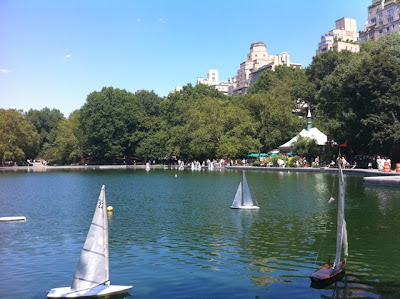
For the Flâneurs: After the Museums, A Walk in Central Park

Strolling the uptown museums and nearby Central Park is a time-honored New York pastime dating back to the days of the nineteenth century century flâneur. During the nineteenth century, the building of the park and later the great Beaux Arts buildings of monumental New York, most notably here the Metropolitan Museum of Art, brought out thousands of men and women to admire the natural and artistic wonders of the great city. For the nineteenth century observer, Central Park, the museums, and other attractions made the city a great scene to behold, achieving a cultural status rivaling the great cities of Europe.

Conservatory Water, Central Park, July 2010.
From Lloyd's pocket companion and guide through New York City, for 1866-67 by Thomas Lloyd:

The Pond, Central Park, looking to the southeast corner of 59th St. and Fifth Avenue. July 2010.
From a visitor's account in 1884:

lawn to the east of the Bethesda Terrace, Central Park. July 2010.
Related Posts Plugin for WordPress, Blogger...