Friday, February 26, 2010

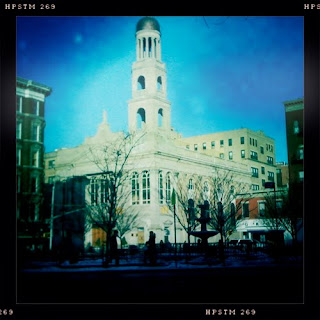
The Snow of Snows: Morning in the South Village, February 26, 2010 (A Super-sized Slideshow)


Images by Walking Off the Big Apple.

Wednesday, February 24, 2010

New York Museum Exhibitions: Spring 2010, with Openings in March, April, and May

PLEASE NOTE: For an updated list of openings in late spring and early summer 2010, please follow this link.

Several shows stand out in a list of Spring 2010 museum exhibitions in New York. Following two major exhibitions opening in late February - William Kentridge: Five Themes at the Museum of Modern Art and the Whitney Museum's Biennial, in March watch for the Grateful Dead exhibit at the New York Historical Society, an important Henri Cartier-Bresson retrospective at MoMA in late April, and a major Picasso exhibit at the Metropolitan Museum, also in April. Other openings of note include MoMA's retrospective, Marina Abramović: The Artist is Present, and the Neue Galerie's Otto Dix.

Though a little offbeat for the springtime, themes of death, hauntings and the afterlife run through several Spring exhibits - aside from the Grateful Dead at the NYHS, there's also Haunted: Contemporary Photography/Video/Performance at the Guggenheim, the opening in May of The Mummy Chamber at the Brooklyn Museum, Dead or Alive at MAD, Charles Addams's New York at the Museum of the City of New York (that one should be funny!), and at the Rubin Museum, Remember That You Will Die: Death Across Cultures (probably with some mirth, in its own way).


What follows is a list of selected museum and other art center exhibitions currently on view in New York City along with dates of upcoming exhibits that are scheduled to open in March, April, and May of 2010. Upcoming exhibitions are noted in bold type.

American Academy of Arts and Letters, 633 West 155th Street (Audubon Terrace):
For more on the must-see Audubon Terrace and neighborhood, see the post, A Visit to Audubon Terrace and Environs (one of Walking Off the Big Apple's 25 Great Things to Do in New York City.)

American Folk Art Museum, 45 W. 53rd St.:
• Approaching Abstraction
Through September 6, 2010
Women Only: Folk Art by Female Hands
Through September 12, 2010
The Private Collection of Henry Darger
Through September 19, 2010

Brooklyn Museum, 200 Eastern Parkway, Brooklyn, New York:
Healing the Wounds of War: The Brooklyn Sanitary Fair of 1964
Elizabeth A. Sackler Center for Feminist Art, Herstory Gallery, 4th Floor
Through September 12, 2010
Kiki Smith: Sojourn
Elizabeth A. Sackler Center for Feminist Art, Herstory Gallery, 4th Floor
Through September 12, 2010
The Mummy ChamberLong-term installation opens May 5, 2010
American High Style: Fashioning a National Collection
May 7, 2010 - August 1, 2010

Cooper-Hewitt, National Design Museum, 2 East 91st St.
:
• Ted Muehling Selects: Lobmeyer Glass from the Permanent CollectionThrough Fall 2010
• National Design Triennial: Why Design Now?
May 14, 2010 - January 9, 2011

El Museo del Barrio, 1230 Fifth Avenue at 104th Street:
• Phantom Sightings: Art After the Chicano MovementThrough May 23, 2010

Sunday, February 21, 2010

A Roundabout Walk in Columbus Circle

On the southwest corner of Central Park, Columbus Circle spins travelers in centrifugal force out toward Broadway, Central Park West, 59th Street (Central Park South), and Eighth Avenue. The circular design, unusual in New York, is the work of William Phelps Eno (1858-1945), one of the true unsung creative minds of the modern world. Known as "the Father of Traffic Safety," the New York native in 1903 developed the world's first traffic code to deal with the nightmares of city congestion. According to his book, Street Traffic Regulation (published by The Rider and Driver Publishing Co., 1909), horse and carriage traffic in New York was completely chaotic in the late 19th century. He writes, "Conditions were execrable so far as time, economy, comfort and safety were concerned, and the police, without systematic direction, were powerless and in fact practically at the mercy of the mob."

Eno's subsequent advocacy for street safety led him to develop many innovations we now take for granted - the stop sign, speed limits, and one-way streets. His solutions for the horse-drawn age carried through to the age of the automobile. Eno is also the father of the rotary traffic circle, his solution for controlling the confusion presented by an intersection with multiple streets. In addition to designing Columbus Circle, Eno is the man responsible for devising the rotary traffic around the Arc de Triomphe at Place de l'Étoile in Paris. There, twelve avenues meet, and automobile traffic is often beyond a nightmare.

The pictures below, as shown in Eno's book, illustrate some of the the typical traffic problems in New York at the beginning of the 20th century.


One hundred years later, in 2005, the plaza at Columbus Circle in New York was renovated and greatly improved. The central plaza now features trees, seating spaces, seasonal plantings, and fountains. For pedestrians, Columbus Circle is much safer than in previous years.


View A Walk Around Columbus Circle in a larger map

Some highlights -

• The Monuments: The monument of Christopher Columbus is at the center of Columbus Circle. Created by Italian sculptor Gaetano Russo, the marble statue of the explorer was dedicated in 1892 to commemorate the 400th anniversary of the voyage to the New World. Merchant's Gate at the southwest corner of Central Park is one of the park's main entrances. The imposing Maine Monument from 1913 (right) was erected in honor of the sailors who were killed in the explosion and sinking of the battleship Maine in 1898. The incident triggered the Spanish-American War.

• Time Warner Center, 2003-2004, designed by David Childs of Skidmore, Owings & Merrill: An enormous complex with fashion and beauty stores, a large Williams-Sonoma store, shoe stores, gourmet markets and cafes and exceptional restaurants. The latter includes Landmarc, Per Se, and Porter House. CNN's New York bureau is here as well as the upscale Mandarin Oriental Hotel and Jazz at Lincoln Center. For a more thrilling walk, look for the places to see Columbus Circle from on high. Ride the escalators to the fourth floor of the Time Warner Center and look out on W. 59th Street, or visit the 35th story Lobby Bar at the Mandarin Oriental Hotel for a dramatic view with cocktails. From the point of view of the visitor to the Time Warner Center, the glass cable-net wall on the east side not only provides wonderful views of Columbus Circle, the six-story wall seemingly extends W. 59th directly into the building. Back in William Eno's day, the ornate Majestic Theatre was built on this spot in 1903. In his book, Eno analyzes the traffic issues presented by people gathering all at once at the theater, a problem that has never found a great solution.

Wednesday, February 17, 2010

Exploring the Italian South Village

The South Village is one of the country’s oldest Italian-American neighborhoods, with roots going back to the Civil War era. According to "The Italians in the South Village" by historian Mary Elizabeth Brown, a report commissioned by the Greenwich Village Society For Historic Preservation, between 1880 and 1920 more than 50,000 Italian immigrants settled in the South Village. Mayor Fiorello LaGuardia was born here. The Italian presence in this lively area south of Washington Square Park gives the place a feeling of a tight-knit European neighborhood.

Italian restaurants such as Il Mulino, Bar Pitti, Bellavitae, Ennio & Michael (CLOSED), Ponte Vecchio, Porto-Bello, Pepe Rosso, Ciao, John's Pizzeria, Tre Giovanni, and many more thrive on the streets, and Italian specialty shops at Raffetto's (Houston Street), Faicco (Bleecker Street), Porto Rico Importing Company (Bleecker), Joe's Dairy (Sullivan Street), and Ottomanelli's Meat Market (Bleecker) treat residents like members of an extended family. The churches, Our Lady of Pompeii Church and St. Anthony of Padua, sustain the traditional bonds of the community. The cafes and pastry shops - Caffe Reggio, Caffe Dante, La Lanterna di Vittorio, Rocco's, Pasticceria Bruno, and others - have become fixed points of reference for the neighborhood's artistic and intellectual heritage. Over the years, however, the number of Italian-Americans living in the Village has dwindled to only a fraction of the population.


View The Italian South Village in a larger map

Monday, February 15, 2010

At the 134th Westminster Kennel Club Dog Show, Madison Square Garden


The second oldest sporting event in the United States - the first is the Kentucky Derby, the Westminster Kennel Club Dog Show in New York features competitors with a keen sense of smell and hearing. For the champion dogs that convened on the first day of the show in Madison Square Garden today, who knows what they heard and smelled? Maybe they sniffed out the unfamiliar scents of the three breeds new this year - the Norwegian Buhund, the Pyrenean Shepherd, and the Irish Red and White Shepherd, or the sellout crowd (the tickets were gone by 12:30 p.m.), or maybe it was just a faint whiff of the Knicks locker room. No matter the distraction, however, each member of the competition kept a keen eye on their human companion, as many of these images attest.

Today, the first day of the two-day event featured judging in the Hound, Toy, Non-Sporting and Herding breeds and varieties. Tomorrow, it will be the turn of the Sporting, Working, and Terrier breeds and varieties. Today's competition provided a rare opportunity to see such dogs as the sleek and elegant Pharaoh Hound and the handsome reddish Begian Tervuren and the stout spirited Swedish Vallhund. Still, some old faithfuls commanded attention, especially the popular Dachshund varieties, Beagles, and Australian Shepherds. All the dogs, not just the Poodles, received the royal treatment in the grooming area.

A $40 general admission ticket is good for all day and includes access to the backstage areas. Much of the fun of Westminster is meeting the individual dogs, usually while their companion is combing out tangles, and then following them out into the floor of the vast Madison Square Garden. Who knows if they can sniff out the winners?

The competition culminates on Tuesday evening. Both Monday and Tuesday evening group judging events will be televised on the USA Network beginning at 8 p.m. ET.

Images by Walking Off the Big Apple from February 15, 2010.

Saturday, February 13, 2010

After Jury Duty: Points of Interest Near the Courthouses and Foley Square

Civic Center, with its concentration of federal, state, and local buildings, many designed to provoke a sense of pride, wonderment, and awe, should be on more visitor itineraries. The dense concentration of monumental buildings in several historic styles - from Beaux-Arts to Art Deco to post-modern - should appeal to those with an interest in history and architecture. Fans of the long-running TV series Law & Order will recognize the courthouse steps. Intriguing fragments of the old city are scattered here and there, but new development points to the next iteration of the city skyline.

For many people the area near the courthouses remains sacred ground. The African Burial Ground rests in the land just to the west of Foley Square, and the cemetery of St. Paul's Church is nearby on Broadway to Church Street. Close, too, just beyond these buildings to the west, are the hallowed grounds of the World Trade Center site. A new Visitor Center for the African Burial Ground will soon open to the public. (read below for more information)

Local residents are accustomed to visiting the area, having to regularly do business with various government offices or courts. Summoned to 60 Centre Street for jury duty, for example, can also be a good opportunity to look at the 4th floor jury room's large WPA heroic realist murals of New York scenes - the skyline of Midtown as seen from the East River, the Municipal Building, Rockefeller Center, and many more, or to explore nearby sights downtown on lunch break. Outside of jury duty or other official business, New York residents may also want to check into downtown to look at several major buildings under construction. Particularly fascinating at this stage is Beekman Tower, a 76-story skyscraper designed by architect Frank Gehry at 8 Spruce Street.


View After Jury Duty: Points of Interest Near the Courthouses and Foley SquareAfter Jury Duty: Points of Interest Near the Courthouses and Foley Square in a larger map

There are many more places here worth seeing including the Woolworth Building, the Tweed Courthouse, City Hall and City Hall Park. Some highlights -

• New York County Courthouse (now Supreme Court), 60 Centre St, between Worth and Pearl Sreets. east side Foley Square, 1913-1927. The ceiling mural in the rotunda, Law Through the Ages by Attilio Pusterla, portrays the major figures in the history of justice. On the floor - an elaborate sign of the zodiac. The Daniel P. Moynihan U.S. Courthouse, behind the court, 1995, represents contemporary Federal architecture by Kohn Pedersen Fox Associates.

• Just to the south of the New York court sits the Thurgood Marshall U.S. Courthouse at 40 Centre St., SE corner Pearl St., east side Foley Square, 1933-1936. The base of this Cass Gilbert and Cass Gilbert, Jr. building is designed as a classical temple, with a tall tower topped with a golden pyramid. The building is currently undergoing major infrastructure upgrades, having received 64 million dollars under the American Recovery and Reinvestment Act of 2009.

Wednesday, February 10, 2010

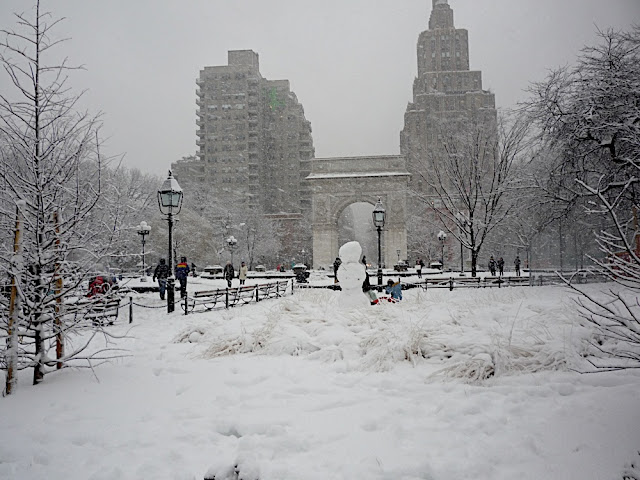
Snow Day, Washington Square Park

From 2010

Many schools are closed. Flights have been canceled. Residents are encouraged to stay home. After watching the dire weather reports on TV and seeing the furious fall of snowflakes outside the window, it's understandable to want to stay in.

But it's so much fun to be outside and be a part of it, even for a few minutes. NYU had originally scheduled classes for today, but school officials announced this morning that the university would close at 1 p.m. Many college students gathered in the park, as well as professors, dog walkers, parents and toddlers. The east side and sections of the south side of Washington Square Park are closed for renovations, so mostly people convened in the fountain area (the area shown here) for snowball fights and snowman making. Looking at the Arch, the two buildings on either side are The Brevoort (left), a residential co-op building at 11 Fifth Avenue dating to 1956, and One Fifth Avenue, an early Art Deco tower from 1927.

Image: Washington Square Park, afternoon, February 10, 2010. Coming next on Walking Off the Big Apple - After Jury Duty: Points of Interest Near the Courthouses and Foley Square.

Sunday, February 7, 2010

City Life in Winter: Nanook, Arctic Fashion, and the Ubiquitous Quilted Down Parka

With the arrival of bitter wind chills and snow this winter, walking in New York feels more like an expedition than a stroll. It's not surprising then to see people on the street dressed in Arctic wear. Quilted down parkas with hoods trimmed in fur or faux fur have become a common sight on the streets of the city, worn by men and women alike, and I've even seen small short-haired dogs wearing them, too. While some women still choose to show off their legs by continuing to wear leggings under short coats - brrrrr, others like me have fully embraced the Nanook of the North look. Bundled up in a knee-length quilted padded parka with a big fur-lined hood, often with a shaggy dog by my side, I feel safe setting out for the wilds of the West Village, braced against the howling wind. The only accessories I am lacking to complete the look are rugged snowshoes and a long harpoon.

Arctic Clothing of North America - Alaska, Canada, GreenlandWondering how the residents of New York City have come to resemble the indigenous people of the Arctic Circle, I've spent some time learning about the history of the parka. The Caribou Intuit, the inland group of Inuit (Eskimo), are said to have invented this type of hooded jacket as protection from the bitter cold weather. The word "parka" comes from the Aleut word for skin or pelt, and the original types, as opposed to the ones on sale at Bloomingdales, were often made of caribou or seal. The lining of parkas, made of down (the fine feathers underneath the outer large feathers on birds) or with synthetic material, creates the sense of warmth. According to the Encyclopedia of American Indian Costume by Josephine Paterek (1996), Aleutian black and white parkas made of horned puffin skins were much coveted by Russian officials. The authoritative Arctic Clothing of North America - Alaska, Canada, Greenland (1995) includes first person narratives about making parkas, a labor-intensive process that not only requires art and skill but also serves as a handed-down tradition that binds generations together. I know no one in the city who has made their own parka.

Friday, February 5, 2010

Toward the Virtual City and The Crisis of Place

A Review of Chronic City by Jonathan Lethem (Doubleday, 2009, 480 pps.)

Chronic CityFor residents of Manhattan, reading Jonathan Lethem's Chronic City may lead to a strange case of urban anxiety. While his portrayal of contemporary Manhattan evokes familiar elements  – the oversize hamburgers, a strange smell in the air, the constant rumblings along Second Avenue, the comings and goings of apartment residents, the touches of fantasy in the writer's new novel seem believable, too. The creeping slippage of a real Manhattan into a manipulated simulacrum, a similar place that rings somewhat true but slightly off, has for many reasons become the new reality.

Manhattan residents already live in a kind of hallucination. Try to live with the everyday presence of the Empire State Building, the Brooklyn Bridge, Central Park, Times Square, and the Statue of Liberty, and you, too, will be occasionally surprised or knocked over at the sight of these highly-charged symbols of the city. Famous actors are a common sighting, interrupting a routine walk with a dose of unreality. Furthermore, walking through movies filming on location provokes surrealist situations such as confusing an acting policeman with a real one or being told by a location manager to not walk in the park and then watching an extra, complete with a similar dog, take the walk for you. More to the point, in books such as Variations on a Theme Park: The New American City and the End of Public Space (edited by Michael Sorkin, 1992), urban critics have warned of the effects of rapid gentrification in the city, a process that can lead to the transformation of pockets into amusement parks and the loss of individuality and public space.

Tuesday, February 2, 2010

The City as Archive and as Playground: Atget's Paris, and Lessons for New York

The work of French photographer Eugène Atget (1857-1927) is featured in two current exhibitions at the International Center of Photography - the traveling Twilight Visions: Surrealism, Photography, and Paris, and well as the smaller in-house exhibition, Atget, Archivist of Paris. Considered a proto-Surrealist for his tendency to photograph oddities or unusual fragments on deserted streets, the streetwise Atget is often linked to the flâneur tradition. Though not one of the top-hat bourgeois gentleman strollers of the 1880s, his keen eye for the everyday street life of Paris, especially the endangered built environment, makes Atget one of the city's most influential documentarians.

In the late 1890s Atget, a former actor and painter, started documenting the old parks, houses, churches, and narrow streets that were vanishing. Beginning in 1852, planner Baron Haussmann's order to clean up the streets had resulted in the reconfiguration of Paris. Winding cobblestone streets, vestiges of the medieval city and friendly to revolutionaries, gave way to the tree-lined orderly avenues and boulevards, better for social control. Atget took upon himself the project of documenting the remaining vestiges of the street life with his heavy camera.

Though he considered himself an illustrator in his own time, referring to his photographs as documents, Atget nevertheless created images that look like visual poems from a strange world. Because he often took his large format camera to the streets early in the morning, his scenes are eerily devoid of people, giving them the sense that Walter Benjamin noted was like a scene of a crime. Many of the thirty one photographs on display in the Atget exhibit at the ICP, however, are less forensic than a catalog of architectural details - door knobs, relief sculptures, curving staircase rails, and so forth. The most haunting images, such as a 1924 photograph of the Rue du Figuier that's part of the Twilight exhibit, are those of narrow cobblestone streets surrounded by apartment buildings. Many of the windows are shuttered. No one is in the street, and the path ahead takes a curve and disappears. The aging apartment buildings threaten to careen and collapse into the street below. While these types of streetscapes are routinely depicted in sentimental paintings, an Atget image conveys much more mystery and lasting interest.

Related Posts Plugin for WordPress, Blogger...