Wednesday, September 30, 2009

A Walk Through the Studio Museum in Harlem - Hurvin Anderson: Peter’s Series 2007-2009

During the next three weeks or so, I recommend a visit to The Studio Museum in Harlem to see several exhibitions from the museum's summer season that have been carried over into the fall. Hurvin Anderson: Peter’s Series 2007-2009, the first solo U.S. museum exhibition of the work of a London-based artist born in 1965 in Birmingham, United Kingdom to parents of Jamaican descent, reveals a fresh approach to both painting and to the relationship between artist and subject. While in the museum also spend time with the works by the artist residents, Khalif Kelly, Adam Pendleton and Dawit L. Petros, and don't miss the photographs by young artists in a downstairs gallery.

Hurvin Anderson's paintings explore the space of a barbershop that served as an informal social center for Caribbean immigrants during the 1950s and the 1960s in the UK. The particular place in these paintings is an intimate shop in a small attic where the artist's father got his hair cut, and Anderson found himself drawn to the space as a way to explore his sense of identity and relationship to the Caribbean. He had once taken photographs of the shop and could refer to them for his paintings, but certainly they are used as a point of departure or inspiration rather than as a concrete reference. Mindful that the shop seemed like a private place and therefore needed to be protected rather than violated, the artist evokes the space in early canvases in the series through abstracted forms only, yet filling in partial details in another. Still, where we are is uncertain. With one of the paintings in the series, Peter's: Sequel, Anderson repaints an earlier canvas from memory. Each painting becomes a careful, tentative discovery of a place revealing itself. The last three paintings incorporate a figure in a barber's chair, thus changing the work in profound ways. No longer abstract shapes evoking a general interior, we now have a human protagonist with a story. Still, we only see the figure seated from the back, so the sense of privacy remains intact.

Anderson paints his chosen space in an effectively limited palette and with thinned coats - predominately cobalt blue for the walls, rust for the floors and flat white for the ceiling. The shapes take on different textures. Over the course of the series, the artistic explorations come to feel like analogies for remembering a particular time and space. And that's what they are. Anderson's work has been compared to that of Luc Tuymans (review from 2008 on this website) and Peter Doig, the latter his art teacher in the 1990s. This series, while somewhat academic in its presentation and conception, holds out the hope that Anderson's artistically adept incursions into meaningful personal spaces can surpass the intellectual vamping that sometimes characterizes other artists.

Through October 25, 2009. See the museum's website for more on current and future exhibitions.

Upcoming:

30 Seconds off an Inch
November 12, 2009-March 13, 2010
Wardell Milan: Drawings of Harlem
November 12, 2009–March 13, 2010

The Studio Museum in Harlem
144 West 125th Street
New York, NY 10012

Hours: Wednesday through Friday 12:00 PM - 6:00 PM
; Saturday 10:00 AM - 6:00 PM; 
Sunday 12:00 PM - 6:00 PM. Admission: Suggested donation:
 Adults $7.00;
 Seniors and students (with valid id) $3; Free for members and children under 12.

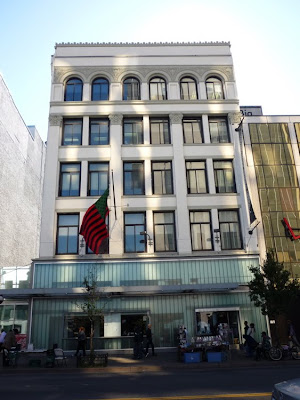
Image of The Studio Museum in Harlem by Walking Off the Big Apple from September 24, 2009. 

Monday, September 28, 2009

James Weldon Johnson's New York and Four Stops in Central Harlem


James Weldon Johnson (1871-1938), influential writer, activist, and diplomat, settled into life in Central Harlem in an attractive red Romanesque building near the corner of 135th Street and Seventh Avenue in 1925. He lived in the building, designated a National Landmark because of his presence, until his death in an automobile accident in Maine in 1938. The intersection of W. 135th and 7th Ave., known in contemporary life as Adam Clayton Powell Boulevard, served as a major crossroads of African-American life, not just for New York but because of the lives and events lived there, for the larger course of history. On the southwest corner, where Thurgood Marshall Academy stands, now occupied on the first floor by an International House of Pancakes, once stood the former Small's Paradise nightclub, a legendary jazz club that opened in 1925, the same year as Johnson moved in across the street. Small's is also the nightclub where Malcolm X worked as a waiter after moving to New York in 1943. Across the street on the northwest corner stood the Big Apple, a smaller club that nevertheless helped popularize the nickname for the city. Down 135th, at 244, the NAACP had its headquarters, the largest chapter in the country. There, for twenty-five years W.E.B. Du Bois edited the Crisis, the organization's influential publication of news, fiction, and commentary.

Along This Way: The Autobiography of James Weldon Johnson (Penguin Classics)A figure at the heart of the Harlem Renaissance, Johnson fused white and black literary traditions, functioning as "a linking agent for black America," as Sondra Kathryn Wilson describes him in her introduction to an edition of Along the Way: the autobiography of James Weldon Johnson. While many still know Johnson solely as the creator of "Life Every Voice and Sing," the song he wrote with his brother in 1900 and later was adopted as the Black National Anthem, he was a widely-published essayist. In a life of many "firsts" - he was the son of the first female, black teacher in Florida at a grammar school, he was the first African-American admitted to the Florida bar after Reconstruction, Johnson was appointed the first African-American professor at New York University and the first to teach African-American literature there.

Wednesday, September 23, 2009

Walking for Peace in Dag Hammarskjold Plaza

When the leaders of the world convene in New York for the opening of the General Assembly at the United Nations, tying up traffic on the east side of Manhattan with their heavily armed motorcades, regular New Yorkers, many of them born in other parts of the world, work around the congestion and go about their normal business. Some avoid the area around the United Nations complex between 42nd and 48th Streets, but others, particularly those with concerns about the actions of a particular government, gravitate toward this area near the East River. While world leaders gather behind closed doors, concerned citizens of various nations gather on Dag Hammarskjold Plaza on E. 47th Street between 2nd and 1st Avenues.


Dag Hammarskjold Plaza is a remarkable place. A tree-lined thin rectangle of a park, the plaza is named for the equally remarkable Swedish diplomat who served as Secretary-General of the United Nations from 1953 until his death in a plane crash en route to the Congo on September 18, 1961. A political economist by training, Hammarskjold showed a strong spiritual inner life with the posthumous publication of Markings (1963), his journal of reflections. A walk to the plaza is marked with streets and corners named in honor of other fallen peacemakers, among them Yitzhak Rabin, the Israeli Prime Minister, and Kudirat Abiola, the pro-democracy Nigerian activist, both victims of assassins. On April 15, 1967, one of the largest antiwar marches in New York history convened on the plaza. The march from Central Park to the United Nations included a broad coalition of civil rights activists, among them Martin Luther King, Jr.  After assembling in Central Park for a peace fair, speeches and performances, the marchers walked down Fifth Avenue and then to Dag Hammarskjold Plaza.

Monday, September 21, 2009

Art "That Doesn't Even Exist": Dave Hickey Explains Ennui; and Upcoming Lectures on Art and Art Criticism

"Do y'all mind if I listen to my Ipod?" asked art critic Dave Hickey in a twang, just before striking the first notes of his freewheeling lecture at the packed SVA Theatre on. W. 23rd St. last Thursday evening. "I just put T. Rex The Slider on it." And then the writer of The Invisible Dragon: Four Essays on Beauty and Air Guitar: Essays an Art & Democracy, to cite two of his most influential collection of essays, launched into an extended riff on the idea of ennui. Addressing how boredom directly relates to the non-existence of a great deal of visual art in contemporary life, Hickey advised the large audience of mostly art students on how to avoid the trap of making boring art, "art that does not even exist."
The Invisible Dragon: Essays on Beauty, Revised and Expanded
According to Hickey, who cited Robert Rauschenberg for sharing the idea, art runs in 40-year cycles. After a fresh new idea comes along, it plays itself out over time and eventually become stale. When artists can't claim it anymore, however, they can begin to steal from it, he explained. Hickey advised artists to look for inspiration in works from 40 years ago or to go even farther back. In his own case, as a practitioner of New Journalism, he reached back for writing models in Victorian reportage. "Go back right to the moment before it started sucking," the Texas-born critic-curator and former Nashville songwriter poetically explained. When art adheres too close to the cannon by replicating its conventions and permitted deviations, it's no longer there. It's boring. "Walk through a provincial museum, and it's like listening to AM radio," Hickey said.

Thursday, September 17, 2009

An Art Walk in Chelsea for a Weekday Afternoon, and Places to Stay for the Night

Walking along W. 22nd Street yesterday, on my way to the galleries on the west side of Chelsea, I realized I had often walked this way before. Looking at the familiar houses and recognizing several stoops, I recalled the series I wrote last December on the literature of Christmas and how I've already pointed out several places near here. This time, however, I was on a different mission - first, to see one of the films screened for yesterday's formal opening of SVA's Visual Arts Theatre on W. 23rd St. Designed by Milton Glaser and inspired by Vladimir Tatlin's never-realized constructivist monument (see Wikipedia article), the complex features state-of-the-art projection systems in its two theatres and is now one of the best places to see a film in town. Second, I had plans to walk west to see several exhibitions that opened the cultural season in Chelsea. Still, though I had been here before, walking the same streets becomes a new experience each time. Furthermore, the last several months have brought important changes to Chelsea. While not apparent along the residential side streets, the neighborhood continues to draw new development, especially near the High Line.

Tuesday, September 15, 2009

Old New York Gets a New Amsterdam Market

Are there really vineyards on Long Island? Yes. Where did the cocoa in the chocolate come from? Ecuador. What is in the Halve Maen pie? Mincemeat. Where can I normally buy this cheese? At Fairway. You really make handmade corn tortillas? Yes. Such were the questions directed toward producers at the New Amsterdam Market on South Street this past Sunday. Inspired by the notion that great public markets make great cities, the organization selected dozens of A-list regional producers to set up shop to sell their fare for the market's inaugural event.

Markets are ancient. Selling goods and produce in places where many are gathered has long propelled the growth of cities. Producers in rural areas travel to the city where they find buyers. Over time, many who grow the produce or make other goods move to the edge of the city to be closer to the action, and more people gather to shop and talk in the markets. Les Halles in Paris, a legendary wholesale central market in Paris, flourished for hundreds of years, and in the mid-19th century great glass and
iron buildings were built to house the merchants. By the mid-1960s, however, the crowded stalls were perceived as an impediment to traffic. The city dismantled the structures in the early 1970s, leaving behind a mess. An underground mall, an enormous subway station and the fast-food friendly Forum replaced the ancient markets, leading to a rather unfortunate decline of the area. The city has since been trying to replace the Forum with something better.

Saturday, September 12, 2009

My One-Night Stand With Fashion

I've never developed a long-term passion for fashion. As a child in Texas, my mother often took me to Neiman Marcus to dress me in pretty little Florence Eisemans, but my inner little cowgirl mapped out her own future in denim. Relieved to be sent to schools where uniforms stamped out visible distinctions and later to colleges where I could live in blue jeans, I've always adhered to the notion that as adults we find our own uniforms and stick with them. When not in farmwear, I sometimes played with clothes as costumes, accumulating a Janis Joplin-esque assortment of bracelets and feather boas. My graduation to fashion adulthood came with the discovery that jeans also came in black. The tendency toward dark colors has now fully transformed my closet into a black hole, a mysterious place that traps light and generates radiation.

Thursday, September 10, 2009

In New Amsterdam, the Half Moon Drops Anchor at the Battery, and Other Events of NY400 Week


From Fall 2009

NY400 Week, a celebration of Holland on the Hudson, continues through September 13, Harbor Day.

• SHIPS: The Half Moon (above), a replica of Henry Hudson's ship and operated by The New Netherland Museum, docked at the Battery yesterday. This week students will take part in the 10th annual Fall trip that recreates Hudson's voyage up the Hudson. See official website for more. In nearby waters, two Dutch naval vessels are also engaging in special activities related to the 400th anniversary of Hudson's "discovery" of New York, and sailboats in the Flying Dutchman class are racing around the harbor. These ships and boats will join others in the Holland on the Hudson flotilla on Harbor Day.

Tuesday, September 8, 2009

My Augmented New York Unreality: Google Street View's Eerie Portrait of a New York Past

(Editor's Note: Since I posted this, it looks like the Google Street View has been updated. - October, 7, 2009)

I'm experiencing a surreal and eerie flashback, because the images of Google Maps' Street View of my Greenwich Village neighborhood have become fascinatingly out of date. While opening Google maps the other day to update one of the self-guided walks on this site, I happened to switch over to Street View. There, at the southeast corner of Bleecker and MacDougal Streets, an intersection I know well, I was surprised to see the now-shuttered location of Cafe Figaro still open - tables with checkered tablecloths on the sidewalk, a couple seated at one of them, and the doors and windows open to the streets. It's been a long time, it seems, that the restaurant left the corner (it has since moved east to the middle of the block) and replaced with a Qdoba, a Mexican chain restaurant. In this uncanny altered reality, I decided to virtually stroll around the nearby streets and check out what else was open in this other-worldy Greenwich Village. After all, it looked like a nice day in there.


View Larger Map

What month and year was it? I ventured from this spot west to Sixth Avenue and up to the IFC Theatre. From reading the names of the films on the marquee, I was able to date the Google Street view images to late September of 2007. Walking from the theater east on W. 3rd. St. I saw that the facade of the Blue Note jazz club was revealed - the grand piano was plainly visible and not behind scaffolding like I've seen it these last few months. On Bleecker, Le Poisson Rouge had not opened on Bleecker. Senor Swanky's was still in business. Other turns on nearby blocks revealed restaurants and cafes that have departed, banks that once planned a location but have gone out of business, and storefronts not yet renovated. In a surprising discovery that may hearten preservationists (or not), in Google's Street View imagery of Greenwich Village, Washington Square Park has not been renovated.

Sunday, September 6, 2009

Fall Fashion 2009 Edition: Walking By the Yard in New York's Garment District, Crimes of Fashion, and Fall Fashion Trends

While no longer a bustling center of manufacturing, New York's Garment District between Thirty-fourth and Forty-second Streets and Fifth to Ninth Avenues still hums with fabric stores, machine shops, specialty notion stores, and showrooms catering to the fashion and theatrical trades. Shoppers for domestic and imported fabrics or silk or lace or even spandex explore the streets of the neighborhood, variably called the Fashion District, for particularly good deals from suppliers. Students of fashion, like the aspiring designers enrolled at Parsons or the Fashion Institute of Technology (FIT), roam the stores in search of swatches for projects. Maybe one day their names will be as acclaimed as those honored along the Fashion walk of fame on Seventh Avenue - among them, Calvin Klein, Ralph Lauren, Halston, Marc Jacobs, Anne Klein, Perry Ellis, Oscar Del La Renta, and Giorgio Di Sant’ Angelo. With the right fabric, Project Runway is in their future.

A good place to begin a walk through the Garment District is on the NE corner of W. 39th St. and Seventh Avenue. In addition to picking up information at the Fashion Center Business Improvement kiosk (official site), look at the oversize needle threading a button and the bronze sculpture of the garment worker sitting at a sewing machine. Walk north and wander west along 40th Street to browse a large selection of fabric in NY Elegant Fabrics or for wedding lace in Sposabella. Wander down W. 39th Street and look for buttons, sewing and knitting supplies in Vardhman. Nearby, Beckenstein Fashion Fabric carries on its legacy from its Lower East Side Orchard Street origins, providing high quality fabrics for men's wear. Look for sewing notions at Steinlauf & Stoller Inc. At Hecht Sewing Machine & Motor Co., the long-standing family-owned business in the Garment District can repair any sort of sewing machine. Many of these businesses reveal the heritage of early 20th century garment workers, especially Eastern European Jews and Italian immigrants. Today, workers in the garment trades are more likely to come from Central America, Asia, and the Caribbean. Stop in for a drink at Stitch's, a nicely tailored bar, or have lunch at Ben's, an old-school deli that recalls the days of an older New York.

Wednesday, September 2, 2009

Art Trips Up the Hudson: Day Excursions From New York City to Museums and Historic Sites

(Revised, 2010) With cool weather returning, September and October are popular months to explore day trips north of the city, especially through sites along the Hudson River Valley. Fall foliage, mountain scenery and a rich artistic and literary heritage contribute to the perennial popularity of the scenic villages along the river valley.

Highly recommended are visits to the sites associated with the Hudson River School artists, especially Thomas Cole's Cedar Grove and Frederic E. Church's Olana. The two estates are close to one another, on opposite sides of the Hudson, linked by the Rip Van Winkle Bridge (how charming!). Other places with special exhibitions featuring the Hudson River School include the Samuel Dorsky Museum of Art at SUNY New Paltz, the Frances Lehman Loeb Art Center at Vassar College in Poughkeepsie, and the Albany Institute of History and Art. If 19th century landscapes is not your thing, there's DIA Beacon and the Hudson Valley Center for Contemporary Art.
Related Posts Plugin for WordPress, Blogger...