Thursday, July 23, 2009

Finding Balance in MoMA's Sculpture Garden

The goat you see in the picture is Pablo Picasso's She-Goat (1950), a bronze sculpture the artist crafted out of discarded objects, and its grazing area is the Abby Aldrich Rockefeller Sculpture Garden at The Museum of Modern Art. On most days when the weather cooperates, this modernist oasis becomes one of the city's most popular retreats. I've written before about similar escapes in midtown, mostly small plazas and walkways, but MoMA's garden could be considered the penultimate modernist refuge in a busy city.

The design of the garden insures that visitors may choose among a variety of activities such a taking a lunch break, talking in groups, walking around, or sitting and thinking quietly. The museum can offer several challenging art experiences, so the garden makes a good place to process one exhibit before moving on to another. The sculpture garden can also serve pleasantly as its own destination, a favored place to sit and look at art. After seeing one of the museum’s special exhibitions, I stopped in the garden for my regular mid-afternoon teatime. Finding a place near the cafe on the north end terrace, I had a good view of the Art Nouveau-inspired Entrance Gate to Paris Subway (Métropolitain) Station (c. 1900) as well as a view through a cut-out frame in the wall of the top floors of pretty buildings across the street. The view of old and new suited me fine. I love the city's ornate 19th-century architecture, but I will always have a soft spot in my heart for cool, hard modernism.

Staying long enough in the garden to want to change seats, I moved to a table next to one of the "canals," as the original designer Philip Johnson called the pools, and just to the side of Aristide Maillol's The River (1938-1943). In the background I could see Barnett Newman's Broken Obelisk (1963-1969). While sketching the works, I imagined a highly gendered dialogue between them, concluding that the precariously placed woman could handle most anything. Falling in the shallow pool certainly wouldn't hurt her. Does she, too, have a place in her heart for cool, hard modernism? I don't think so, but she has some powerful arms.

The presence of water, cool Georgia marble, soft green trees, the varying heights and shapes of the walkways, and the presence of movable chairs are just some of the reasons that make the museum's sculpture garden amenable to human needs. I highly recommend stepping out of the dizzying pace of midtown and into this cool spot of art and reflection. It's possible to regain a sense of balance there. Just don't step on the ivy.

MoMA The Museum of Modern Art is located at 11 W. 53rd Street. New York, NY. Website here.

Related posts:

• Shhh, Don't Tell: The Quiet Modernist Escapes of Midtown
• The Walking Arcades of Midtown
• After Walking, A Place to Sit: Greenacre Park, E. 51st St

Images from July 20, 2009 by Walking Off the Big Apple.

Wednesday, July 22, 2009

The Time and Place for James Ensor, Unmasked

Artists who express a fondness for masks aren't necessarily kooky. Carnival masks often show up in the art made in joyous seaside cultures whether it's Venice, New Orleans, Rio, or yes, Ostend. A major seaside city that rose to prominence due to the importance as a harbor, Ostend, Belgium, home to artist James Ensor (1860-1949), is well known among tourists for its esplanade, scenic cityscapes, and seasonal events. Among the latter is the popular carnival (external link ) at the beginning of March, a traditional event that includes clog throwing, dress balls, and something called a "Cimateire-parade." Ensor's parents sold masks for carnival revelers, along with other theatrical fare, and so the painter would often leave his attic studio to walk downstairs to borrow anything that would serve his artistic whims. Masks and skeletons, imagery a Cimateire-parade would inspire, became the props for his satire, iconoclasm and importantly, for wild artistic experimentation. People hailing from boring Puritanical cultures would not find him trustworthy.

James EnsorEnsor's art career begins normally enough, by the look of things in MoMA's exhibition. Though lacking the signature major piece, Christ's Entry into Brussels in 1889, in the collection of the Getty Museum, or representative works from his later years, the exhibition in MoMA's special sixth floor galleries gives a good sense of the early years and the subsequent "kookier" ones. Trained in an academic style but veering toward the modern, the portraits, landscapes, and domestic scenes of his young years look ambitious and accomplished for a twenty-something. His scene of Brussels Town Hall (1885) shows an oddly compelling juxtaposition of a building on the left, adorned with squares in primary colors, with a loose and expressive line of buildings on the right. Variations on the primary - red, ochres, and blues, often characterize his palette, infusing his Lady in Distress, for example, a moody painting of a woman in a bedroom with only one curtain open. Props from the parents also find use in nicely rendered works such as in Chinoiseries with Fans and humorously in Self-Portrait with Flowered Hat. His portrait of his father shows a respect for the man as well as a sense of comfort and ease with paint. But, along with these works, we see a hint of what's to come with The Scandalized Masks from 1883.

Entering the next gallery and scanning the novel artistic experiments from the subsequent phase of his life, the viewer may jump to the conclusion that he's lost it. His figures grow cartoonish, flat, grotesque, and symbolic rather than representational, and his colors go wild. I've never seen anything quite like Fireworks, an exuberant expression of an awe-inspiring spectacle in flaming yellows and oranges exploding over the cool blue ground. Christ enters the picture, specifically in Brussels, and the depictions of the scene, as revealed in large drawings, point to the kind of obsessive qualities often characteristic of self-taught artists. Identifying with the Christ figure, he overwhelms the street with a crowd of politicians, public figures, and even members of his family. Experimenting with line, color, and most famously with light, he’s searching for his personal best form of communication. He’s never lost an ability to render the human figure in traditional ways. The portrait of his dying father, for example, shows he’s respectful of the old school.

The presence of top-hatted flaneurs, many donning pig-like masks, and grotesquely lipsticked individuals of all genders in many paintings show his fondness for the visual culture of social performance. Taking to the streets and sites of public amusements, Europeans of the 1880s like Ensor explored the spectacle of vision, of seeing and being seen. Walking the streets in fine clothes or concealed behind a costume and mask prompted a willingness to suspend conventional social manners for a topsy-turvy spectacle of alternative self-invention. At MoMA, while stopping to look at the painting The Intrigue (1890), several people excitedly murmured about the resemblance of one particularly grotesque figure to the late Michael Jackson. A contemporary reading, yes, but it was dead on, considering the intriguing discourse about the performer's own tragic-comic quest for self-identity.

Exhibition info:
James Ensor
Through September 21, 2009
The museum has an excellent website devoted to the Ensor exhibit. See it here.

Images by Walking Off the Big Apple from Monday, July 20, 2009. Note: Personally, I don't think taking an interest in masks is kooky.

Sunday, July 19, 2009

25 Great Things to Do in New York City

Some favorite New York experiences, old and new, from Walking Off the Big Apple

"The Gothic Revival structure, granted the status of Landmark Site by the Landmarks Preservation Committee in 1975 on the basis of its picturesque ruination, is now undergoing a $4 million stabilization process in order to stem the tide of accelerating decay."

2. Shop at a bookstore and then visit a nearby cafe.
"In the olden days, many of us liked to shop for books and then go to a favorite café to read or write. We never worried about the availability of electrical outlets or a wireless cloud."

3. Read up on the history of Audubon Terrace and visit the Hispanic Society of America.
"Flash backward and imagine the estate that once belonged to John James Audubon, the famous naturalist and explorer, and then jump forward to the early 1900s when railroad heir and philanthropist Archer M. Huntington commissioned this acropolis."

4. Visit the permanent exhibit at the Museum of the Moving Image in Astoria.
"Discover and explore Tut's Fever Movie Palace, an art installation and functioning theatre designed by Red Grooms and Lysiane Luong that serves as an homage to the art of cinema."

5. Ride a bike through Times Square.
"Seeing this part of the city by two wheels is nevertheless a strange excursion, because the cultural history of New York has little reference to experiencing Times Square and the theater district in quite this way."

6. Take a tour of Lincoln Center.
"We were in fact watching a rehearsal of a rehearsal, a confusing spectacle that appealed to my sense of the absurd."

7. See The Unicorn Tapestries at The Cloisters.
"In 1850 the Count de la Rochefoucauld decided he wanted his family's stuff back."

8. Take a walk through the South Village below Houston Street.
"An area of tenement buildings with well-preserved late 19th and early 20th century architecture, the South Village below Houston Street features small specialty shops, restaurants, and cafes in a friendly, well-balanced and human-scaled neighborhood."

9. Find New York places mentioned in Truman Capote's Breakfast at Tiffany's.
"The disappearance of the New York locations mirrors the disappearance of the main character. Of course, changing New York is part of reality and not just a literary device."

10. Drink a Red Snapper at The King Cole Bar at the St. Regis and then shop on Fifth Avenue.
"The "Red Snapper" is the name for the St. Regis Hotel's "Blood Mary," the now-ubiquitous concoction the hotel introduced to the United States."

11. Take an evening stroll from the West Village to the Hudson to watch the sunset.
"The winding streets, European-style cafes with outdoor seating, sports bars, small stores, music clubs, theaters and public parks offer so much that many stay awake all night to enjoy the neighborhood."

12. Visit 123 Lexington, the address for Kalustyan's, an amazing spice market and store, and appreciate that it was once home to President Chester A. Arthur.
"As I suggested, please stop into Kalustyan's to shop for exotic spices or to grab a bite to eat. Bring a shopping list, because when I visited I wish I had already prepared a grocery list for some spice-heavy dishes."

13. Wander around the Ramble in Central Park.
"Because the Ramble works in mysterious ways, I wandered over the Azalea Bridge, near the area you see here, and then made my way east."

14. Stroll along W. 10th Street from Fifth Avenue to Waverly Place.
"At 51-55 once stood the Studio Building where artists Winslow Homer, Frederic Church and Albert Bierstadt, among others, once worked and where the sublime American West was painted."

15. Go find real bagels, rugelach, and bialys on the Lower East Side.
"I wanted a little of everything, but I decided to restrain myself by settling on a lone large chocolate pastry that's somewhere between a rugelach and a babka. I was told I made a really good choice."

16. Visit Bryant Park just to appreciate the glories of the American Radiator Building.
"It's unusual to see a building made of black brick, much less one with gold trim. Designed by Raymond Hood, the American Radiator Building of 1924 fit the bill of the clients - it was massive, solid, and it would glow at night."

17. Read a book while sitting in Greenacre Park.
"Greenacre Park, with a 25-foot waterfall, a stand to buy snacks, comfortable movable chairs, and a zen-like design, provides one of the most successful types of spaces in our urban fabric."

18. Visit the lobby of the old New York Daily News Building, aka The Daily Planet.
"Visiting the Daily News building should be on every visitor's list. The building is only a few blocks east of Grand Central Station. Only the lobby is open to the public, but that's the part you want to see."

19. Listen to street musicians in Washington Square Park.
"Self-styled bohemian traditions of the Village do not conform to an imposed order from the outside, and in that sense, I embraced my neighbors' righteous protests. Some of their good ideas made their way into the new design."

20. Participate in Jazz & Sketch Night at the Society of Illustrators.
"Tuesday night's session of "Jazz & Sketch" at the Society of Illustrators perfectly fit our needs - a beautiful setting in the society's home on E. 63rd., one with a rich artistic and social history, the exquisite additions of live jazz and a cash bar, excellent models, and a congenial atmosphere."

21. Walk through the Fort Greene neighborhood in Brooklyn.
"In addition to its early connection to the writer Walt Whitman, Fort Greene is known for its successes as a racially diverse neighborhood. The final stretch of the walk took me past beautiful townhouses along Carlton Avenue."

22. Walk from Battery Park to the Esplanade in Battery Park City.
"The promenade next to the water, with views of the Statue of Liberty, Ellis Island, and the Jersey shore, and the cool esplanade of trees in a stretch of the southern section make for a particularly satisfying walk."

23. Pretend you're Greta Garbo and walk the streets and avenues near her apartment.
"Greta Garbo often walked up and down the streets you see before you, "Mademoiselle Hamlet," as Alice B. Toklas called her, wanting to be alone. Starting at her apartment on the East River, Garbo wandered west and mostly north through streets and avenues of Midtown and into the Upper East Side."

24. Tour the ruins of American finance and ask for your money back.
"Surveying the urban landscape of New York, the financial capital of the world, I've mapped out the pinpoints of flickering light (some have flicked off) - among them, AIG Private Client Group (70 Pine Street), Bernard Madoff's penthouse apartment (133 E. 64th St.), RIP Bear Stearns (383 Madison) until its purchase by JPMorgan Chase (270 Park Avenue), Lehman Brothers (745 7th Ave.), and several more."

25. Visit Grant's Tomb. Seriously. A very moving experience.
"After spending some time looking at the tombs of Ulysses and Julia and then visiting the churches, I began to think of this stroll as the Death, Reconstruction, and Resurrection Walk."

And now the map.

View 25 Great Things to Do in New York in a larger map

Images and text by Walking Off the Big Apple.

Thursday, July 16, 2009

A Visit to Audubon Terrace and Environs

Though far from the state of dilapidated ruin that would excite the fantasy of the modern romantic, the worn facades of the monumental museums that make up Audubon Terrace in Washington Heights look sufficiently weathered to induce a civic form of melancholia. Step into the courtyard of this once bright place and see verdigris on copper doors, layers of city dirt wedged into the carved incisions spelling out names of Spanish conquistadors high along the walls, grasses peaking up between the cracks. Flash backward and imagine the estate that once belonged to John James Audubon, the famous naturalist and explorer, and then jump forward to the early 1900s when railroad heir and philanthropist Archer M. Huntington commissioned this acropolis. But flash-forward again to the present, and closer investigation hints not of signs of decay suggested on the surface but rather points to simmering signs of life. Considering that the blocks to the south comprise the necropolis known as the Trinity Church Cemetery and Mausoleum, that's saying something.


View A Visit to Audubon Terrace and Environs in a larger map

The construction of Audubon Terrace, this formal configuration of museums between 155th and 156th Streets just west of Broadway, began in 1904. The plan was conceived in tandem with the building of the uptown subway, and indeed, the 1 train stop at Broadway and 157th delivers visitors conveniently to the complex. In 1908, the Hispanic Society of America opened to the public, then the American Numismatic Society, the American Geographical Society, the American Indian Museum (1916), and the American Academy of Arts and Letters (1923). Two churches are within the area - the Church of Our Lady of Esperanza and the Church of the Intercession. Later, another building was added to the Hispanic Society. Archer Huntington's cousin, Charles Pratt Huntington, a 1901 graduate of the Ecole des Beaux-Arts in Paris, designed the original buildings, and architects Cass Gilbert and William Mitchell Kendall from the firm McKim, Mead & White contributed with their designs for the American Academy. Now, of the founding residents only the Hispanic Society and American Academy remain. The American Indian Museum relocated downtown to the Customs House. Boricua College, a college founded for Puerto Ricans and other Hispanics, makes its home in the Geographical Society.

Tuesday, July 14, 2009

French Lessons: Visiting the Metropolitan Museum of Art's New American Wing, and Paris Photographs from the Second Empire

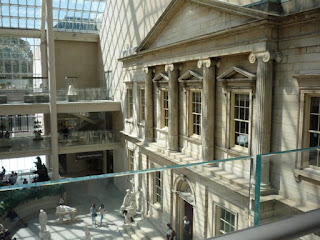
The New American Wing, the second phase of the renovation of the Metropolitan Museum of Art's American collection, has opened to the public, including the Charles Engelhard Court and the period rooms of decorative arts. In spite of the name, the wing feels as much French as American, given the museum's strengths in French-influenced artists like Augustus Saint-Gaudens, John LaFarge and Louis Comfort Tiffany, collaborators on several occasions for projects favored by East Coast patricians. Richard Morris Hunt's French-style lamps that once graced the entrance of the museum take a new place in the airy room, a court that echoes the classical mindset of the Founding Founders (of the Met and of the nation) and the aesthetic preferences of its early tastemakers.

The museum has repositioned many of its decorative objects, making new use of the balcony space. While new computer screens aid in understanding the form and function of the decorative objects, the works themselves, although exquisite, tend to reinforce old school notions of Americana. With the exception of the sprawling Frank Lloyd Wright room, the one that looks the most radical and the most comfortable in context, there's not much evidence of a nation that looked west for a significant part of its history. Though the Met has a different mission that the Smithsonian, for example, I'd love to see a period room here representing the diversity of the American experience - a California Mission-style house, a Texas Victorian ranch, or a beautiful adobe structure with New Mexican retablos and Spanish furniture.

One stunning highlight of the American wing, although French in spirit, is American artist John Vanderlyn's "Panoramic view of the the Palace and Gardens of Versailles, 1818–19." First exhibited in a building called the Rotunda near City Hall in New York and now installed in a large circular room in the museum, the panorama was a sensation in its day, giving the viewer the illusion - we may call it virtual reality, of actually walking through the gardens of the great French palace. The work is impressive in its precision, though once again, the effect is more French than American.

For those interested in seeing a special exhibition that deals forthrightly with France, I recommend a visit to the Met's small focused exhibit titled Napoleon III and Paris (The Howard Gilman Gallery through September 7, 2009). The modernization of Paris under the direction of Baron Haussmann, a powerful city planner who directed the destruction of the medieval and less hygienic city in favor of wider and more manageable boulevards and the construction of a monumental Paris, is told through the photographers of the 1860s and 1870s, many of whom were commissioned to document the changes. The exhibit is divided into Old Paris and New Paris, culminating in images of the ruins of Paris following the crisis of the Franco-Prussian War and the brief uprising of the Commune of 1871. Yes, people often compare Baron Haussmann to Robert Moses, the man who oversaw much of the remaking of modern New York.

I didn't know how to resolve these dueling ideologies of the civic city. In gazing through the exhibit's stereoscopes, half of me wanted to roam the orderly tree-lined sidewalks of the Boulevard de Strasbourg in the company of fellow flâneurs. The other imagined herself behind the barricades, seething at the attempts to destroy the mysterious streets of the old world. Those were my thoughts leaving the steps of this grand Beaux-Arts museum and into the rush of Fifth Avenue. It's the duality of how I often feel roaming the streets of this New World city - as a willing booster of its avenues, as clandestine subversive in its winding lanes and streets.

But today, I'm on the barricades. "Le jour de gloire est arrivé!" Happy Bastille Day, everyone.

Additional French-related Posts on Walking Off the Big Apple

Gustave Caillebotte: Impressions of Water
Antoine de Saint-Exupery on E. 52nd Street
Edgar Varèse Lived Here
J.P. Elephant: Drawing Babar at the Morgan
A Walk in Nolita, Sometimes Speaking French
Seurat Out Walking and Drawing on an Ordinary Sunday
The Cloisters: The Unicorn Tapestries and Their Provenance
Homage to Pâte à Choux: French Pastry South of 14th Street
Walking Off the Big Apple with the Situationist International

Elsewhere: Many stereoscopes of Paris in the 1860s and 1870s may be viewed on this external site, stereoscene. It's possible to simulate the 3D aspects of the images by holding your index finger in front of your face at the place in the middle of the two pictures and relaxing. Try not to go cross-eyed.

Exhibit Information:
Napoleon III and Paris
The Metropolitan Museum
June 9, 2009–September 7, 2009
The Howard Gilman Gallery

Images of the New American Wing and John Vanderlyn's "Panoramic view of the the Palace and Gardens of Versailles, 1818–19" by Walking Off the Big Apple, Sunday, July 12, 2009.

Monday, July 13, 2009

New York, in Vintage Black and White, and Photography Posts on Walking Off the Big Apple

Some see the world through rose-colored glasses, but many of the city's most famous image-makers prefer to see New York in black and white. Street photographers, portrait photographers, documentary photographers, photojournalists, almost every variety of shutterbug finds a soft place in the heart for black and white film. You remember film. Photographers Diane Arbus, Weegee, Paul Strand, Walker Evans, Robert Frank, Margaret Bourke-White, Garry Winogrand, Edward Steichen, James Van Der Zee, Helen Levitt, Berenice Abbott, Lee Friedlander, Gordon Parks, Alfred Stieglitz, and many others selected and shared with us impossible, scandalous, mundane and beautiful moments of the city's story. It would be entertaining to select the most famous photographs of New York or of New Yorkers, but near the top of my list would be Alfred Eisenstaedt's "The Kiss at Times Square," the one of the sailor kissing the nurse during a V-J celebration on August 14, 1945, or Diane Arbus' "Exasperated Boy with Toy Hand Grenade," the disturbing image of a boy in Central Park from 1961.

Black and white photographs cut to the chase, drawing attention to content, composition, and always, the value of light. Shooting images in black and white, as opposed to color, makes amateur photographers like myself connect to a tradition of fine art photography. I remember a two-week stay in Paris many years ago when I took pictures in color for the first week, but for the second I switched to black and white film. I still value many of these latter images of Parisian places - a windy street in the Marais, a cafe on the Left Bank, or a walkway in the Place des Vosges, and I hardly know where I've stashed the color ones.

Yesterday, I spent three hours in the Metropolitan Museum of Art, mainly to see Roxy Paine's Maelstrom on the roof, the New American Wing and a small number of exhibits - Augustus Saint-Gaudens, The Pictures Generation, 1974–1984, and yes, a photo exhibit of Paris, Napoleon III and Paris. I didn't bring a conventional film camera, only a digital point and shoot, but I did recently install the "Vint B&W" app on my iPhone and wanted to try it. The images turned out just OK, but they bore me less than the color ones I took with my digital. The black and white vintage qualities automatically date the images, like I was there not yesterday but in 1959. I was OK with that.

A Selection of Photography-related Posts on Walking Off the Big Apple

The Lomo/Leica Walk
Walker Evans, a Block on E. 61st Street in 1938, and a Visit in April of 2009
The Flâneur's Sketchbook and Camera
How to Take Better Images With the iPhone 3G Camera
Making My Own Manhatta (on Paul Strand)
William Eggleston and Alexander Calder at the Whitney (Note: If you work in color photography, study Eggleston)
Earning Her Wrinkles: Rosalind Solomon at Silverstein Gallery
Capturing the Big Mo: Michele Asselin's Photographs of Mike Huckabee
The Intrinsic Beauty of Gotham in the Falling Snow
Diane Arbus and the Hotel Chelsea Walk: No Freaks, No Punks

Images by Walking Off the Big Apple from July 12, 2009 at the Metropolitan Museum of Art made with the Vint B&W app for iPhone3G. Click on an image to enlarge. When I illustrate future posts, I'll try not to bum myself out if the pictures are in color.

Sunday, July 12, 2009

American Cultural History on Walking Off the Big Apple: A Chronological Guide to a Selection of Posts

Over the course of the last two years writing Walking Off the Big Apple, and it's been two years this week, I realize that many posts situate themselves in a category that would best be described as American cultural history. While I spend most of my time on contemporary issues and urban matters, I often explore topics in the history of visual and performing arts, literary history, and architecture.

When I'm out looking for the past, I often find that historical walks find their way into current preoccupations. For example, last fall when I was trying to recreate the fictional world of Lily Bart and her creator, writer Edith Wharton, the Wall Street collapse drew immediate parallels with the writer's time. Even seeing an art exhibit on Babar drew parallels with the Gilded Age.

To better understand the city involves being able to perceive the layers of its history, so when I'm out walking I often chase the furtive shadows of the past. I've put together a chronological guide to a selection of posts, approximately 42 of the 700 on this site, thinking it would be useful to share with student types and with readers who may see old posts that they haven't yet read.

(Ed. note - This list will be updated, as needed. - Teri)

1600s
The "fresh, green breast of the New World- Mannahatta/Manhattan
Towards a New Amsterdam: Celebrations of Henry Hudson
In New Amsterdam, the Half Moon Drops Anchor at the Battery

1810s
Washington Irving's Solitary Walk through Christmas

1850s
Before the Whale: Ishmael Takes a Walk in Manhattan
Art and Spectacle in Nineteenth-Century New York

1860s
Walking Broadway With Abraham Lincoln: The Visit to New York for the Cooper Union Speech
Living Now in the New York of the Gilded Age: Inheriting the Built Environment of the Nineteenth Century

1890s
Reservoir Dog: New York's Demon-Cur of the Winter of 1893
Charles Hemstreet's Nooks and Corners of Old New York: Lessons in Mortality
Tribeca Living: A Building for Chocolate and One for the Wool Trade
The Making of the Monumental Metropolis: New York and the Ecole des Beaux Arts

1900s
New York 1900: Edith Wharton and The House of Mirth
A Walk for a New York Christmas: O. Henry and "The Gift of the Magi"
Henry James' Uneasy Homecoming to Washington Square
A Visit to Audubon Terrace and Environs

1910s
Fifth Avenue and the High Road to Taos: Mabel Dodge and Flannery O'Connor
Harvey Wiley Corbett and the E. 8th Street Apartments
The Woolworth Building
1917: Trotsky's Flâneur Boy Wanders Downtown
Focus on POTUS: The Two Washingtons of the Washington Square Arch

1920s
A Visit to Astoria, Then & Now: The Marx Brothers at Paramount Pictures and Notes on Contemporary Attractions
Making My Own Manhatta (on Paul Strand)
New York's Theater District: The Legacy of the Golden Age, A Walk and a Map
The Marx Brothers on Broadway, & Notes on New York Theatres in the 1920s
From The Great Gatsby: Nick Carraway's Walk
Walking New York: Theodore Dreiser on St. Luke's Place
James Weldon Johnson's New York and Four Stops in Central Harlem

1930s
Lessons from the Days of the "Empty State Building"
The New York of Raymond Hood, Architect: The Daily News Building
Walker Evans, a Block on E. 61st Street in 1938
The Light in Edward Hopper: The Sunny Side of the Great Depression

1940s
Flannery O'Connor's Six Months in New York City
E.B. White and the New York of Stuart Little

1950s
Mapping Holly Golightly: Walking Off Breakfast at Tiffany's
Places From The Bell Jar: Sylvia Plath's New York
The Classic New York of Mame Dennis
Garbo Walks: Into the Modern

1960s
JFK: The Presidential Candidate From the Bronx
The New York Hotel That Looks Like It's in Miami
Freewheelin' Jones Street
Bye Bye Penn Station: Mad Men Takes on an Epic Battle

1970s
After Walking, A Place to Sit: Greenacre Park, E. 51st

2000s
Walking Off the Wall Street Bears: A Subprimer (November 2007)
After the Closing Bell, A Protest Against the Wall Street Bailout (September 2008)
A Timely Visit to The Museum of American Finance
Follow Your Money: The New York Financial Crisis and Walk
A Stroll Down Pennsylvania Avenue
J.P. Elephant: Drawing Babar at The Morgan

Images by Walking Off the Big Apple.

Friday, July 10, 2009

The "fresh, green breast of the new world" - Mannahatta/Manhattan

A particularly noisy robin lives near me, perched somewhere in a sycamore tree on the east side of our building. Already sensing the light of day and anticipating the morning, the bird chirps incessantly through the hours of nautical and civil twilight until shortly after the sun rises. At this time of summer, on the island of Manhattan, the tweeting often begins around 4:20 a.m. and continues until 6 a.m. I've heard the bird for a long time now, and only this week, while out on the first dog walk of the day, have I seen it with my own eyes and caught it in its song. While I live on the west side of the building, facing the sunset over Greenwich Village and the Hudson, I wonder how anyone on the east side of the block could sleep through this incessant chirp.

Mannahatta: A Natural History of New York CityYesterday, while visiting the enthralling exhibit, Mannahatta/Manhattan: A Natural History of New York City at the Museum of the City of New York, I thought about my bird when I came across the following quote from an early visitor to Manhattan, dated 1630, and posted on a gallery wall: "Birds fill the woods so that men can scarcely go through them for the whistling, the noise and the chattering.” Adjusting to life in Manhattan most always involves coping with an often-discordant symphony during the early hours, but I never realized until now that the earliest visitors and residents may have also suffered from lack of sleep.

What a beautiful place this Mannahatta, the verdant paradise Henry Hudson and fellow sailors came upon almost 400 years ago. Switching from audio to visual for a moment, the visual aspects of the exhibit at the museum, with several geographical sections including Inwood, Foley Square, Turtle Bay/Murray Hill, Harlem, and Times Square illuminated in their own display, are stunning in their virtual renderings and computer simulations of the bygone natural world. Explaining that the pre-neon Times Square, for example, was a natural draw with its convergence to two streams, it's no wonder that we continue to assemble there. Now the lawn chairs make more sense.

F. Scott Fitzgerald's famous quote from The Great Gatsby, one of the most beautiful passages in American literature and that adorns one wall of the exhibit, speaks to the imagined awe of the explorers' first encounter.* The exhibit could have shamed us for our crass destruction of such a beautiful environment, but the organizers take a different route. Instead of bemoaning the lost Eden and advocating its return, the exhibit, curated by Eric W. Sanderson of the Wildlife Conservation Society at the Bronx Zoo, aims to heighten awareness of the theme of diversity throughout the area's history. At the time the Dutch arrived, the place had already lost its Eden qualities, as the small native-American population cleared and rearranged the land for their own purposes. Yet, here were hundreds of species of plants, fish, reptiles, birds and mammals living in a hilly-forested place with many islands and streams and in several distinct ecosystems. In time, a great diversity of ethnic groups and nationalities would come to live here and rearrange the landscape.

Like the two New Yorkers stumbling across the mythical Scottish village of Brigadoon in Lerner and Loewe's 1947 musical, it is still possible to encounter glimpses of Mannahatta now and then. In fleeting moments, a walk down Minetta Street in the Village, for example, feels like walking beside a stream. Of course, it should. Minetta Brook, from the Dutch Mintje Kill meaning "small stream," once flowed there, part of its wandering course from 23rd Street down to the Hudson. In most parts of the city you can watch volunteering native plants push up through cracks in the pavement or between cobble stones or from under the tracks on the High Line. Even in the elaborately landscaped and affected "natural" parts of Central Park, in the Ravine and the Ramble, the original Mannahatta makes an appearance here and there. The birds know where to find it, and they'll let others know the location by their sounds in the twilight.
__________

Images: above, computer simulation in exhibit; below, NW entrance of Central Park by Walking Off the Big Apple, Thursday, July 9, 2009.

Museum of the City of New York, 1220 Fifth Avenue (link to website)

Mannahatta/Manhattan: A Natural History of New York City
Through October 13, 2009

Also recommended: Amsterdam/New Amsterdam: The Worlds of Henry Hudson
Through September 27, 2009

Dutch Seen: New York Rediscovered
Through September 13, 2009

* "And as the moon rose higher the inessential houses began to melt away until gradually I became aware of the old island here that flowered once for Dutch sailors' eyes - a fresh, green breast of the new world. Its vanished trees, the trees that had made way for Gatsby's house, had once pandered in whispers to the last and greatest of all human dreams; for a transitory enchanted moment man must have held his breath in the presence of this continent, compelled into an aesthetic contemplation he neither understood nor desired, face to face for the last time in history with something commensurate to his capacity for wonder." - F. Scott Fitzgerald, The Great Gatsby, 1925

For more on The Great Gatsby and New York, read the related entry on Nick Carraway's Walk.

Wednesday, July 8, 2009

From The Great Gatsby: Nick Carraway's Walk, A Slideshow and A Map

The Great GatsbyThe New York zeitgeist this summer seems interested in revisiting F. Scott Fitzgerald's acclaimed masterpiece, The Great Gatsby, first published in April 1925. Director Baz Lurhmann has bought the rights to make a new film version, the radio program Studio 360 recently featured an in-depth look at the acclaimed novel, and even the Mannahatta/Manhattan exhibit at the Museum of the City of New York, the one that investigates the island's verdant Eden, prominently features a quote from the book on the wall. One reason for the resurgent interest is Fitzgerald's vivid portrait of New York culture during the Jazz Age, a time that invites a comparison with the city's most recent boom years and its subsequent loss of relative affluence. Beyond this interpretation and the literary ones mentioned by your high school English teacher, the book makes a good summer beach novel, with its breezy Long Island setting, reckless drivers, and endless cocktails. So much for Prohibition.

When he's not pulled into Jay Gatsby's magnetic vortex, Nick Carraway, the book's narrator - a budding 29-year-old bond trader (surely he would be a hedge funds guy in a contemporary remake) and a Yale man, spends most of his summer of 1922 working in the city. Toward the end of Chapter 3, he explains, "Most of the time I worked. In the early morning the sun threw my shadow westward as I hurried down the white chasms of lower New York to the Probity Trust." Much like the author Fitzgerald, Nick is the kind of walker-voyeur type who watches the world with dispassion but with a keen sense of observation. He spends lunch with coworkers dining "in dark, crowded restaurants on little pig sausages and mashed potatoes and coffee."

Nick's description of his evening routine is brief, but his words are geographically specific enough to follow in a real life New York context:

"I took dinner usually at the Yale Club—for some reason it was the gloomiest event of my day—and then I went up-stairs to the library and studied investments and securities for a conscientious hour. There were generally a few rioters around, but they never came into the library, so it was a good place to work. After that, if the night was mellow, I strolled down Madison Avenue past the old Murray Hill Hotel, and over 33rd Street to the Pennsylvania Station."


On a recent summer evening much like the narrator describes, I traced Nick's walk from the Yale Club to Pennsylvania Station. Circumstances of weather and the long days of summer sunsets over the Hudson do not change, but the built environment has changed greatly from 1922 to 2009. The specters of the Empire State Building and the Chrysler Building, two towers constructed in the years following the novel's publication, followed me on my walk, as if they were looking over my shoulder. And while I tried to erase these immense stalkers from my virtual sight in order to imagine Nick's walk, I also faced the challenge of adding to my imagination two monumental buildings that he saw and that are no longer there - the Murray Hill Hotel, a grand rococo hotel dating from 1884, and Pennsylvania Station, the glorious Beaux-Arts monument from 1910 by McKim, Mead and White.

The reserved and handsome Yale Club still stands, just west of Grand Central Terminal at 44th and Vanderbilt. Arriving for the walk via the 6 train, I quickly fell into the mood of the Jazz Age upon seeing professionals of our era sipping, as advertised, "Cocktails from another era" at The Campbell Apartment. At the Yale Club, a light was on upstairs, as if Nick was still there studying his investments, and a short time after an alum emerged from the gilded-hued revolving door of the Vanderbilt street entrance. I walked the block west to Madison and proceeded south, noticing that the land slightly declined with these blocks. Those familiar with the novel will be amused by the presence of so many optical shops along the way. Shades of Dr. T.J. Eckleburg!


View From The Great Gatsby: Nick Carraway's Walk in a larger map

The Murray Hill Hotel, the 600-room hotel that once stood at 112 Park Avenue at East 40th Street, was modern for its time and popular with the city's elite at the turn of the century. The wealthy residents of Murray Hill convened in the lobby to smoke cigars and drink coffee. One notable habitué was J.P. Morgan, the powerful financier, who died in 1913. Walking south on Madison, Nick would have strolled past Morgan's home and library at the southeast corner of 36th Street. With just the mention of Murray Hill, Jazz Age readers of The Great Gatsby would have understood Fitzgerald's implicit reference to the world of the old rich. Jay Gatsby, by way of contrast, was nouveau riche.

Turning on 33rd St. and walking west gradually opens a sportier and a shadier world - Jack Dempsey's Pub, followed by peep shows and a neon sign advertising "Live Girls." The route opens onto the crossroads of Herald Square to the north and Greeley Square to the south. A statue there of Horace Greeley, editor of The New York Tribune, invites another literary connection to Fitzgerald's novel. Greeley's most famous dictum, "Go west, young man!" echoes the novel's western-versus eastern moral and cultural themes.

Reaching 7th Avenue, Nick would have passed on his left The Hotel Pennsylvania, a great columned hotel built in 1919 by the Pennsylvania Railroad and designed by McKim, Mead & White. Like the demolished Penn Station across the street, one that gave way to the eyesore known as Madison Square Garden, this structure, too, faces an uncertain future. Leave Nick here to catch his train, and walk one more block west to 8th Avenue to see the enormous Corinthian colonnade of the James A. Farley Building. New York's main post office, another monument by McKim, Mead & White, was built in 1912 and when opened in 1914 was known as the Pennsylvania Terminal. Plans are on the drawing board to convert this space into a new entrance for a renovated train station, but the complexities and debate over the Garden's future has left development of this area of the city in limbo. While we continue to debate the uses of real estate, Nick Carraway has probably slipped off to West Egg. Who knows? He may have already gone home to the Midwest by now.

Additional Notes:

• Link to Studio 360's excellent broadcast about The Great Gatsby.

• See Berenice Abbott's photographs of the Murray Hill Hotel, 112 Park Avenue at East 40th Street, demolished in 1947, on this page of the website of the Museum of the City of New York.

• See images of Penn Station, a glorious Beaux-Arts monument from 1910 by McKim, Mead and White, on this page at NYC-Architecture. Read about Penn Station's destruction as featured on an episode of Mad Men in this post on WOTBA.

• Read about walks near Penn Station in the post, From Penn Station to New York Landmarks: Measuring Distance and Time in Manhattan.

Images in slideshow by Walking Off the Big Apple from Monday, July 6, approx. 8:20 p.m. - 8:45 p.m.

Sunday, July 5, 2009

Sunday Excursion on the 5th of July: Bicycling Off the Big Apple

After a relentlessly long and rainy June in New York that seemed to literally dampen summertime spirits, during a time that has many questioning how they can personally manoeuvre this changing urban economy, following what must be an unusually dark, often bizarre and fast news cycle for the summer, the dawn of a serene 4th of July weekend seemed like a gift from the heavens. Saturday was a tad breezy, but our city managed to get through the whole day and into the night for the spectacle of fireworks on the Hudson and the opening of the Statue of Liberty's crown without one drop of rain. Given our state of mind, it felt like a miracle.

Sunday the 5th turned out even more miraculous weather-wise - low humidity with a cool morning with the clearest of skies. After walking the dogs, I felt an instant urge to see the city. Many residents had abandoned the city for beaches, and while most Sunday mornings prove a quiet time, I knew the moment of this particular Sunday morning, the 5th of July, provided a rare time to sail uptown on a bicycle with hardly a soul in sight. While I may have enjoyed a walk uptown equally as well, I woke up craving a jaunty and faster pace. Looking at the blue skies from my balcony, I wanted to get to Central Park as fast as possible, and without resorting to waiting for a train in a dark subway station below the earth.

Under this cloudless blue sky I biked straight north via 6th Avenue, stopping rarely, but after 49th St., I was forced to weave slowly and carefully through a group of vendors setting up a street fair for the day. Reaching the park, I cruised around at a slow pace, choosing to let the serious cyclists (the guys with striped jerseys and the gear) speed around me. I dismounted and walked my bike up The Mall, stopping and gazing for a few minutes on the lovely Bethesda Fountain down below me on the terrace. On 72nd Street, I found the bike route that directed me home, to the west and to the southwest, to 59th Street and Broadway.


View Cycling Off the Big Apple: From the Village to Central Park in a larger map

A bike ride from Washington Square Park uptown to Bethesda Terrace & Fountain in Central Park and then back again takes in an impressive number of New York attractions, especially for the return trip downtown via Broadway and Fifth Avenue. On the way up, I passed by Chelsea, Bryant Park, the Theater District and Radio City Music Hall. On the way home, I sailed through Times Square and Herald Square and then past Madison Square Park where I had a good look at the oncoming Flatiron Building, and then I soared down Fifth Avenue to the Washington Square Arch. At the end of this modest 7-mile ride, I felt triumphant, as if the Arch marked my own finish line of the last stage of the Tour de France.

I have played my share of video and computer games over the years, but riding a bicycle through Times Square on a Sunday morning seemed so surreal that I can only compare it to simulated virtual reality. With the newly-painted bike paths, riding a bike through this electric part of Manhattan is not only easy, but it's encouraged. Seeing this part of the city by two wheels is nevertheless a strange excursion, because the cultural history of New York has little reference to experiencing Times Square and the theater district in quite this way. Reading the city's cultural and literary history prepares us for taxis, limos, cars, cigarettes and cigars, engine exhaust, dressing up for the play, pretty women and handsome men in elegant clothing, martinis and doorman, someone opening the car door, the city at night. We don't yet have a body of literature that includes, for example, episodes like biking past the Palace Theatre at 10 a.m. on a Sunday holiday morning and crashing into a set of disposable lawn furniture. I'm sure that will come.

Images by Walking Off the Big Apple from July 5, 2009.

Thursday, July 2, 2009

A Visit to Astoria, Then & Now: The Marx Brothers at Paramount Pictures and Notes on Contemporary Attractions

The Marx Brothers at Paramount Pictures

The Marx Brothers Silver Screen Collection (The Cocoanuts / Animal Crackers / Monkey Business / Horse Feathers / Duck Soup)(Updated 2011) In 1929, in the wake of their stage successes, the Marx Brothers signed a five film deal with Paramount Pictures. During their stage run in Animal Crackers at the Forty Fourth Street Theatre, the Marx Brothers traveled to Paramount's New York facility in Astoria to film The Cocoanuts, their previous Broadway hit. Paramount had built the facility in 1920 as a convenience to New York-based actors who could not leave town. Monta Bell, the production head of the Astoria Paramount studios, assigned the script to Robert Florey, the director. When Florey asked about shooting background locations in Florida to "open up the production," Bell declined the request, commenting that it was pointless to shoot realistic scenes for a movie in which one of the lead actors insisted on wearing a fake moustache.

With the picture entirely shot on the sound stage, the resulting film is quite static, although watching The Cocoanuts gives a good sense of how the musical may have appeared on the Broadway stage. One peculiarity of the filming, according to Florey, was that the sound stage was "so drafty that everytime someone came in or went out the scenery would shake." (The Marx Brothers Scrapbook, p. 116) The shakiness is visible in the movie. Florey said that the greatest challenge was keeping the wayward brothers within the sights of his camera. The Marx Brothers weren't able to see the opening of the film at the Rialto Theatre (Broadway and 42nd Street) because they were still in the midst of their Broadway run. Their mother, Minnie, attended the opening and reported that everyone laughed.

With Animal Crackers a hit on Broadway and The Cocoanuts a top grossing picture, the brothers commanded salaries of several thousand dollars per week. Sadness would soon come, however. In September of 1929 Minnie died. In October, they watched their money disappear in the stock market. Groucho lost the most money, Harpo lost some, and Chico, who always was in trouble with gambling debts, had little left to lose.

In 1930 the brothers went back to the studios in Astoria to make the film version of Animal Crackers. The director, Victor Heerman, brought some discipline to the production, an order lacking in the free-for-all of The Cocoanuts. The movie did well, as predicted, and after they toured Europe, the Marx Brothers made their big move, away from home in New York to Hollywood. The era of New York film production was winding down anyway. The great Marx Brothers pictures of the early 1930s would follow in quick succession- Monkey Business (1931), Horse Feathers (1932), Duck Soup (1933), and A Night at the Opera (1935). Though they made new lives on the West Coast, the brothers never shed their New York-born characters.

Visiting Astoria

The building that housed the soundstage for the Marx Brothers' early Paramount pictures in Astoria was designated a National Historic Landmark in 1976, and the following year the studio reopened again. In 1982 real estate developer George S. Kaufman and some celebrity partners took over the lease. The sprawling Kaufman Astoria Studios (34-12 36th Street; website) functions as a major site for film production on the East Coast.


View A Walk in Astoria in a larger map

To visit the studio and nearby attractions, take the R train to the Steinway stop. Walk a few blocks south along Steinway, a major business street with low-lying buildings that evoke an earlier postwar era, and turn right on 35th Ave. Keep walking, and you'll soon see the newer studio buildings on the left. Walk past the Museum of the Moving Image and at the corner of 35th Ave. and 36th St. (confusing, yes?) see the old studio building. Across the street from the studio, check out the impressive new modern building for Frank Sinatra School for the Arts, an academically rigorous school founded in 2001 by Astoria native and famous crooner, Tony Bennett, in honor of his pal.

By all means, visit the Museum of the Moving Image, an entertaining interactive museum that inhabits the former site of the Kaufman Astoria Studios. The exhibits of motion picture cameras, projectors, and sound equipment (television also), props, and costumes are fascinating, even for those versed in the history of the moving image, but the many interactive features make the experience fun and enlightening. Choose various soundtracks for Alfred Hitchcock's Vertigo, change the chroma key for your own photo op, or create a flip book. Discover and explore Tut's Fever Movie Palace, an art installation and functioning theatre designed by Red Grooms and Lysiane Luong that serves as an homage to the art of cinema. I wasn't looking for them, but I found the Marx Brothers inside the movie palace also.

It's pointless to travel to Astoria without eating. With its international population, the cafes, street vendors, and restaurants of Astoria are well-known. A large Greek population supports some of the city's best Greek restaurants. Venture up and down Broadway or Steinway and find a variety of kebabs, empanadas, French diners, and so forth.

Museum of the Moving Image
35 Avenue at 37 Street
Astoria, NY 11106

Images: screenshots from The Cocoanuts and Animal Crackers; images of Paramount Studio building, Frank Sinatra School of the Arts, Tut's Fever Movie Palace, and kebab street vendor on Steinway by Walking Off the Big Apple. Look for more pictures on Flickr WOTBA.

This post also functions as one in a chronological series about the Marx Brothers in New York. To see other posts in the series, follow this link.
Related Posts Plugin for WordPress, Blogger...