Bye Bye Penn Station: Mad Men Takes on an Epic Battle
 In Season 3, Episode 2 of AMC's Mad Men, titled "Love Among the Ruins," Pete Campbell, the Co-Head of Accounts for Sterling Cooper, the fictional Madison Avenue advertising agency at the center of the series set in the early 1960s, chairs an office meeting with the representatives of Madison Square Garden. The plans to raze one of the greatest Beaux Arts buildings in New York, designed by McKim, Mead and White and built in 1910, and replace it with the more modernist arena has set off a storm of protest. The Garden officials have a PR problem on their hands. During the meeting, the copywriter Paul voices his opposition to the destruction, siding with the protesters. The conflict sets up the ensuing drama.
Don Draper, the series' central character, a man with a shadowy past, woos the Garden men in a subsequent meeting with a line out of John Winthrop's 1630 sermon to the Puritan colonists. The past, he argues, should be ignored in favor of a new New York, a modern and clean metropolis, a "city on a hill."
The old Penn Station was by most accounts one of the most spectacular monumental buildings to grace the New York landscape. Classical to the max, the massive granite building featured the largest indoor space in the city, welcoming travelers into a grand space fit for Roman emperors. The station was even more grand than Grand Central Terminal, and it was featured in several Hollywood films and novels (i.e. The Great Gatsby). During the 1950s, as highways and air travel became the more common means of transportation, the Pennsylvania Railroad looked to replace the building with a smaller structure. Plans for a new Plaza and a new sports venue called Madison Square Garden were announced in 1962. The idea that Penn Station could be razed set off a storm of protest, a heartbreaking struggle that would lead to the city adopting statutes for architectural preservation.
The demolition of Penn Station was part of a larger battle. Urban activist Jane Jacobs' seminal work, The Death and Life of American Cities, a call for the preservation of small urban neighborhoods of human scale, was published in 1961. Playing Goliath to her David, Robert Moses, the city's "power broker," as Robert Caro calls him in his masterful biography, oversaw the wholesale destruction of historic neighborhoods in order to construct super highways. His
 plan for a Lower Manhattan Expressway, for example, would have essentially destroyed Greenwich Village and SoHo. These types of plans and the psychic trauma brought about by the actual demolition of Penn Station, beginning in the fall of 1963, set in motion a new preservationist spirit and with it, a rejection of the modernist ethos. The battle between preservation and modernity continues to this day to influence how many New Yorkers envision their ideal city.
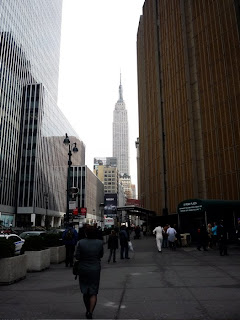
Image of Pennsylvania Station from the Library of Congress, Prints & Photographs Division, FSA-OWI Collection; Collins, Marjory, 1912-1985, photographer; LC-USW3-007028-D DLC (b&w film neg.). Image of Madison Square Garden, opened in February 1968, from February 2009 by Walking Off the Big Apple. The title of this post plays on references in the TV episode to the film version of Bye Bye Birdie, released in 1963.
See related post, In New York City, Historic Preservation Begins at Penn Station. (2012)




Wonderful, if sad post. When I spoke out about matters of a similar nature closer to (my) home, I was accused of wishing to "preserve any old" pile of stones. This is not my (nor, if I may suggest,) yours. It is just that often what comes after is such a huge disappointment. Buidings are not simply 'things' they have a life, indeed define life in subtle ways.
ReplyDeleteI love New York as the song goes, but how many lovely buildings can you afford to loose? This one was a beautiful essay about a people and a civilisation. The replacement I visited a cavern.
It happens a lot more over here than you might think; look up "Euston Arch" if you get five minutes.
Wow. I looked up Euston Arch as you suggested, and the time and circumstances of its demolition, along with protests, is a perfect parallel with the demolition of the old Penn Station. Thank you for bringing this to our attention.
ReplyDelete