The Marx Brothers on Broadway, & Notes on New York Theatres in the 1920s
 This post is the fourth in a series about the Marx Brothers in New York.
 After playing the Palace Theatre, the pinnacle of the big time, the Marx Brothers drifted about on the lower rungs of the vaudeville circuit following a series of contractual disputes with the powerful moguls, E.F. Albee, and then the Shuberts. Fortune changed with their major Broadway debut on May 19, 1924, a stage review titled I'll Say She Is. Compiled mostly of recycled routines and music numbers, the play nevertheless showed off the talents of each brother.
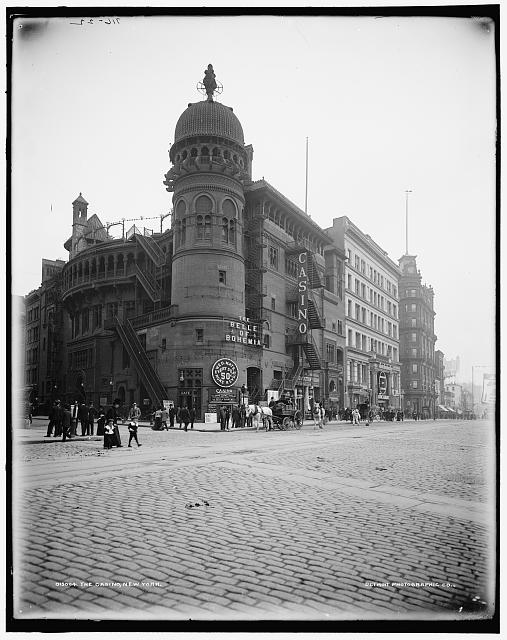
I'll Say She Is played at the Casino Theatre, an extravagant theatre located near the intersection of Broadway and W. 39th St. Built in 1882 and designed by Francis H. Kimball and Thomas Wisedall, the theater boasted a facade showing off an eclectic mixture of Islamic and Gothic details. The circular corner tower was particularly eccentric. In their survey New York 1900: Metropolitan Architecture and Urbanism 1890-1915, Robert A.M. Stern, Gregory Gilmartin and John Massengale describe the Casino as "a theater with an exotic, individualistic, even hedonistic character that exemplified the values of the Cosmopolitan Era." (p. 206)
In his memoir (Harpo Speaks), Harpo writes that he had long anticipated the opening, as the show had been in tryout for a year and a half. The routine of the road was getting old, and the Marx brothers threatened to quit the road shows unless the review opened in a theatre in New York. They got their wish, though they believed their manager were just humoring them. Harpo was glad to finally be home in the city - his mother and father had rented a place on Long Island, and he spent his days at Lindy's or Reuben's. "I was back with my own people," he writes, "who spoke my language, with my accent - cardplayers, horseplayers, bookies, song-pluggers, agents, actors out of work, and actors playing the Palace."
The show was a smash success. In his review of the play for The New York World, legendary theatre critic Alexander Woollcott singled out
 the silent one for the most praise, calling Harpo "a shy, unexpected, magnificent comic." He describes the funny eldest brother "as a craft comedian with a rather fresher and more whimsical assortment of quips than is the lot of most refugees from vaudeville." So taken was Woollcott with Harpo that the big portly critic bolted into his dressing room the following evening and told Harpo he was the funniest man he's ever seen on a Broadway stage. The two became great friends, with the critic inviting the clown to join his legendary vicious circle at the Algonquin Hotel. Harpo joined the Round Table.
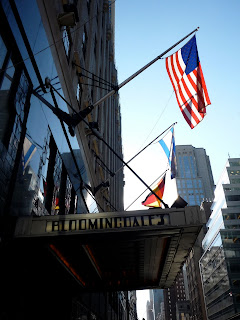
The success of I'll Say She Is led to more famous Broadway triumphs with The Cocoanuts and then Animals Crackers. The Cocoanuts, a zany production about the Florida real estate boom, with music and lyrics by Irving Berlin, opened on Broadway on December 8, 1925 at the Lyric Theatre on 42nd Street. The theatre, built in 1903 and featuring sculpture in a Renaissance style, was originally planned for opera productions. The Shuberts took it over for their lighter theatrical purposes. Later, the Lyric suffered the same fate as many other venues in the 1930s when it was converted into a movie house. It was later shut, with parts incorporated
 into the Hilton Theater. After the show closed its run in August of 1926, the Marx Brothers took The Cocoanuts on tour. In 1929 it was made into a motion picture, billed as "Paramount's All-Talking-Singing Musical Comedy Hit." The brothers didn't have to travel far for the filming. In 1920 Paramount Pictures built a studio in Astoria, Queens, New York to be near the Broadway theater district. The Cocoanuts and Animal Crackers (1930) were both filmed at what is now known as the Kaufman Astoria Studios.
The Marx Brothers were unable to attend the film premiere of The Cocoanuts at the Rialto Theatre on Broadway and 42nd Street, as they were playing that night in their third and final Broadway show, Animal Crackers. A musical built on a thin plot of an African explorer (Groucho as Captain Spaulding) attending a party in his honor (hosted by the great Margaret Dumont as Mrs. Rittenhouse) while a valuable painting goes missing, Animal Crackers opened on October 23, 1928 at the Forty-Fourth Street Theatre. A Shubert house, the Forty-Fourth Street Theatre was located just off Broadway and had opened in 1912 as the New Weber and Fields Music-Hall. Animal Crackers was one of the theater's most successful productions until the advent of World War II. The New York Times bought the theater in 1940 and tore it down in 1945 to make room for its postwar expansion.
The 1920s on Broadway constituted the so-called "Golden Age" of the Broadway theater. Many new theaters were constructed along the Great White Way during the boom years of the 1920s, serving a burgeoning number of actors, designers, playwrights, critics, directors, and production companies seeking stardom in New York. The stage in New York was spectacularly successful financially. During the 1926-1927 season alone, over 260 shows opened on Broadway. By comparison, during the 2008-2009 season, 43 new productions opened.
"Strange figguhs..."
But wait, am I intruding?
Images: Broadway Theatres, c. 1920, and Casino Theatre, c. 1900, from The Library of Congress Prints and Photographs Division, Detroit Publishing Company Collection; image of Hilton Theatre by Walking Off the Big Apple; YouTube clip from Animal Crackers (1929).
Note on clip from Animal Crackers: Strange Interlude, a play by Eugene O'Neill and produced by the Theatre Guild, opened at the John Golden Theatre on January 30, 1928. Actress Lynn Fontanne played the featured roll of Nina Leeds. Contemporary audiences for Animal Crackers would have been familiar with Broadway culture and would easily readily understand Groucho's parody of O'Neill's internal monologues and the play's production history. Strange Interlude won the Pulitzer Prize for drama in 1928.
To read the other posts in the series, click on The Marx Brothers.
For much more on the theater district, see the post New York's Theater District: The Legacy of the Golden Age, A Walk and a Map



A small correction: Harpo wasn't the eldest brother; Chico was. Harpo came next, then Groucho, Gummo, and Zeppo.
ReplyDelete