
New York City as the Stage for the World: Walks Through the City's International Cultural Centers
(revised 2012) New York City is home to many international cultural centers that serve to highlight, advocate, or otherwise educate a larger public about a particular country, cultural group, or language. The city's international culture extends back to its earliest days, but New York firmly established itself as a world financial and cultural center in the latter half of the twentieth century. Certainly, the waves of immigration over the centuries have made New York one of the most diverse cities in the world. One of the city's most well-known institutions, the United Nations, brings thousands of people from around the world to live and work. The headquarters of the UN, built in the Turtle Bay neighborhood in the years 1949-1952, is designated international territory.
This walk serves as an introduction to several international societies, groups, and institutes, primarily located in a convenient swath of land from the Upper East Side, specifically the area known as the Gold Coast, to Midtown Manhattan. Some of the institutions are homegrown, like the Asia Society, founded by John D. Rockefeller III. Other organizations are sponsored by a country, such as the Austrian Cultural Forum, an agency of the Republic of Austria.
View International Cultural Centers in New York in a larger map
• Asia Society (725 Park Ave. at 70th St.)
• Austrian Cultural Forum (11 E 52nd St.)
 |
| Park Avenue. The Italian Cultural Institute of New York is on the left. In the distance, the Asia Society. |
View International Cultural Centers in New York in a larger map
Start at the Asia Society and walk south to the Onassis Cultural Center in the Olympic Tower, stopping in at several of the centers. The distance is a little over one mile. Or, find some of the other cultural centers located on the map (and this list in not complete) and make your own international walk. The only reason these centers are grouped together for a self-guided walk is their geographical proximity. This particular walk, however, has the added benefit of several historical points of interest, architectural gems and retail attractions between the stops. A few of these places are noted below and on the accompanying map.
 |
| Asia Society |
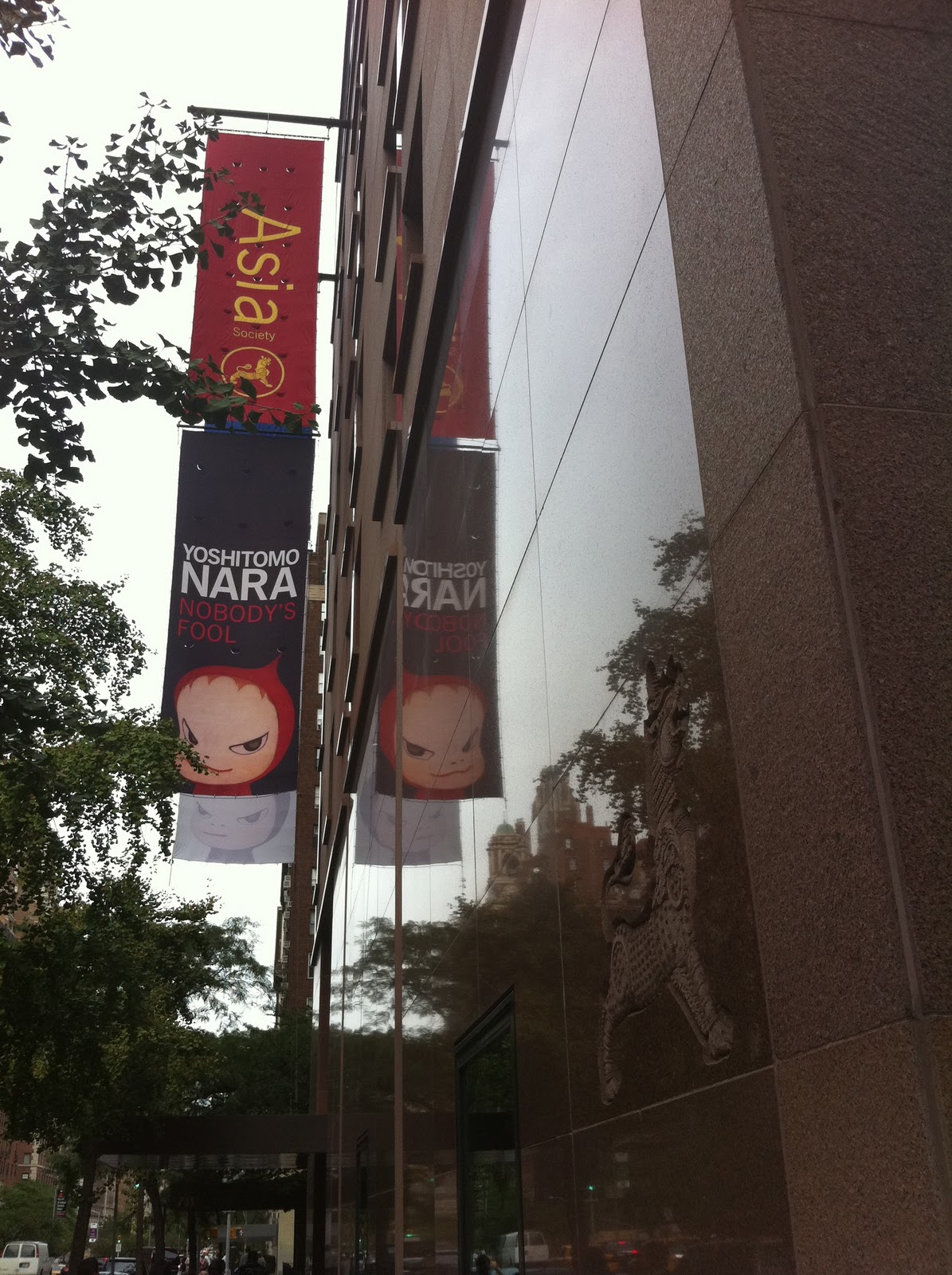
The society's building in New York, just one of many Asia Society centers around the world, is housed in a large building on Park and E. 70th Street. The society hosts a full range of exhibitions and programs, all centered on developing a better understanding of the nations of Asia. Stop for lunch at the Garden Court Cafe, a highly-regarded culinary favorite for the surrounding neighborhood.
• Italian Cultural Institute of New York (686 Park Ave)
A small room just inside the main doors of the institute hosts art exhibitions.
• Queen Sofia Spanish Institute (684 Park Ave)
The society was founded in 1954 to promote Spanish culture. Margaret Rockefeller Strong de Larraín, Marquesa de Cuevas, the granddaughter of Standard Oil founder, John D. Rockefeller, donated the building to the society in 1965. The neo-Federal townhouse by McKim, Mead & White dates from 1927. For more on the fascinating life of Margaret Rockefeller Strong de Larraín, read this essay from 1987 in Vanity Fair by the late Dominick Dunne.
• Americas Society (680 Park Avenue)
The society's mission is to encourage understanding of issues affecting Latin America, the Caribbean, and Canada.
 |
| Seventh Regiment Armory (with temporary sculpture by Yoshitomo Nara) |
• Seventh Regiment Armory (643 Park Ave.)
Walking along Park, be sure to take note of the armory at 67th Street, built by the Seventh Regiment of the National Guard in response to President Lincoln's call for troops in 1861. The Park Avenue Armory is a newly designated arts institution committed to hosting cultural events in the non-traditional venue.
• China Institute In America (125 E 65th St.)
A group of American and Chinese educators founded the institute in 1926 to foster a better understanding of China. The institute presents cultural programs, including an exhibition series at the gallery.
 |
| Roosevelt House |
• Sara Delano Roosevelt and Franklin and Eleanor Roosevelt Houses (47-49 E. 65th St.). now Roosevelt House Public Policy Institute, Hunter College, CUNY. This double townhouse is the where FDR recovered from polio (1921-22) and where he learned he was to be Governor of New York (1928) and later President of the United States (1932).
Walking note: Throughout the Gold Coast, look for buildings that serve as permanent missions of countries in the United Nations.
• Barneys New York (660 Madison Ave.)
Barney Pressman opened the store in 1923 at Seventh Avenue and W. 17th Street. This nine-story store on Madison Avenue opened in 1993, the largest store built in New York since the Great Depression. Filing for bankruptcy in 1996, the family later sold its shares of the store to Jones Apparel. That company in turn sold Barney's to an equity firm based in Dubai.
• 36 and 40 E. 62nd Street. Stop to look at the two handsome buildings on the south side of the street: 36 E. 62nd is the neo-Georgian Links Club. The facade of 40 East 62nd (1910) is rich in medieval ornament.
• French Institute Alliance Française (FIAF) (55 E 59th St.)
A formidable player in New York culture, FIAF is a multi-faceted organization presenting music and film at Florence Gould Hall, literary programs, a popular language center, a gallery, and many special events.
• IBM Building (590 Madison Ave.) 1983, designed by Edward Larrabee Barnes Assocs. Step inside to the Garden Plaza, a public space, to see the tree-filled glass atrium.
• Sony Tower (550 Madison). Famous post-modern building with a Chippendale top built by AT&T and designed by Philip Johnson/John Burgee.
 |
| Austrian Cultural Forum |
Before entering, please step back to look at the acclaimed architecture of this 2002 building. Architectural theorist and practitioner Raimund Abraham designed the slender 24-story building on E. 52nd Street, built in 2000.
• Onassis Cultural Center (645 5th Ave.)
 |
| atrium, Olympic Tower |
In his will, Aristotle Onassis directed a foundation to be established to honor the memory of his son Alexander. The Cultural Center opened in 2000 and presents exhibitions, musical events, lectures, and films concerning ancient and contemporary Hellenic culture. The public atrium inside the Olympic Tower, built in 1976, features contemporary art by Greek artists as well as the casts from the original friezes of the Parthenon (housed for the most part in the British Museum). The geometric neon and metal sculpture on the wall, titled "The Road to Mistra," is by Stephen Antonakos.
Walk through the Olympic Tower to the other side of the building on E. 51st. St. Patrick's Cathedral is directly ahead. Rockefeller Center is on the right.
Images by Walking Off the Big Apple from September 29, 2010.


Comments
Post a Comment